

UST Closure Under Washington Ecology and PLIA
Washington runs a split regulatory structure for oil tank removal. A standard yard-buried heating oil tank comes out for $1,500 to $3,500. Commercial USTs fall under the Washington Department of Ecology UST program, which requires licensed service providers for all regulated tank work. Residential heating oil tanks sit outside state regulation, but western Washington cities enforce local closure rules through fire departments and county health offices. Seattle, Tacoma, and most King County jurisdictions require fire-department permits before any heating oil tank can be pulled or abandoned in place. Owners choosing closure in place rather than excavation use Washington tank decommissioning services to pump, clean, and fill the tank. Local permits typically demand soil sampling at the tank bed and documentation of proper tank disposal.
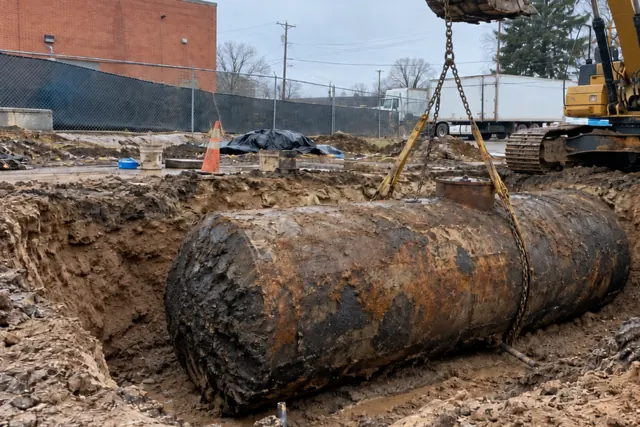
Washington tank removal demand splits between residential heating oil work in western Washington and commercial UST closures statewide. Seattle, Tacoma, Everett, and Bellingham sit at the center of the residential market, where pre-1980 homes commonly have 275- to 550-gallon buried heating oil tanks. The Olympia to Portland I-5 corridor sees steady basement-tank closures tied to older mid-century housing stock. Commercial work concentrates at gas stations along I-5, I-90, and I-82, plus Port of Seattle and Port of Tacoma bulk petroleum terminals. Spokane and eastern Washington see more agricultural and commercial UST work because natural gas has been the dominant residential fuel east of the Cascades since the 1970s. Active commercial tanks also require regular Washington UST inspection and testing under Department of Ecology rules.
Residential heating oil tank removal in Washington typically costs $1,500 to $3,500 for a standard yard burial, with basement tanks running $2,500 to $5,000 due to access constraints. Commercial UST removal at gas stations or fleet facilities ranges from $5,000 to $25,000 per tank depending on size and site conditions. If soil sampling reveals contamination, contamination cleanup adds $10,000 to $50,000 or more, especially in Puget Sound shoreline zones with high water tables. Washington PLIA closed its heating oil insurance program on June 30, 2025 and stopped accepting new claims under it on July 31, 2025. It now runs a Heating Oil Loan and Grant program offering cleanup grants of up to $60,000 plus loans for tank replacement and upgrade. Our complete cost guide walks through pricing by tank location, contamination scenario, and Puget Sound or Spokane regional drivers.
A Washington residential removal starts with utility locates, a local fire-department permit, and scheduling tank cleaning. The physical removal usually takes one day at yard-tank sites, though basement tanks often stretch to two days because of access and disassembly. Soil samples collected at the tank bed go to a certified laboratory overseen by the Department of Ecology, with turnaround of one to three weeks before closure paperwork can be finalized. Before hiring, verify the contractor carries pollution liability insurance, knows the local permit process, and shows recent Seattle or Tacoma closure references. Property owners often find a tank contractor in Washington or request a free quote to scope a project.