

What to Know About Site Assessment in Delaware
Site assessment in Delaware is required before most commercial property transfers and refinancings. Most deals budget $1,500 to $4,000 for that first environmental review. The Department of Natural Resources and Environmental Control (DNREC) oversees the regulatory framework that environmental professionals follow on Delaware properties. Phase I ESAs document historical use, agency records, and recognized environmental conditions; a Phase II ESA follows when records suggest a possible release, layering soil borings and monitoring wells onto the Phase I findings. Lenders and corporate buyers across New Castle, Kent, and Sussex counties rely on this work to clear environmental risk before closing dates lock in. Buyers comparing scope often consult the Phase I ESA pricing guide before fieldwork.
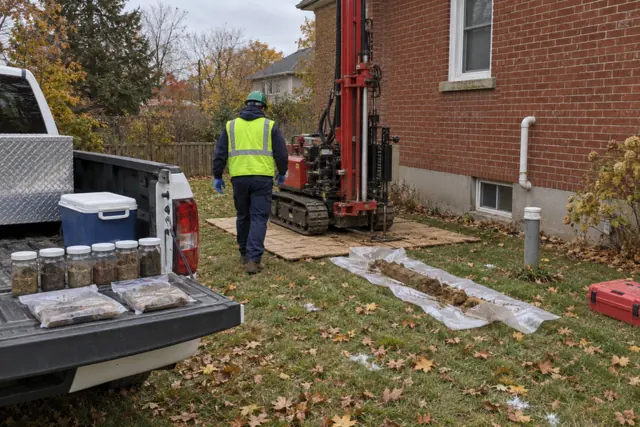
Demand for environmental due diligence concentrates in the Wilmington industrial corridor along the Delaware River. Decades of chemical manufacturing, fuel terminals, and rail-served logistics yards there have produced a long inventory of brownfield-eligible parcels handled through DNREC's Site Investigation and Restoration Section. Newark generates steady contamination assessment volume around aging commercial strips and University of Delaware adjacent redevelopments. In Kent County, Dover and Smyrna drive Phase II testing on former auto repair shops and small fueling sites tied to mid-Atlantic chain expansions. Sussex County growth around Lewes, Rehoboth Beach, and Milford has pulled coastal commercial buyers into Phase I ESA workflows ahead of hospitality and mixed-use deals, where sandy soils and a shallow water table change the sampling calculus.
Phase I ESAs in Delaware typically run $1,500 to $4,000, with most New Castle County commercial deals landing in the upper half because of dense regulatory history and the Wilmington industrial overlay. Phase II soil and groundwater testing usually ranges $3,000 to $10,000, and that figure climbs once Sussex County's shallow water table forces deeper monitoring wells or coastal sediment panels. Soil sampling alone runs $500 to $2,000 per location depending on lab turnaround. Documented UST releases are handled through DNREC's Tank Management Section, which must be notified of a release and receives the closure documentation. Delaware cost-assistance arrangements change and are not documented consistently in public DNREC materials, so confirm directly with DNREC Tank Management what applies to your site before assuming any cost is recoverable. Drilling access, investigation-derived waste disposal, and lab queue length are the biggest cost levers.
A Delaware Phase I ESA takes two to four weeks from kickoff to deliverable, and Phase II fieldwork adds another three to six weeks depending on lab queue and well permit timing. Before signing, property owners should confirm the Delaware site assessment contractor follows ASTM E1527-21, carries pollution liability coverage, and assigns an Environmental Professional whose qualifications meet 40 CFR Part 312. Subcontractors pulling soil cores or installing monitoring wells inside an active release zone need current HAZWOPER training before stepping onto the work zone. Ask for a redacted prior Wilmington or Sussex County report so you can see how the firm handles DNREC file reviews, brownfield coordination, and language around recognized environmental conditions. If the closing calendar is tight, request a fixed-fee Phase I with a contingent Phase II already priced so a contamination assessment finding does not stall the deal.