Compare Texas contractors who close and remove underground storage tanks, and read what TCEQ requires before, during and after a tank closure.
What to Know About Tank Decommissioning in Texas
The Texas Commission on Environmental Quality (TCEQ) regulates underground storage tank closure through its Petroleum Storage Tank program, under 30 TAC Chapter 334. TCEQ's exclusions and exemptions page points to 30 TAC 334.3(a), which makes two kinds of underground tanks completely exempt from that chapter. One is a tank storing heating oil for consumptive use on the premises, with no size limit. The other is a farm or residential tank of 1,100 gallons or less holding motor fuel for noncommercial purposes. TCEQ requires no notice, sampling or registration to close those tanks, and 30 TAC 30.319 says no TCEQ supervisor license is needed to remove them. TCEQ's owner guide notes that local governments may still have rules that apply. Gas station, fleet and other regulated USTs go through the full process below.
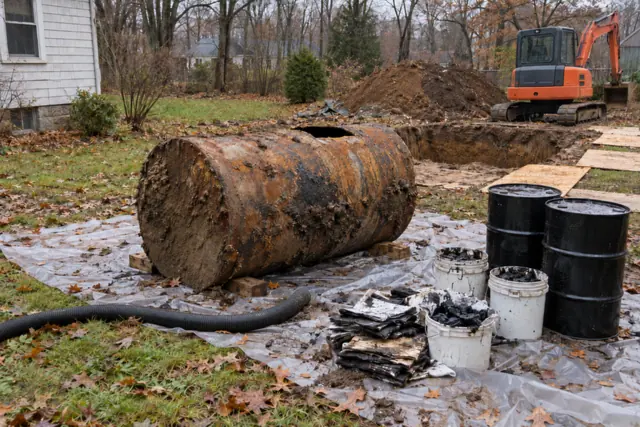
Texas recognizes three ways to close a regulated UST: removal, abandonment in place, or a change in service. TCEQ's removal guidance requires written notice at least 30 days before the work, filed online through STEERS or on form TCEQ-00495, and the notification page covers both removal and abandonment in place. The owner must also contact the TCEQ regional office between 24 and 72 hours before work starts. A TCEQ-registered UST contractor does the job, with an On-Site Supervisor holding a License B (removal) or License A/B present during the tank removal. A removed tank must leave the site within 24 hours unless the regional office approves longer storage.
Texas no longer reimburses owners for tank cleanup. Under Texas Water Code 26.361, the reimbursement program expired September 1, 2012, and TCEQ may no longer use the Petroleum Storage Tank Remediation Fund to reimburse an eligible owner or operator. TCEQ's reimbursement page confirms the program has ended. The PSTR Fund now pays for cleanups that TCEQ contracts for itself, mostly at sites where the responsible party is financially unable to pay. Owners do not file claims against it. Our guide to closure in place versus UST removal explains what changes the scope of a closure job.
The leak check at closure follows TCEQ guidance RG-411 on sample counts, and the sampling must be supervised by a TCEQ-licensed installer or on-site supervisor or a registered corrective action project manager. The results are filed with the amended registration, due within 30 days, and closure records are kept for five years. A suspected or confirmed release must be reported to TCEQ within 24 hours. In the eight Edwards Aquifer counties, including Bexar around San Antonio and Travis around Austin, TCEQ's owner guide warns that additional aquifer protection requirements may apply. Before hiring any contractor on this page, look the company up in TCEQ's UST contractor search.
No. A tank storing heating oil for use on the premises is completely exempt from 30 TAC Chapter 334, whether it serves a home, a farm or a business. TCEQ requires no notice, sampling, closure report or registration to close one, and no TCEQ contractor registration or supervisor license is needed to remove it. TCEQ's owner guide adds that local governments may have their own rules. A farm or residential tank holding motor fuel is exempt only at 1,100 gallons or less and only for noncommercial use.
Who can remove a regulated UST in Texas?
A TCEQ-registered UST contractor, with an individual On-Site Supervisor present who holds a License B, which covers removal, or a License A/B. The supervisor must be on site during the tank removal. TCEQ's find a contractor page explains how to search registered UST contractors by city, county or TCEQ region. Ask each bidder which licensed supervisor will be on site.
How much notice does TCEQ need before a tank closure?
At least 30 days, filed through STEERS or on form TCEQ-00495, and the notice stays valid for 180 days. Between 24 and 72 hours before work starts, the owner or operator must contact the TCEQ regional office. A tank found during unrelated construction, when the property owner did not know of it, may qualify for quicker notice to the regional office, with a detailed report within 30 days after the work. The amended registration, form TCEQ-00724, follows within 30 days of the tank closure.
Can a UST be abandoned in place in Texas?
Yes. Texas calls closure in place abandonment in place, and 30 TAC 334.55 allows it instead of removal, with the tank filled with a solid inert material. A tank owner who does not own the land must notify the landowner in writing first. The landowner then keeps the closure records and passes them to the next buyer. A change in service is also allowed, but a tank that held a regulated substance can never be converted to hold drinking water or food for human consumption.
Does Texas force closure of a tank that has been out of service for a year?
No. Texas has no 12-month closure trigger like the one in the federal UST rule. Under 30 TAC 334.54(c), a UST system may remain out of service indefinitely if the rule's requirements are met, and 334.55(a)(7) treats tanks at closed businesses as temporarily out of service. TCEQ's temporarily out of service page says the owner must file an updated registration within 30 days of the change in status.
Can TCEQ pay to remove an abandoned tank in Texas?
Only in narrow cases. Texas Water Code 26.351 and 30 TAC 334.84 give TCEQ authority to remove a tank that is out of compliance, out of service and a contamination risk when the owner is financially unable to remove it. The rule sets out no owner application for this removal. At a leaking site, an owner who is financially unable to pay can ask the site's TCEQ project manager about state-contracted cleanup. For a routine tank closure, plan on paying the contractor directly.