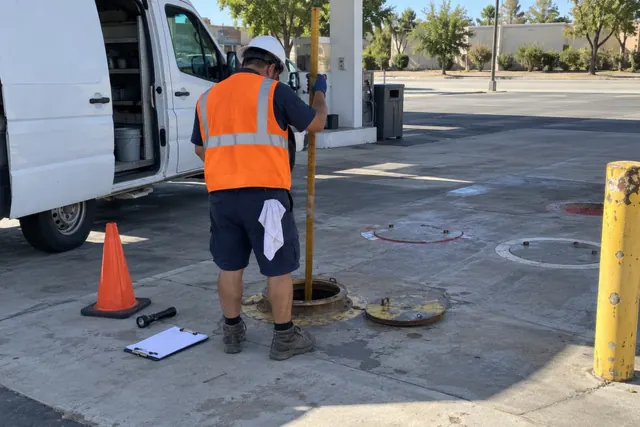
Find licensed contractors in Texas for oil tank inspection, underground storage tank testing, tank tightness testing, leak detection, and UST compliance assessments. Serving Houston, Dallas, San Antonio, Austin, Fort Worth, El Paso, and communities statewide.
What to Know About Oil Tank Inspection & Testing in Texas
Texas requires worker safety certification for contractors performing oil tank inspection and testing on regulated
underground storage tanks. The market is entirely commercial and industrial. Residential heating oil is
effectively nonexistent in Texas, so every underground oil tank in the state sits beneath a gas station, truck
stop, fleet yard, industrial facility, or petrochemical support operation. What makes Texas different from every
other state in this directory is scale. Texas has more regulated underground storage tanks than any other state,
spread across 268,000 square miles from the Gulf Coast to the Panhandle. The certified contractor pool is large to
match, but so is the demand. In the Houston metro alone, the concentration of fueling infrastructure supporting
the petrochemical corridor, the Port of Houston, and the sprawling logistics network generates more inspection
work than most entire states produce.
Underground oil tank inspection demand in Texas follows three major interstate corridors. The I-10 corridor along
the Gulf Coast from Beaumont through Houston to San Antonio supports the highest density of commercial fuel tank
inspection work. Demand is driven by the petrochemical industry, port operations, and one of the busiest freight corridors
in the country. The I-35 corridor from San Antonio through Austin, Waco, and Dallas-Fort Worth to the Oklahoma
border supports a second massive concentration of truck stops, distribution centers, and fleet facilities. The
I-45 corridor connecting Houston and Dallas completes a triangle that contains the majority of the state's
regulated tank population. Outside that triangle, West Texas, the Panhandle, and the Rio Grande Valley have their
own inspection demand from oilfield support operations, agricultural fueling, and border logistics. Many of the
same contractors who perform underground oil tank inspection also handle oil tank removal and tank decommissioning
when aging commercial systems reach end of life. This is increasingly common at older independent gas stations
built during the Texas oil boom decades that have not upgraded their tank systems since.
Oil tank inspection cost in Texas typically ranges from $500 to $2,000 for a basic tank tightness test and $2,000
to $5,000 for comprehensive multi-tank facility assessment. Cost varies by location, with Gulf Coast metro areas
generally competitive due to contractor density and rural West Texas or Panhandle sites costing more due to
travel. TCEQ ended reimbursement from the Petroleum Storage Tank
Remediation Fund on September 1, 2012, so a release uncovered during testing is a cost the owner carries in
full. Soil contamination from a
leaking underground storage tank in Texas can generate environmental remediation costs of $10,000 to $50,000 or
more, with releases near the Gulf Coast's shallow water table or sensitive coastal ecosystems pushing costs
significantly higher. The oil tank inspection cost that catches a problem early is a
fraction of what undetected contamination produces. For more details, see our guide on UST compliance obligations for facility owners.
Federal law requires EPA or the state to inspect each regulated underground storage tank at least once every three years. Owners also have duties of their own under 40 CFR 280: release detection on tanks at least every thirty days by one of several approved methods, and walkthrough inspections every thirty days and once a year. Texas heat is a factor that facility owners in northern states do not face. Soil temperatures in
southern Texas and the Gulf Coast regularly exceed 100 degrees at tank burial depth during summer months, and that
sustained heat degrades flexible connectors, gaskets, and tank coatings faster than the same materials age in
cooler climates. The Gulf Coast also adds hurricane and tropical storm exposure. Storm surge flooding can saturate
soil around buried tanks, increase hydrostatic pressure on tank walls, and shift ground in ways that stress piping
joints. For facilities in the Gulf Coast region, scheduling a fuel tank inspection after significant storm events
is practical maintenance, not overcaution. For aging systems anywhere in Texas where inspection reveals
heat-related degradation or repeated marginal tightness results, an environmental remediation contractor can help. The right partner evaluates
whether continued monitoring or tank decommissioning and replacement is the better path before a summer
failure or storm event forces the decision.
Do I need a certified contractor for oil tank inspection in Texas?
Not for testing alone. Under TCEQ rules, a registered UST contractor with a licensed on-site supervisor must do any installation, repair or removal of a regulated tank. Tank tightness testers must be certified by the maker of their test equipment rather than by the state. There is no residential heating oil infrastructure to speak of. Using an
uncertified contractor risks producing inspection documentation the state will not accept, which can jeopardize
UST compliance status and expose the facility to enforcement. In the largest
regulated tank market in the country, there is no shortage of certified contractors. Verifying credentials
before scheduling is a simple step that protects both compliance and financial interests.
How much does oil tank inspection cost in Texas?
A basic tank tightness test in Texas typically costs $500 to $2,000 depending on tank size, site complexity, and
location. Comprehensive underground storage tank inspection for multi-tank commercial facilities runs $2,000 to
$5,000. Oil tank inspection cost is generally competitive in the Houston, Dallas, and San Antonio metros where
contractor density keeps pricing in check. Rural and remote sites in West Texas or the Panhandle cost more due
to travel. The comparison that drives the decision is not between quotes. Soil contamination from a leaking
underground storage tank in Texas can generate environmental remediation costs of $10,000 to $50,000 or more,
with Gulf Coast releases near shallow groundwater or coastal ecosystems pushing costs substantially higher. Texas ended
reimbursement from the Petroleum Storage Tank Remediation Fund on September 1, 2012, so catching a release
early is the only thing standing between a facility and the full cost of it.
How often do underground storage tanks need to be inspected in Texas?
Federal law requires EPA or the state to inspect each regulated underground storage tank at least once every three years. Owners also have duties of their own under 40 CFR 280: release detection on tanks at least every thirty days by one of several approved methods, and walkthrough inspections every thirty days and once a year. The three-year cycle is adequate for
newer double-wall systems with continuous monitoring. For older single-wall tanks, particularly those installed
during the oil boom decades of the 1970s and 1980s, annual fuel tank inspection is the practical standard most
certified contractors recommend. Texas heat degrades tank components faster than cooler climates, and the Gulf
Coast adds hurricane exposure that can stress systems between scheduled inspections. Facilities in storm-prone
areas should schedule an inspection after any significant flooding event rather than waiting for the next
three-year cycle.
Why does Texas have so many regulated underground storage tanks?
Texas has the largest regulated underground storage tank population of any state because of the intersection of
geographic size, population, and petroleum industry history. The state covers 268,000 square miles and has more
miles of interstate highway than any other state, which means more gas stations, more truck stops, and more
commercial fueling infrastructure per mile of road. The petrochemical corridor along the Gulf Coast from
Beaumont to Corpus Christi adds thousands of industrial fueling operations. Oilfield support facilities across
West Texas and the Permian Basin add another layer. The result is a tank population that dwarfs most states and
creates steady, year-round demand for oil tank inspection, tank tightness testing, and UST compliance
assessments across every region of the state.
What types of tank testing are available in Texas?
Texas contractors offer several UST testing methods adapted to the state's size and climate extremes. Tank
tightness testing measures whether a tank holds pressure without loss, detecting leaks below automatic gauging
thresholds. Line tightness testing checks piping connections between the tank and dispenser for slow seepage at
joints that may have degraded in sustained heat. Cathodic protection testing verifies the corrosion prevention
system is functioning, which is critical along the Gulf Coast where high soil moisture accelerates corrosion and
in West Texas where dry soils can reduce cathodic current effectiveness. For sites with suspected contamination,
groundwater monitoring is essential near the Gulf Coast where the water table sits close to the surface. Soil
vapor surveys help map contamination spread in the sandy and clay soils that vary across the state. For aging
systems where inspection reveals heat-related degradation or storm damage, a certified contractor can evaluate
whether continued monitoring or tank decommissioning and replacement is the more cost-effective decision.