
UST compliance means following 40 CFR 280 and your state's version of it. This guide covers five of those duties: release detection, financial responsibility, operator training, spill and overfill protection, and tank registration. Most owners fail on release detection, and fixing it after an inspector shows up costs ten times what staying current costs.
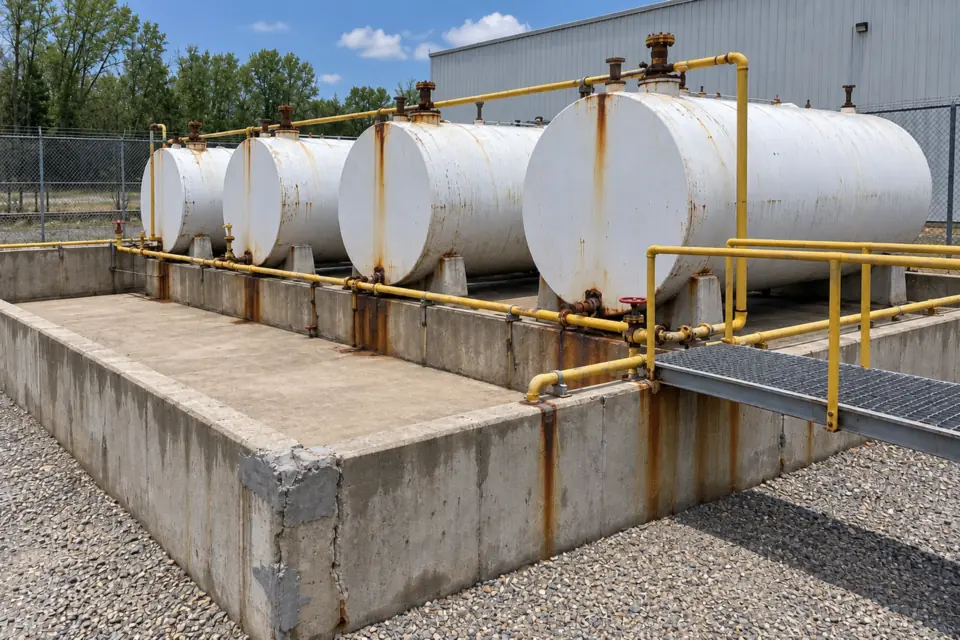
Staying compliant is cheaper than cleaning up a violation.
The EPA finalized sweeping updates to the federal underground storage tank compliance regulations in 2015 under 40 CFR Part 280. Those changes tightened operator training requirements, added new release detection standards for previously deferred tank systems, and closed loopholes in financial responsibility. States had until October 2018 to adopt the updated rules or implement equivalent programs. Most did. Some went further.
The problem is that many small operators, especially single-location gas station owners and fleet managers, built their compliance programs around the pre-2015 rules and never updated. A facility that passed inspection in 2014 may be out of compliance today without a single thing changing at the site. The rules moved underneath them.
The exception is large petroleum companies with dedicated environmental departments. They tracked these changes in real time. If you run a single gas station or a small fleet yard, you almost certainly have gaps that don't meet current UST requirements.

What Changed After 2015 and Why Most Small Operators Are Behind
Release detection means continuously monitoring your tanks and piping for leaks. The federal requirement is straightforward: every UST system must have functioning release detection equipment, and you must keep records proving it works. Monthly monitoring records. Annual equipment testing. Written documentation of both.
The 2015 rule added a key requirement. Tanks that had previously relied on groundwater monitoring or vapor monitoring as their sole release detection method must now also demonstrate those methods are properly designed and maintained for the specific site conditions. A monitoring well that was drilled in 1995 and never recalibrated does not meet the current standard, even if it met the old one.
Where this gets expensive is after a failure. A release detection lapse that coincides with an actual leak exposes you to the full cost of corrective action without the safety net of your state cleanup fund. Many funds require proof that release detection was active at the time of the release as a condition of eligibility. No records, no reimbursement.
The detection equipment itself costs $2,000 to $5,000 to install or upgrade. The cleanup it protects you from costs $15,000 to $100,000 or more.
Not every facility needs the same detection setup, though. A small single-tank fleet yard has different monitoring needs than a multi-product gas station with six compartments. Paying for a complex statistical inventory reconciliation system on a single heating oil tank is overkill. Match the detection method to the site.
Release Detection: The Requirement That Triggers the Most Enforcement Actions
Every owner and operator of a petroleum UST must demonstrate financial responsibility for corrective action and third-party liability, up to $1 million per occurrence and $2 million aggregate depending on throughput and tank count. This is a federal floor. Some states set it higher.
You can meet this requirement through insurance, a state cleanup fund, a surety bond, a letter of credit, a trust fund, or a guarantee from a parent corporation. Self-insurance is also allowed if you pass the federal financial test, which includes a tangible net worth of at least $10 million. Most small operators use a combination of a state cleanup fund and a private pollution legal liability policy.
The trap is assuming your state fund alone satisfies the requirement. In many states, the fund covers corrective action but not third-party liability. If your tank leaks and contaminates a neighbor's well water, the state fund may reimburse your soil cleanup but not the neighbor's lawsuit. You need both pieces.
A Pollution Legal Liability (PLL) policy fills the third-party gap. Premiums run $1,500 to $5,000 per year for a typical gas station, which sounds like a lot until you compare it to a $200,000 lawsuit from a neighboring property owner.
There is one scenario where this requirement does not apply: if your state has a financial assurance fund that explicitly covers both corrective action and third-party damages, and your facility is enrolled. Pennsylvania's USTIF is one of the few that comes close. Check your state's fund structure before assuming you're covered.
Financial Responsibility: The $1 Million Requirement Nobody Talks About
Federal UST regulations define three classes of operator. Class A is the person who has primary financial responsibility for the facility. Class B is the person who implements the day-to-day compliance activities. Class C is the employee on site during operating hours. All three must be trained.
The 2015 rule made this non-negotiable.
The catch is that each state designs its own training program. Texas requires Class A and B operators to complete a TCEQ-approved training course that includes an evaluation of operator knowledge. California requires each designated operator to hold an ICC certificate showing a passed California UST System Operator exam. Some states accept an online course. Others require in-person instruction.
A handful allow a single person to serve as both Class A and Class B. A few don't. If you operate in multiple states, expect to deal with different requirements at each location.
What trips people up is employee turnover. Your Class C operators are the gas station attendants and fleet yard workers who rotate through the job. Every new hire needs Class C training before they're left alone on site. If an inspector arrives and the person behind the counter hasn't been trained, that's a violation. It doesn't matter that the person they replaced was trained.
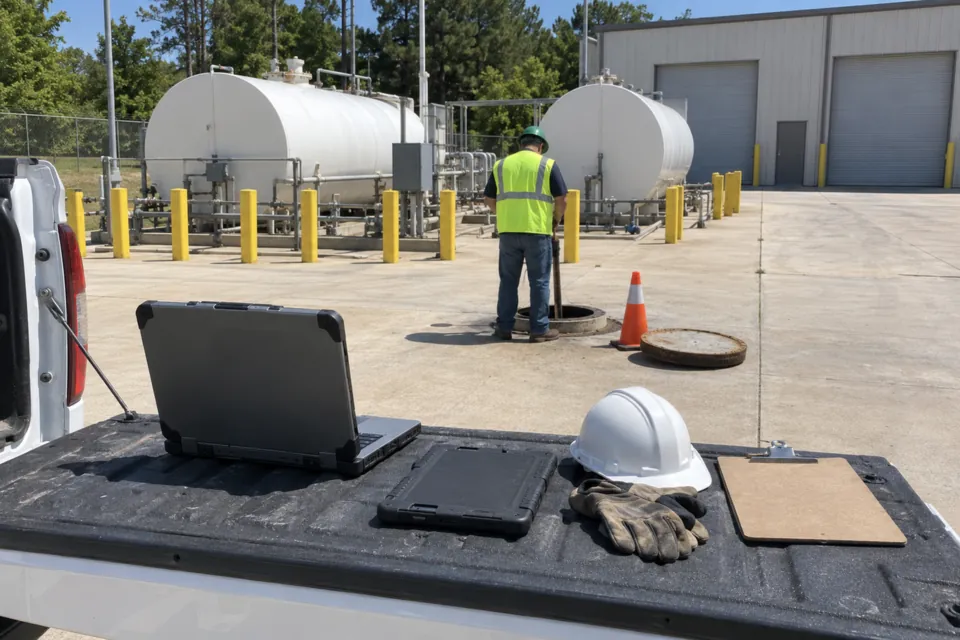
Operator Training Is Not Optional, and the Rules Vary Wildly by State
Class C training is the simplest part of the requirement. It covers what to do during a spill, who to call, and how to read the monitoring equipment. Fifteen to thirty minutes in most states. The documentation proving it happened is what matters.
Every UST must have spill prevention equipment (spill buckets at the fill port) and overfill protection (an automatic shutoff valve, a flow restrictor, or an overfill alarm). These have been required since 1988. The 2015 rule added a testing requirement: spill equipment must be tested, and overfill equipment inspected, at least once every three years.
The spill bucket catches fuel that drips when the delivery driver disconnects the hose. A cracked or corroded spill bucket is a violation. A spill bucket full of rainwater and debris is a violation. These sound minor, but they account for a disproportionate share of inspection failures because they are visible, obvious, and easy to check.
An inspector walks up to the fill port, lifts the cover, and either the spill bucket is intact and dry or it isn't.
Overfill protection is less visible but more consequential. A stuck overfill valve means a delivery can push fuel out the top of the tank and onto the ground. That is a reportable release in every state. The three-year overfill inspection takes 20 minutes and costs $200 to $500 from a UST contractor. The overfill event it prevents can trigger a $50,000 cleanup.
Spill Prevention and Overfill Protection: The Equipment You Forget About
One thing to know: if your overfill device is a ball float valve manufactured before 2000, it may not meet current performance standards. Several manufacturers have issued service bulletins recommending replacement. Check with your equipment vendor.
It is not a leaking tank.
It is not a failed inspection. The most expensive compliance mistake is letting a tank sit idle without formally closing it.
Federal rules under 40 CFR 280.70 set a 12 month limit on temporary closure for tanks that do not meet new or upgraded system standards. During temporary closure, you must maintain corrosion protection and, unless the tank is empty, release detection. After 12 months, such a tank must go through permanent closure unless the implementing agency grants an extension. An extension requires a site assessment first.
Some states offer extensions beyond 12 months, but they require an active application, continued monitoring, and a demonstrated intent to return the tank to service. "We just haven't gotten around to it" is not a qualifying reason.
The UST Compliance Mistake That Costs the Most Money
A tank that fails current standards and has sat idle for three years with nobody maintaining it is violating the temporary closure rules, the permanent closure deadline, and potentially the release detection and financial responsibility requirements.
That is four violations from one tank doing nothing.
If you have a tank you're not using, begin UST closure now. The permanent closure process for a clean tank costs $3,000 to $10,000 depending on your region. The accumulated fines and eventual forced closure cost far more. The exception is if you genuinely plan to resume operations within the next six months and your state grants extensions. In that case, file the temporary closure paperwork, maintain monitoring, and document everything.
Every UST must be registered with the state. Registration typically includes the number of tanks, their size, the product stored, the date installed, and the type of corrosion protection. When ownership changes, the registration must be updated. When a tank is permanently closed, the registration must be updated.
This is not a one-time filing.
| Item | Typical cost |
|---|---|
| Release detection equipment, install or upgrade | $2,000 to $5,000 |
| Pollution legal liability policy (typical gas station) | $1,500 to $5,000 per year |
| Spill and overfill equipment test and inspection, every three years | $200 to $500 |
| Permanent closure of a clean tank | $3,000 to $10,000 |
| Tank registration | Free or under $100 |
| Proactive compliance review | $500 to $2,000 |
Tank Registration: The Paperwork That Proves You Exist
The registration itself is usually free or under $100. The consequence of not having it is disproportionate. An unregistered tank may not be eligible for the state cleanup fund. An unregistered tank may not appear in state databases, which means an inspector finding it will treat it as an unreported UST and escalate accordingly.
Property buyers should verify tank registration as part of due diligence. If you are acquiring a commercial property with USTs, confirm that the registration is current and that the listed owner matches the seller. Gaps in registration history are a red flag for gaps in compliance history.
Pull your last inspection report. If you can't find one, that's your first problem. Contact your state UST program and request a copy of your facility's compliance file. Every state maintains one.
Check three things: Is your release detection equipment operational and are you keeping monthly records? Is your financial responsibility documentation current? Have your Class A, B, and C operators been trained under the post-2015 requirements? Related reading: Signs of an Underground Oil Tank.
If the answer to any of those is no or "I'm not sure," bring in a qualified UST contractor for a compliance review. This is not the same as waiting for the state to inspect you. A proactive review costs $500 to $2,000 and identifies every gap before enforcement does. You can find UST contractors in your state and ask each whether it does compliance reviews, not just removal. Related reading: the full testing schedule.
Does Your Station Have to File Tier II Reporting by March 1?
A retail gas station files when it holds 75,000 gallons of gasoline or 100,000 gallons of diesel at any one time, counting all grades together. Those are the EPCRA section 312 thresholds for retail stations in 40 CFR 370.10. Other hazardous chemicals on site are measured against the general threshold of 10,000 pounds, or, for an extremely hazardous substance, 500 pounds or its threshold planning quantity, whichever is lower.
The higher fuel thresholds carry a condition that ties them back to the rest of this guide. They apply only to fuel stored entirely underground in tanks that were in compliance with every applicable UST requirement at all times during the previous calendar year. Read literally, a station that skipped required walkthroughs or let release detection lapse at any point that year does not meet the condition, which puts its fuel under the 10,000 pound threshold instead. Fuel in an aboveground tank at the same station never qualifies for the higher thresholds and counts against 10,000 pounds.
Fleet yards and contractor shops are a separate case. The rule defines a retail gas station as a facility selling gasoline or diesel principally to the public for motor vehicle use on land. A site that only fuels its own vehicles uses the 10,000 pound threshold whatever its UST compliance record. Fuel used in routine farm operations is exempt under 40 CFR 370.13.
Tier II reporting runs on the calendar year. The inventory is due by March 1 and covers what was on site during the year before, per 40 CFR 370.45. It goes to the State or Tribal Emergency Response Commission, the local emergency planning committee and the local fire department. Federal rules set Tier I as the minimum form, but EPA notes that most states require the Tier II form, so file in your state commission's format.
The name invites a mix-up: EPCRA Tier II has nothing to do with the Tier I and Tier II qualified facility labels in the SPCC plan rules. It is not part of Stage I and Stage II vapor recovery either, the air rules for gasoline deliveries and dispensing.
UST Compliance Steps to Take This Week
Compliance is not a one-time project. It is a recurring set of deadlines: monthly monitoring records, annual release detection equipment tests, spill bucket tests and overfill inspections every three years, operator retraining when staff turns over. Miss one and you're exposed. Stay current and the cost is a few thousand dollars a year.
If you have a tank you're no longer using, request a quote for permanent closure before the idle clock runs past 12 months. That is the single most cost-effective compliance decision a facility owner can make.