Federal UST equipment checks run on three clocks: 30 days, 1 year and 3 years. Owners hunting for UST compliance deadlines 2026 are usually chasing the slowest one, the 3-year cycle for spill buckets, interstitial monitoring sumps and overfill equipment under 40 CFR 280.35. That cycle opened on October 13, 2018, the first-round due date for systems in use on or before October 13, 2015.
A UST testing deadline is the latest date a piece of tank equipment can go before its next required test or inspection. Because no more than three years may pass between rounds, a site's 2026 dates depend on when its last test was done, and two stations on the same street can sit on different years.
Many states run tighter clocks, and at least 22 jurisdictions credential the people who run some or all of these tests.
Below, the federal UST testing requirements are taken one clock at a time, starting with the yearly operation test of the leak detection equipment. Spill and sump tests follow, paired with the overfill inspection on the same cycle, and then the walkthrough every 30 days. Tester credentials and record rules come after those.
| Equipment | What the rule requires | How often | Rule |
|---|---|---|---|
| Spill buckets | Liquid-tightness test by vacuum, pressure or liquid, or double walls monitored at every walkthrough | At least every 3 years | 40 CFR 280.35(a)(1) |
| Sumps used for interstitial monitoring of piping | Same test, or double walls monitored at every walkthrough | At least every 3 years | 40 CFR 280.35(a)(1) |
| Overfill prevention equipment | Inspection that it is set to activate at the correct level and will activate | At least every 3 years | 40 CFR 280.35(a)(2) |
| Spill buckets and release detection equipment | Walkthrough: visual check, no alarms, records current | Every 30 days (spill buckets before each delivery if deliveries are more than 30 days apart) | 40 CFR 280.36 |
| Sumps and hand-held release detection equipment | Walkthrough: visual check | Every year | 40 CFR 280.36(a)(1)(ii) |
| Automatic tank gauge, probes and sensors | Operation test: alarm, configuration, battery backup, probes and sensors | Every year | 40 CFR 280.40(a)(3) |
| Automatic line leak detector | Operation test by simulating a leak (3 gallons per hour at 10 psi within 1 hour) | Every year | 40 CFR 280.40(a)(3) and 280.44(a) |

UST Compliance Deadlines 2026: What Gets Tested and How Often?
A regulated gas station UST carries four recurring federal duties. Spill buckets and sumps used for interstitial monitoring of piping get a liquid-tightness test every 3 years, and overfill equipment gets an inspection on the same cycle. Walkthroughs happen every 30 days with an annual add-on, and the leak detection equipment gets an operation test once a year.
The three clocks run at different speeds, and the schedule table above lists each one with its citation. The walkthrough log is a monthly habit, the operation test arrives with a yearly service visit, and the three-year round comes up so rarely that whoever booked the last one may have moved on. For a typical station, the UST compliance deadlines 2026 calendar holds a walkthrough every 30 days, one operation test and, depending on the last round, a 3-year visit.
Since October 13, 2018, 40 CFR 280.40 has required a test of proper operation for release detection equipment at least once a year. On an automatic tank gauge or other controller, the tester checks the alarm, verifies the system configuration and tests the battery backup. Probes and sensors, a sump sensor included, are inspected for residual buildup, for floats that move freely, a shaft without damage, and cables with no kinks or breaks, then checked for alarm operability and communication with the controller. An automatic line leak detector gets a simulated leak, and under 280.44(a) it must detect 3 gallons per hour at 10 pounds per square inch of line pressure within 1 hour. Method detail sits in the leak detection system guide.
Tank tightness, line tightness and cathodic protection testing follow separate clocks, and the UST inspection and testing guide covers that tank testing work.
Spill Bucket Testing and Sump Tests: The 3-Year Clock
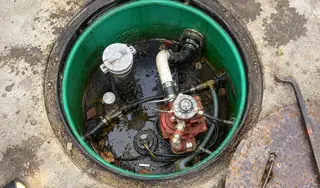
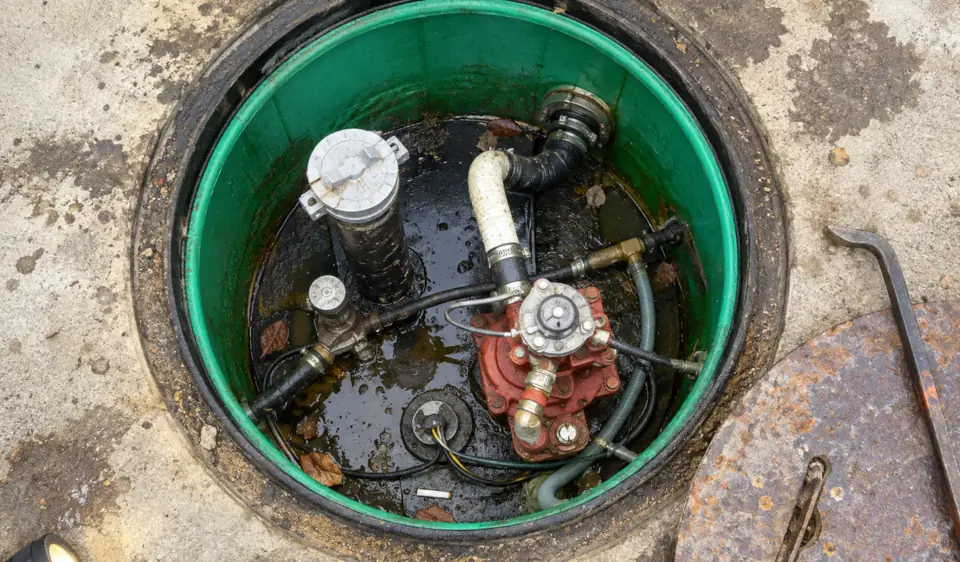
Spill prevention equipment and containment sumps used for interstitial monitoring of piping need a liquid-tightness test at least once every three years under 40 CFR 280.35, using vacuum, pressure or liquid testing. The spill bucket gas station delivery drivers open at every drop is the familiar example, and the rule also reaches catchment basins and other spill containment devices. Construction details, single wall against double wall, are covered in the secondary containment guide.
Double-walled equipment has a second route. When both walls are monitored for integrity at least as often as the walkthrough looks at that equipment (every 30 days for a spill bucket, once a year for a sump), the liquid-tightness test is not required. In practice that monitoring is the interstitial check already built into each walkthrough, as long as it is done every time and written down. The exemption lasts only as long as the monitoring does. Stop checking the interstitial space and a test falls due within 30 days.
Booking all three in one visit is the schedule to aim for. The spill bucket test, the sump test and the overfill inspection share one 3-year clock under 280.35, so doing them together resets every date and leaves a single deadline in the file instead of three that drift apart. The tradeoff is the double-wall route: skip the liquid test on monitored equipment and the interstitial checks must continue at every walkthrough, or that item needs its own test within 30 days.
Each test follows the manufacturer's requirements, a code of practice from a nationally recognized association or independent testing laboratory, or requirements set by the implementing agency. The rule lists PEI RP1200 as a code of practice that may be used. A visual look alone is not a liquid-tightness test. Sumps outside piping interstitial monitoring fall outside the federal three-year test, though every sump still gets the annual walkthrough check.
What Does an Overfill Prevention Valve Inspection Check?
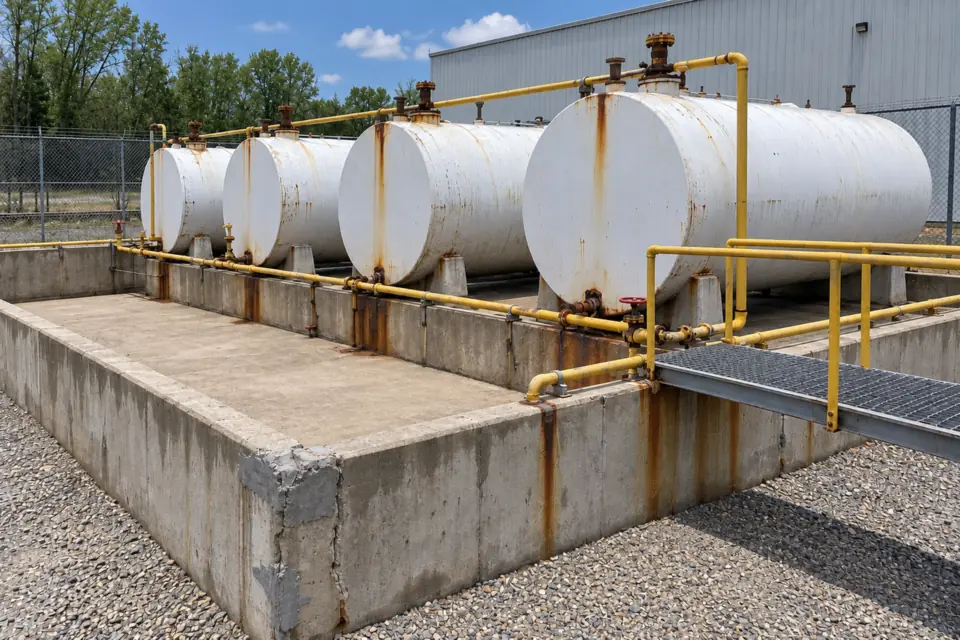
An overfill inspection has to show two things: that the equipment is set to activate at the correct level under 280.20(c), and that it will activate when product reaches that level. Section 280.35(a)(2) requires that inspection at least once every three years, the same interval as the spill and sump tests. Spill buckets and sumps pass or fail on liquid tightness; the overfill inspection passes or fails on function.
The correct level depends on the device. An overfill prevention valve meeting the first option shuts off flow automatically when the tank is no more than 95% full. An overfill alarm or flow restrictor meeting the second must alert the person making the delivery when the tank is no more than 90% full. The third option restricts flow 30 minutes before overfilling, sounds a high-level alarm one minute before overfilling, or shuts off flow so no fitting on top of the tank is exposed to product.
Overfill devices fail quietly. A shutoff valve stuck open or an alarm horn that never sounds gives no sign during normal sales, so the inspection every 3 years is the moment someone has to prove activation rather than assume it. A site that has never had a near overfill has no everyday evidence the device works at all.
The report worth keeping states two facts for each tank: the level the device is set to and whether it activates there. One that reads only 'overfill OK' leaves both points unproven, and like the spill and sump results it stays on file for 3 years under 280.35(c). An inspection that finds the device set above the level its option allows has found a failure, even when the device still trips.
Does a Walkthrough Inspection Count as a Test?
Only in one case. A walkthrough inspection is the owner or operator's routine visual check under 40 CFR 280.36, and for single-walled spill buckets and sumps it never replaces the 3-year liquid test. The one case is double-walled equipment whose interstitial space is checked on the walkthrough schedule, the route described above. The walkthrough has a different job: it catches a spill bucket full of water or a release detection alarm within 30 days, long before the next test round.
Every 30 days the walkthrough covers spill prevention equipment and release detection equipment. For spill equipment, that means checking for damage, removing liquid or debris, checking the fill pipe for obstructions, making sure the fill cap is secure and, on double-walled spill equipment, checking the interstitial area for a leak. For release detection, it means confirming it runs without alarms or other unusual conditions and that its records are reviewed and current.
Sites that receive deliveries less often than every 30 days may check spill equipment before each delivery instead. Once a year the walkthrough adds a containment sump check for damage, leaks into the containment area, releases, liquid or debris to remove, and the interstitial area on double-walled sumps. Hand-held release detection equipment, such as tank gauge sticks and groundwater bailers, gets its check on the same annual visit.
PEI RP 900 is the code of practice the rule names for walkthroughs, and walkthrough records are kept for 1 year under 280.36(b). Problems found on a walkthrough, such as debris in a spill bucket or a loose fill cap, get fixed and noted, but they never reset the three-year clock. An outside tester's 3-year report cannot stand in for a missing month in the log.
Who Is Allowed to Test UST Equipment in Your State?
Your state decides who may test. Section 280.35 sets how a spill or sump test is run; tester credentials come from state programs. At least 22 jurisdictions require a state credential for whoever runs some or all of these equipment tests, based on a review of state UST rules completed in October 2026. For an owner, the practical question is whether the person signing the report holds whatever the state requires.
Those 22 are Alaska, Arkansas, California, Colorado, the District of Columbia, Illinois, Indiana, Kansas, Maine, Maryland, Minnesota, Mississippi, Montana, New Jersey, Oklahoma, Oregon, Pennsylvania, Rhode Island, Utah, Washington, West Virginia and Wyoming. Where no such credential applies to these tests, the tester still has to follow one of the method routes in 280.35, and the owner still keeps the report for 3 years.
Testing rules change from state to state as well. The same review found a stricter spill bucket rule in at least 10 states and a stricter sump rule in at least 21. At least six states go further on overfill equipment and one on the automatic tank gauge or line leak detector. California requires spill containment testing at least once every 12 months under 23 CCR 2664(a), and the California UST inspection and testing page carries the state detail. An owner with stations in more than one state needs one calendar per state, since the stricter rule sets each date.
New York sits at the other end: its own rules leave out periodic spill, sump and overfill testing, and its DEC calls the 2015 federal tests "an EPA-only requirement", which leaves the obligation with the federal rule. The state-by-state column for all of this sits in UST compliance deadlines by state. Firms that do this testing are listed state by state in the UST contractor directory; a listing is no evidence of a state tester credential, so confirm the credential with the state program wherever one is required.
How Long Do You Keep Test Records, and What If a Test Fails?
Spill, sump and overfill records stay on file for 3 years under 280.35(c), and annual operation test results are kept for 3 years under 280.45(b)(1). Walkthrough records need only 1 year under 280.36(b). Those are minimums, and a site that has kept every 3-year report since the 2018 round can show its whole testing history to a buyer or lender.
The operation test record names every component tested, says whether each one passed or needed action, and notes any action taken. A single line reading 'ATG passed' leaves out what the rule asks for, and a sensor replaced during the visit belongs in the action entry with its date. Missing component lines are the gap to look for when reviewing last year's report.
Repair comes first when a test fails. A spill bucket or sump that fails its liquid test is not liquid tight, and it does not meet 280.35 until it is repaired or replaced and passes a retest. When monitoring results indicate a possible release, 280.50 adds a report to the implementing agency within 24 hours, or within another period the agency sets. Section 280.52 then requires the owner to investigate and settle within 7 days whether a release happened.
Retests after a repair belong in the same 3-year file, so the record shows the failed result and the passing one that followed. The rest of the owner's list, from operator training to financial responsibility, is in the UST compliance guide for facility owners.
When Is Your Next UST Test Actually Due?
Your next 3-year round is due no later than three years after your last test, whatever year that lands in.
A site that tested on October 13, 2018 and retested on each 3-year anniversary hit October 2021 and October 2024, which puts its next round in October 2027. A site whose last round was done in December 2023 owes the next one by December 2026, so its UST compliance deadlines 2026 include the full 3-year visit. Any early retest along the way pulls the date forward, which is why the last test date counts for more than 2018 does.
Owners who want the whole round priced as one job can request a quote and include the dates from the last reports.
The number that changes the plan is 30. It is the walkthrough interval for spill equipment, and it is also the deadline for a liquid test once interstitial monitoring stops on a double-walled spill bucket or sump, whatever the 3-year date in the file says.