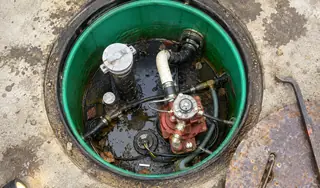
Secondary containment is a barrier that catches a leak before it reaches soil or groundwater. Federal rules at 40 CFR 280.20 require it on underground storage tanks and piping installed or replaced after April 11, 2016, and 40 CFR 112 imposes a parallel requirement on aboveground oil facilities storing more than 1,320 gallons. The capital cost of retrofitting an existing site runs $2,500 to $15,000 per tank pit, and a court can impose up to $59,114 per day for each violation of the SPCC rule.
Owners and operators get tripped up most often by the same handful of details. Spill buckets fill with rainwater and never get pumped. Containment sumps crack at the boot penetration and leak unnoticed for years. SPCC plans go past the five-year review the rule requires because nobody put it on the calendar. Each of these failures can draw a violation at a routine inspection, even when the tank system itself is intact.
The compliance picture is also a moving target. EPA revised the federal UST rule in 2015 and phased in new walkthrough, testing and inspection duties through October 13, 2018. It has also raised Clean Water Act civil penalties for inflation three times since January 2023, most recently on January 8, 2025. A program that was current three years ago is not necessarily current now, and a facility manager who assumes otherwise risks a surprise during the next walkthrough.
This guide explains who is regulated, which federal rules drive the requirement, what equipment options look like in the field, how overfill protection fits into the broader containment picture, and where most facilities fail an inspection. Use it as a planning reference before scheduling new work, and request contractor quotes through our contractor directory when the scope is set.

What Secondary Containment Is and Who Needs It
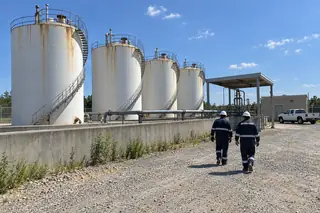
Secondary containment requirements apply to most petroleum storage facilities in the United States, though the exact rule that governs varies by tank type and capacity. Underground systems holding regulated substances fall under 40 CFR Part 280 unless an exclusion applies, such as a capacity of 110 gallons or less or heating oil used on the premises. Aboveground petroleum facilities storing more than 1,320 gallons of oil in containers of 55 gallons or larger fall under the SPCC rule at 40 CFR Part 112.
Some sites fall under both rules at once. A typical truck stop operates underground tanks for retail gasoline and an aboveground diesel generator day tank for backup power. The underground side answers to the state UST program, the aboveground side falls under SPCC, and the same containment failure (a cracked sump that releases petroleum to soil) can draw findings under both programs at once.
State programs frequently impose stricter rules than the federal floor. California required under-dispenser containment, or a board-approved alternative, on existing UST systems by deadlines that ended December 31, 2003, under Health and Safety Code 25284.1, and its current rule, 23 CCR 2640(h), requires it under every dispenser. New York runs its own Petroleum Bulk Storage program at 6 NYCRR Part 613, separate from federal SPCC, with registration renewed every five years and monthly inspections of aboveground systems. Owners verifying compliance need to read the state code alongside the federal rule, since both apply.
Heating oil tanks that serve the building they sit at are outside federal UST rules at any size under 40 CFR 280.12. A heating oil container used solely at a single-family home is also exempt from SPCC under 40 CFR 112.1(d)(9). State programs sometimes pull home tanks in anyway: Maine registers underground oil tanks of any use or size, and Massachusetts requires a fire department permit to remove one. Our oil tank replacement guide covers the homeowner side of that picture in detail.
Federal Rules That Drive Secondary Containment Requirements
The federal UST rule at 40 CFR 280.20 sets the baseline for new and replacement tank installations. Tanks and piping installed or replaced after April 11, 2016 must be secondarily contained and use interstitial monitoring, and the containment must hold a leak until it is detected and removed. Under 280.20(f), every new dispenser system installed after that date needs under-dispenser containment that is liquid-tight on its sides, bottom and penetrations. The rule sets no minimum capacity for it.
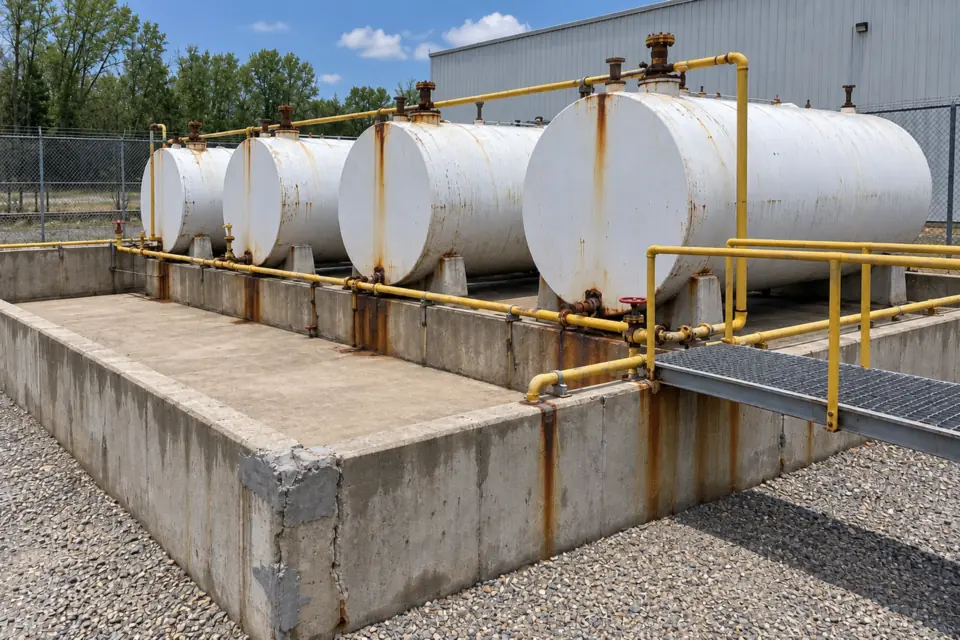
The SPCC rule at 40 CFR Part 112 imposes a related but distinct requirement on aboveground facilities. Under 40 CFR 112.8(c)(2), bulk storage containers need secondary containment for the entire capacity of the largest single container plus enough freeboard to hold precipitation. The rule applies to facilities that could reasonably be expected to discharge oil to navigable waters of the United States or adjoining shorelines, and its 1,320-gallon threshold counts only containers of 55 gallons or more.
Inspection cadence varies by program. Federal law requires EPA or the state to inspect each regulated UST on site at least once every three years under 42 U.S.C. 6991d. SPCC requires the owner to review the plan at least once every five years and to test or inspect each aboveground container on a schedule set by industry standards. A licensed Professional Engineer must certify the plan unless the facility qualifies to self-certify, which takes 10,000 gallons or less of aboveground storage and a clean recent spill history. Missing the five-year review or a container test creates a paper-trail gap that surfaces at the next agency walkthrough.
Penalties have teeth. According to EPA's inflation-adjusted penalty table at 40 CFR 19.4, last updated January 8, 2025, a court can impose up to $59,114 per day for each SPCC violation, and EPA can assess administrative penalties of up to $23,647 per violation. A single cracked berm, left unrepaired through two inspection cycles, can generate cumulative penalties higher than the original retrofit cost.
Equipment Types: Spill Buckets, Sumps, and Berms
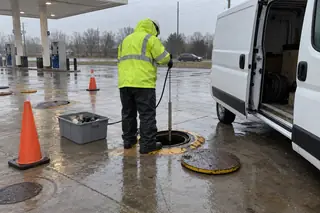
Spill buckets sit at the fill port of an underground tank to catch the small product release that occurs when the delivery driver disconnects the hose. A standard spill bucket holds five to fifteen gallons, and 40 CFR 280.35 requires a liquid-tightness test at least once every three years unless the bucket is double-walled and the space between its walls is checked during walkthroughs. The cost of replacement runs $400 to $1,200 per fill port, and the federal walkthrough checks every bucket for damage, liquid and debris every 30 days.
Containment sumps go under dispensers and at submersible turbine pump locations to catch leaks from piping connections. Modern dispenser sumps are molded polyethylene units sized for the dispenser footprint, with boot penetrations sealed against the supply piping. Sumps used for interstitial monitoring of piping must be tested for liquid-tightness at least once every three years by vacuum, pressure or liquid testing, and every containment sump gets a visual check during the annual walkthrough. Spill buckets and sumps used for interstitial monitoring share one three-year test cycle, set out in how often buckets and sumps are tested.
Berm containment serves aboveground installations subject to SPCC. A typical fuel berm is a precast concrete or HDPE structure surrounding a single tank or a tank battery, sized at 110 percent of the largest tank volume plus expected precipitation accumulation. Removable berms exist for temporary fueling operations, and engineered earthen berms work for larger bulk plants, though both options carry inspection burdens that fixed concrete berms do not.
Drop tubes and overfill devices work together. The drop tube extends from the fill port toward the bottom of the tank, which prevents free-fall splashing during delivery and reduces vapor release. Under 40 CFR 280.20(c), one overfill option shuts off flow when the tank is no more than 95 percent full. Another warns the delivery driver, by restricting flow or sounding a high-level alarm, when the tank is no more than 90 percent full.
Overfill Protection and Drop Tube Requirements
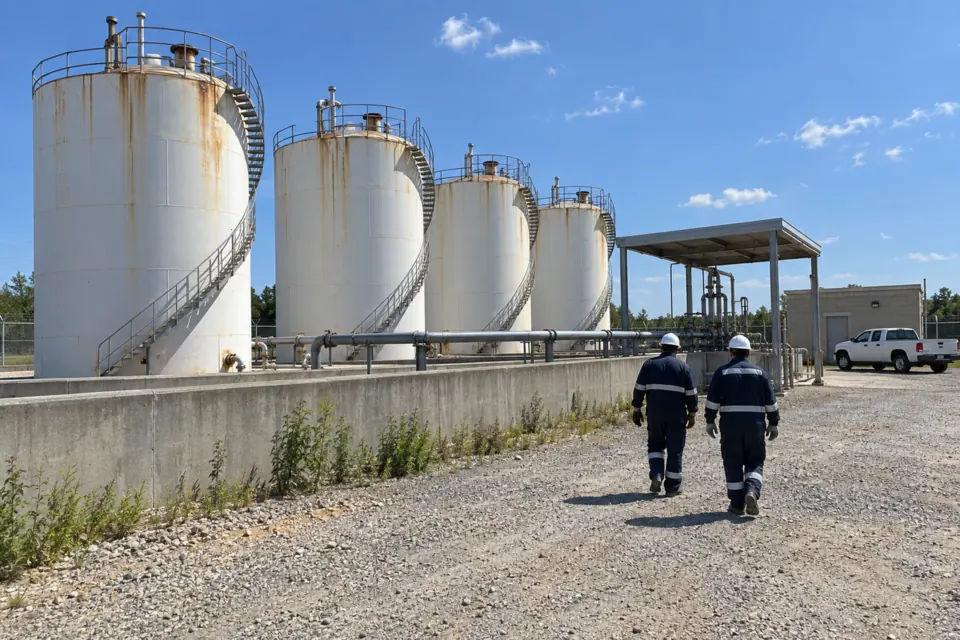
Overfill protection sits beside the spill and overfill operating rule at 40 CFR 280.30. Every UST filled by transfers of more than 25 gallons at a time needs overfill equipment. The rule offers three options: automatic shutoff, an alert by flow restriction or high-level alarm, or a device that restricts flow 30 minutes before overfilling. The 2015 rule barred vent-line flow restrictors (ball floats) for overfill prevention installed or replaced after October 13, 2015, and added an inspection at least every three years for every option.
Equipment selection follows three rules. Most modern installations use the automatic shutoff valve as primary protection because it requires no operator intervention. Audible and visual alarms function as a secondary backup, especially at unattended facilities where a driver might not see a flag-style indicator. Ball floats installed in vent lines before October 13, 2015 can stay in service, but they cannot be used when overfill prevention is installed or replaced after that date.
Testing requirements mirror the spill bucket cadence. Overfill prevention equipment must be inspected at least once every three years under 40 CFR 280.35 to confirm it activates at the correct level, and the records kept for three years. Some states test other equipment more often. California tests overfill prevention every 36 months under 23 CCR 2665, but it tests spill containment every 12 months (23 CCR 2664). Its 12-month release detection equipment test (23 CCR 2663) matches the federal annual test at 40 CFR 280.40(a)(3).
Documentation decides how an inspection goes. Keep test paperwork that shows the device type, the test date, who did the test and their certification, the pass or fail result, and any corrective action taken. A boilerplate certificate that lacks these details is hard to defend, even when the equipment itself passed the test, because the inspector cannot confirm what was actually checked.
Common Compliance Failures and Inspection Findings
Data from EPA's UST performance measures shows where facilities fall short. Of facilities inspected from April 2025 through March 2026, 82.1 percent met the spill prevention rules, which include spill bucket testing, and 83.1 percent met the overfill prevention rules. Release detection fared worst at 71.5 percent, and only 60.9 percent of facilities met every technical category.
SPCC inspections turn up a different set of problems. The plan must be reviewed at least once every five years under 40 CFR 112.5(b), and inspection and test records must be signed and kept with the plan for three years under 40 CFR 112.7(e). Containment also has to keep its design capacity: a precast berm that has cracked may no longer hold the largest container plus precipitation.
Catch the failures early. The federal walkthrough already sends someone to every fill port every 30 days, so use it. Open the bucket, drain any water, check for debris, make sure the fill cap is secure on the fill pipe, and document the date and result. A written record of each walkthrough is also what the rule asks you to keep.
Document everything in writing. Inspectors do not credit verbal claims of compliance, only signed records. A bound paper logbook works as well as a digital recordkeeping platform, but the records must be retrievable on request. Sites that store inspection records in an email folder or on a personal phone routinely fail audits when the responsible person is unavailable or has left the company.
Hiring a Contractor for Secondary Containment Work
Three credentials matter when hiring for secondary containment work. For a regulated tank, 40 CFR 280.20(e) requires the owner to show the installation meets code, and one accepted way is an installer certified by the tank and piping manufacturers or certified or licensed by the state program. A licensed Professional Engineer must certify the SPCC plan unless the facility qualifies to self-certify. Pollution liability insurance with at least $1 million per occurrence protects the owner if a release occurs during work.
Scope the work carefully before requesting bids. A retrofit project might include one or more of: spill bucket replacement, dispenser sump replacement, overfill device upgrade, SPCC plan recertification, or full secondary containment installation around an aboveground tank. Each line item carries different licensing requirements, and a single contractor may not hold every credential needed for the full job.
Cost varies by scope. A spill bucket retrofit runs $400 to $1,200 per fill port. Dispenser sump replacement runs $1,500 to $4,000 per dispenser. Aboveground berm installation runs $5,000 to $25,000 per tank depending on size and site conditions. Full SPCC plan certification by a PE runs $1,500 to $6,000 depending on facility complexity. See our SPCC plan guide for the planning-side detail.
Get three written bids and verify each contractor's credentials before signing. Our how to choose a UST contractor guide walks through the vetting checklist. Once the scope is set and the contractor is selected, request a quote through our directory to start the formal procurement process and lock in installation timing before the next inspection cycle.