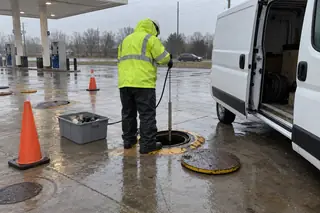
A leak detection system checks USTs for releases every 30 days under 40 CFR 280.41. EPA estimates that more than 562,000 USTs operate in the United States, and every regulated tank must use one of the release detection methods the rule allows. Capital cost for a modern system runs $4,500 to $15,000 per tank pit, and ongoing testing and recordkeeping add $400 to $1,200 per year for a typical retail fueling station.
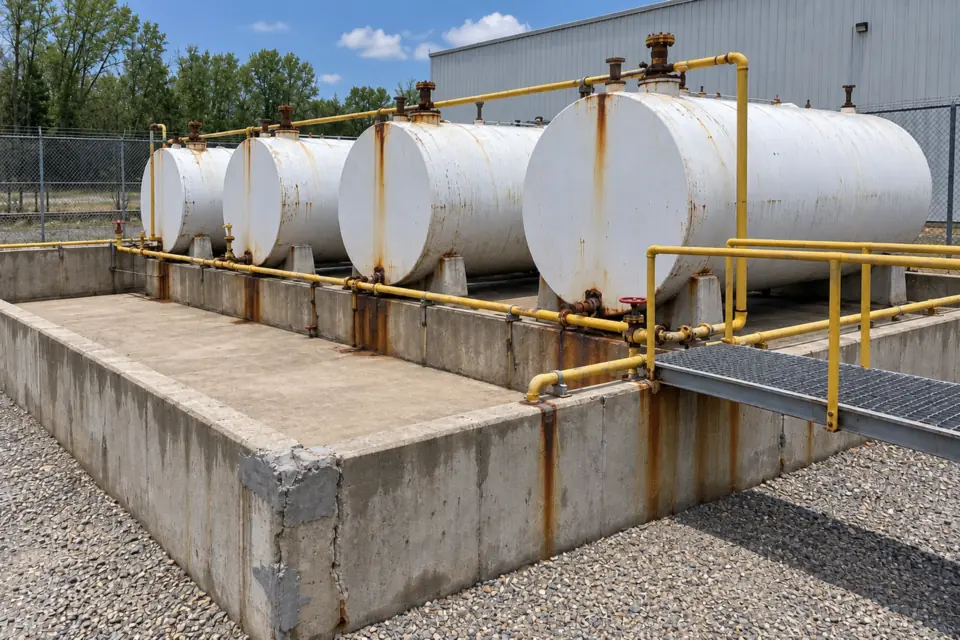
Compliance failures on leak detection produce a steady share of state inspection findings. Tank operators most often draw a notice of violation for a stale automatic tank gauge calibration, missing monthly leak detection records, or an interstitial monitoring sensor reading the alarm state for weeks without follow-up. Each finding triggers a corrective action timeline, and unresolved findings escalate to administrative penalties that can exceed $25,000 per violation.
The compliance picture shifted in 2015 when EPA revised the federal UST rule. The revision required secondary containment with interstitial monitoring for tanks and piping installed or replaced after April 11, 2016. It also added walkthrough inspections every 30 days and spill tests and overfill inspections at least once every three years. Tanks installed on or before April 11, 2016 could stay on their existing method, while new and replacement tanks and piping shifted to interstitial monitoring with electronic sensors.
This guide walks through what the federal rule requires, the methods EPA accepts, what each method costs to install and operate, the recordkeeping that closes the loop, and how to hire a qualified contractor. Use it as a planning reference, then browse prequalified installers in the contractor directory when the scope is set.

What a Leak Detection System Does on a UST
A leak detection system works on a simple principle: a tank or piping run holds a known volume of liquid, and any deviation from that known volume points to a release. Modern systems pair physical sensors at the tank, in the dispenser sump, and along the piping run with electronic logging and threshold-based alarms. The setup reports continuously, not just during a monthly check, so an operator gets warning hours after a release begins rather than weeks later.
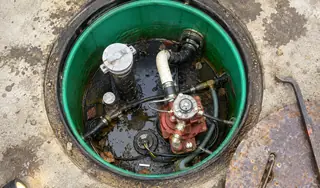
Hardware sits in three locations. The first is inside the tank, where a magnetostrictive probe reads product depth, water level at the tank bottom, and temperature. The second is in the interstitial space of a double-wall tank or in a containment sump, where a liquid or pressure sensor triggers on any breach of the primary wall. The third is along the supply piping, where line leak detectors check for pressure loss under operating conditions.
The console pulls all three sensor streams into one place. A modern Veeder-Root TLS-450 or Franklin INCON TS-LS console shows current tank levels, recent leak test results, sensor status across the site, and pending alarms on a single screen. Most units retain records for the previous 12 to 24 months depending on configuration, and the leading product lines integrate with a fuel inventory management portal for remote access by the facility manager.
Alarm response separates a working program from a paper-only one. When a sensor reads an alarm state, the console logs the event and sends a notification via the dispenser display, SMS, or email depending on integration. Logging continues until the alarm clears or is acknowledged. A facility that ignores or silences the alarms without investigating fails the implicit purpose of leak detection: timely notification.
Federal Leak Detection Requirements at 40 CFR 280
Federal regulations define a leak detection system as the equipment, procedures, and recordkeeping that confirm a tank and its piping are not releasing product to the environment. Automatic tank gauging must be able to detect a 0.2 gallon per hour leak under 40 CFR 280.43(d), and 40 CFR 280.40(a)(4) requires a 0.95 probability of detection for that and several other methods. Owners cannot meet the rule by visually checking a tank, and plain inventory control counts only when paired with tank tightness testing.
The rule applies to every regulated UST. The federal definition covers any tank with 10 percent or more of its volume below grade that stores petroleum or hazardous substances. Heating oil tanks used on the premises sit outside the rule at any size under 40 CFR 280.12, as do farm and residential motor fuel tanks of 1,100 gallons or less used for noncommercial purposes. Tanks of 110 gallons or less and several other listed types are excluded too. Compliance starts the day a tank receives product, not the day a permit issues.
The system has two halves. Tank monitoring confirms that the tank itself is intact, and piping monitoring confirms that the supply lines between the tank and the dispenser are intact. The two halves use different sensors, different test methods, and different recordkeeping forms, and an operator can pass on one half and fail on the other simultaneously. A complete program addresses both.
Detection is only the first step. When a method indicates a possible release, 40 CFR 280.50 requires a report to the state implementing agency within 24 hours, and 40 CFR 280.52 requires the owner to confirm or rule out the release within seven days. A confirmed release moves the site into corrective action. See our UST compliance for facility owners guide for the corrective action timeline in detail.
Methods: ATG, Interstitial, SIR, Vapor, and Groundwater
40 CFR 280.43 lists the tank release detection methods EPA accepts, in paragraphs (a) through (i). Tanks installed or replaced after April 11, 2016 must use interstitial monitoring between tank walls, while older tanks commonly use an automatic tank gauge with in-tank probes or statistical inventory reconciliation. Three additional methods (manual tank gauging, vapor monitoring in the surrounding soil, and groundwater monitoring in nearby wells) still see use on older sites or special configurations.
Automatic tank gauge systems dominate the modern market. An ATG console reads probe data from each tank every few minutes, runs a static leak test during quiet periods (typically overnight), and stores the results electronically for inspection retrieval. The Veeder-Root TLS-450, the Franklin Fueling INCON TS-LS, and the OMNTEC OEL-8000 dominate the installed base, and each runs daily 0.2 gph leak tests automatically.
Interstitial monitoring is now standard on new installations. Double-wall tanks include a hydrostatic or vacuum-sensed interstitial space between the inner and outer walls, and a sensor in that space alarms when liquid or pressure changes appear. The same approach applies to double-wall piping. The 2015 rule update made interstitial monitoring the de facto baseline for new piping construction nationwide.
Statistical inventory reconciliation, or SIR, applies math to daily inventory records. A vendor-certified SIR analyst reviews the previous month of fill, dispense, and stick readings, and applies a statistical test to detect a slow loss within the 0.2 gph threshold. SIR can serve as a monthly method on its own under 40 CFR 280.43(h) for tanks installed on or before April 11, 2016. Plain inventory control, not SIR, is the method that pairs with tank tightness testing every five years, and only until 10 years after installation.
Leak Detection System Cost and Installation
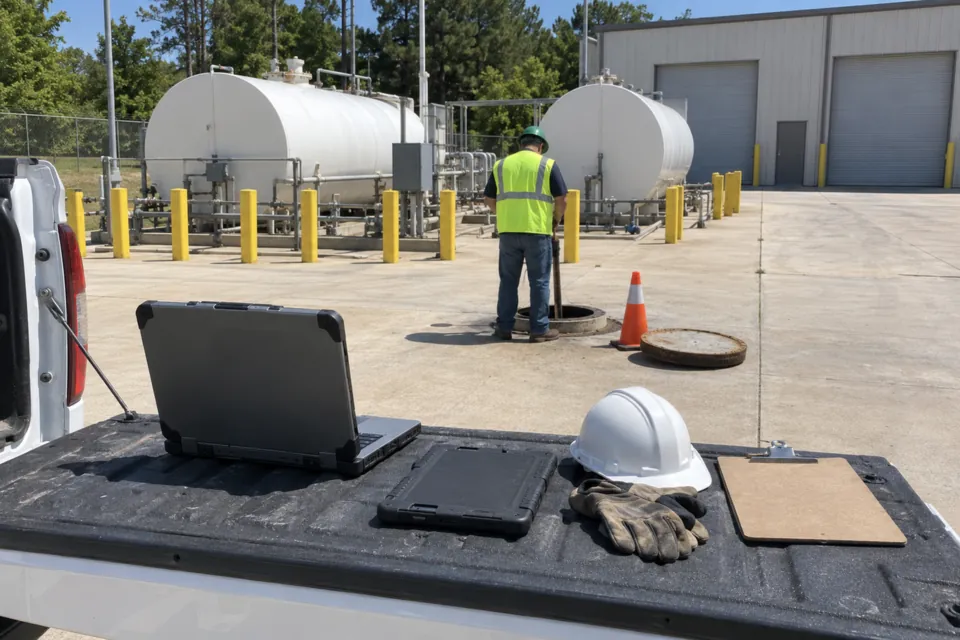
Leak detection system cost varies sharply by method. A new automatic tank gauge installation, with a console and one probe per tank, runs $5,500 to $12,000 for a typical 3-tank retail station. Adding interstitial sensors at each tank and at each line termination adds $800 to $2,000 per sensor. A full sensor refresh (ATG plus interstitial plus dispenser sumps) on a 3-tank, 4-dispenser station runs $9,000 to $18,000 in 2026 pricing.
Pressurized piping needs a line leak detector. Federal rules require an automatic line leak detector on every pressurized piping system, set to detect a 3 gallon per hour leak at 10 psi within one hour. Mechanical line leak detectors run $400 to $700 per line, while electronic detectors integrated with the ATG run $800 to $1,500 per line and produce digital records that simplify inspection retrieval.
Annual operating costs depend on certification cadence. A 0.2 gph in-tank leak test under an ATG generates its own automatic record, but an annual functional test by a certified service technician runs $200 to $400 each tank. Line tightness testing on a non-pressurized piping system costs $300 to $600 each line every three years. SIR services run roughly $40 to $80 monthly for each tank, and a tank tightness test, which 40 CFR 280.41 requires every five years where inventory control is the method, runs $400 to $800.
Retrofit projects move pricing further. Replacing a pre-2015 single-wall tank with a double-wall unit, including all interstitial sensors and new piping, runs $40,000 to $85,000 per tank pit in most markets. That figure rises sharply if excavation hits contaminated soil from a prior release. See our oil tank removal cost guide for the broader UST closure and replacement cost picture.
Recordkeeping and Inspection Findings
Under 40 CFR 280.45, owners keep release detection results for at least one year, written performance claims for five years from installation, and annual operation test results for three years. Closure site assessment results are kept for at least three years after closure under 40 CFR 280.74. Most state programs extend the one-year retention to three or five years through their own administrative orders. Records must be kept at the site and immediately available, or at a readily available alternative site and provided to the implementing agency on request, under 40 CFR 280.34(c).
The records themselves have a required content list. A passing ATG leak test result must show the date, the tank identification number, the test result (pass or inconclusive), the method used, and the technician or system that produced the result. Logs that show only a date and a pass flag, without method or tank identification, typically fail audit because the inspector cannot verify what was actually tested.
Inspection findings cluster around three patterns. The most common is missing or incomplete monthly leak detection records, which typically appears as a paper-trail gap rather than an actual equipment failure. The second is an interstitial sensor in the alarm state for an extended period (often months) because nobody investigated. The third is an automatic tank gauge that has not been functionally tested by a certified technician within the last calendar year.
Catching these failures is straightforward if these checks go into the walkthrough that 40 CFR 280.36 already requires every 30 days. Pull the ATG monthly report and confirm a passing 0.2 gph leak test for each tank in every month. Walk every dispenser sump and verify the interstitial sensor is in a normal state. Check the calibration sticker on the ATG console. Document each step in writing. Keep each completed checklist, since 40 CFR 280.36(b) requires walkthrough records to be kept for one year.
How Often Does an ATG Need Testing, and What Do You Do When It Alarms?
At least once a year. Since October 13, 2018, 40 CFR 280.40(a)(3) has required an annual test of the proper operation of release detection equipment, on top of the leak tests an automatic tank gauging system runs by itself. For the gauge and any other controller, the minimum is to test the alarm, verify the system configuration and test the battery backup. These annual ATG and leak detector checks sit on the same calendar as the 3-year spill, sump and overfill tests.
The same annual test covers the other release detection components. Probes and sensors are checked for residual buildup, floats that move freely, an undamaged shaft, and cables free of kinks and breaks, and each one's alarm has to reach the controller. The leak detector on pressurized piping is tested by simulating a leak. Vacuum pumps, pressure gauges and handheld groundwater or vapor sampling equipment get checked too, where a site has them. The rule names PEI RP1200 as one code of practice for running the test, alongside the manufacturer's instructions or a method your state approves.
Keep the result for three years: 40 CFR 280.45(b)(1) requires it to list each component tested, whether it met the criteria or needed action, and what was done to correct any issue. The 30-day walkthrough under 40 CFR 280.36 is a separate duty, and it includes confirming the equipment shows no alarms or unusual operating conditions.
An alarm is a reporting question before it is a repair question. Under 40 CFR 280.50, monitoring results that point to a possible release, including what an alarm investigation turns up, must be reported to the state within 24 hours unless an exception applies or the state sets another period. Three exceptions can fit a console alarm, and the first is a defective device that is immediately repaired, recalibrated or replaced when further monitoring does not confirm the first reading. Another is a leak held in secondary containment, with liquid removed from the interstitial space right away and any defective component repaired or replaced. The third is an alarm investigated and found to be a non-release event, such as the rule's own examples of a power surge or filling the tank during a test. If no exception fits, report it and follow 280.52, which calls for confirming or ruling out the release within 7 days.
Hiring a Contractor for Leak Detection Work
Three credentials matter when hiring for leak detection work. Many states license UST contractors or certify installers and testers, so check your state program before you hire. A manufacturer-certified technician designation from Veeder-Root, Franklin Fueling, or OMNTEC is required for warranty-covered ATG calibration and repair. A current pollution liability insurance policy protects the facility owner if a release occurs during the service visit.
Scope the project before requesting bids. A leak detection refresh might cover ATG calibration only, ATG plus interstitial sensor replacement, line leak detector retrofit on pressurized piping, full system replacement, or some combination of the above. Each line item carries different licensing requirements and different testing protocols, and a single contractor may not hold every credential needed for the full job.
Get three written bids and verify each contractor's credentials before signing. Our how to choose a UST contractor guide covers the vetting checklist, including reference calls, license verification, and insurance certificate review. The lowest bid often omits the post-install functional test or the calibration paperwork that closes out the inspection record, so match each quote line by line.
Once the contractor is selected, schedule the work during a low-traffic window. Most leak detection installations require taking each tank offline for one to four hours per probe or sensor. Request a quote through our directory to start the procurement process. Lock in the testing schedule before the next state inspection date to avoid a notice of violation in the meantime.