Find Georgia contractors for UST site remediation, soil cleanup, groundwater treatment, contamination assessment, and tank closure work. Serving Atlanta, Savannah, Augusta, Columbus, Macon, and communities across the state.
What to Know About UST Remediation in Georgia
Georgia environmental remediation contractors work corrective action files through the EPD UST Program. The Georgia Environmental Protection Division administers Chapter 391-3-15, the rule that implements federal UST requirements at 40 CFR Part 280 for tank closures and petroleum cleanup work statewide. EPD accepts written reports from any qualified environmental consultant, with certain submittals requiring a Georgia-licensed Professional Geologist or Professional Engineer seal. Operators discovering a release have 24 hours to notify the Georgia EPD UST Program and seven days to confirm it, and most projects open with a Phase I ESA before any invasive sampling. Convenience stores along I-75 and I-85, fleet yards near the Port of Savannah, and shuttered service stations in older Atlanta neighborhoods produce most of Georgia's caseload.
Demand for soil cleanup work clusters along Georgia's commercial fuel corridors and largest metros. Atlanta generates the highest volume, with legacy gas stations along Buford Highway and aging fleet facilities in Marietta driving steady caseload. Savannah produces port-adjacent contamination assessment work tied to the Garden City logistics terminals and the broader Chatham County industrial belt. Augusta and Columbus generate mid-sized projects from former service stations and military fueling depots near Fort Gordon and Fort Benning. Secondary corridors include Macon's I-75 freight zone, Athens college-town infill projects, and Albany sites where shallow groundwater in the Flint River basin can spread petroleum plumes well beyond the original tank pit.
Georgia remediation costs span a wide range based on plume size, soil type, and contamination depth. Confirmation soil sampling runs $400 to $1,200 per location, while a Phase II contamination assessment on a Georgia UST site typically costs $3,500 to $12,000. Excavation and disposal of petroleum-impacted soil falls between $12,000 and $75,000 for moderate releases. Groundwater treatment systems for larger Atlanta-area or Savannah-area plumes can run $50,000 to $175,000 over the multi-year cleanup window, with in-situ vs ex-situ treatment options driving most of the cost variance on Georgia plumes. The Georgia Underground Storage Tank Trust Fund, administered by EPD, may reimburse eligible cleanup costs for registered, compliant facilities up to statutory caps. See cleanup workflows and methods for a phase-by-phase cost breakdown across a corrective action file.
The typical Georgia corrective action file moves through release notification, site characterization, remedy selection, and EPD closure approval. Initial notification and confirmation sampling come first, followed by a corrective action plan negotiated with EPD reviewers at the Atlanta tower. Most petroleum-only sites reach closure in 18 to 36 months, though plumes that reach the Floridan aquifer in south Georgia or fractured piedmont bedrock can stretch beyond five years. Before signing a contract, ask Georgia contractors for current EPD references and written proof that field crews carry 40-hour HAZWOPER training. Verify pollution liability coverage on Georgia job sites and get a written scope that separates excavation, disposal manifests, and EPD reporting as line items so you can compare bids accurately.
Does Georgia require a special license to perform UST remediation?
Georgia does not license environmental remediation contractors as a separate trade. EPD requires corrective action plans, site characterization reports, and closure submittals to be prepared by qualified consultants, and certain documents must be sealed by a Georgia-licensed Professional Geologist or Professional Engineer. Property owners should ask prospective firms for examples of EPD-approved closure reports the company has authored on comparable Georgia files. Georgia's open-consultant model places more responsibility on tank owners to vet experience than the licensed-contractor model used in some Northeast states. Verify pollution liability insurance and references from completed Georgia EPD cleanups before signing any contract.
How much does environmental remediation cost on a Georgia UST site?
Costs in Georgia vary widely based on plume depth, soil type, and proximity to drinking-water receptors. A clean tank closure with minor sampling can run $6,000 to $18,000 total. Soil excavation projects typically fall between $15,000 and $75,000, and groundwater treatment work in the Atlanta, Savannah, or Augusta metro corridors can exceed $125,000. Sites flagged as free-product recovery or off-site migration cases push final figures significantly higher. The Georgia UST Trust Fund reimburses eligible costs above the statutory deductible for compliant facilities, which lowers out-of-pocket exposure on registered tanks. When you compare quotes from soil remediation companies in Georgia, make sure each one covers excavation, soil disposal, backfill, and the confirmation sampling needed to close the case.
How long does a Georgia UST cleanup project take from start to closure?
Most petroleum cleanup files in Georgia reach closure within 18 to 36 months. Initial release notification and confirmation sampling come first. Site characterization and corrective action plan negotiation with EPD typically takes another 4 to 8 months. Active remedy implementation runs from a single excavation week to multi-year groundwater monitoring at deeper sites in the Coastal Plain or fractured Piedmont bedrock. EPD's No Further Action letter is usually issued within 120 days of closure report submittal once monitoring data confirms the cleanup standards have been met.
What does the Georgia UST Trust Fund cover for remediation?
The Georgia Underground Storage Tank Trust Fund reimburses eligible site investigation, soil treatment, and groundwater monitoring costs for tanks registered with EPD. Coverage requires the tank owner to be in compliance with EPD registration, equipment upgrade, and release-reporting rules at the time the leak is discovered. Reimbursement applications run through EPD's Land Protection Branch, and the fund pays after work is completed and invoiced rather than upfront. Tank owners typically pay contractors directly and wait several months for reimbursement to land. Non-compliant facilities are excluded from fund coverage entirely.
What happens during a typical Georgia UST corrective action?
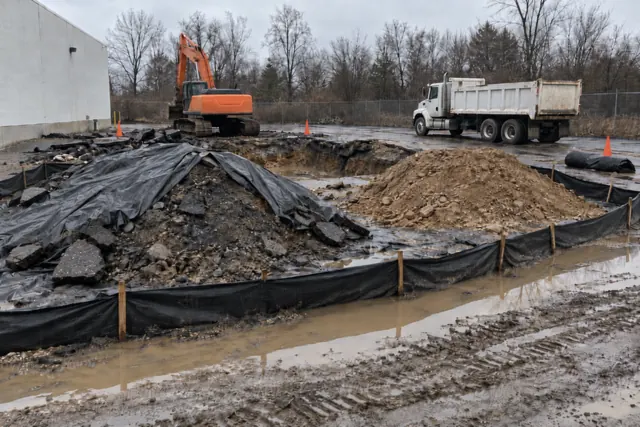
Work begins with release confirmation through soil and groundwater sampling at the tank pit. The consultant submits an initial site characterization report to EPD that scores the site by receptor proximity, contaminant type, and plume mobility. EPD responds with a corrective action plan directive specifying cleanup targets and monitoring frequency. Most sites involve excavation of impacted soil, off-site disposal at a Georgia-permitted Subtitle D landfill, and quarterly groundwater monitoring at the property until cleanup goals are met. The file closes with an EPD-issued No Further Action letter accepting the site as remediated.