
Tank Decommissioning

Tank Decommissioning Contractors in Ohio

Compare Ohio contractors who close and remove underground storage tanks, and read what BUSTR and the State Fire Marshal require for a tank closure.

What to Know About Tank Decommissioning in Ohio

Ohio's underground storage tank program is run by BUSTR, the Bureau of Underground Storage Tank Regulations in the Division of State Fire Marshal, not by Ohio EPA. The UST definition in Ohio Adm. Code 1301:7-9-02 leaves out tanks storing heating fuel for consumptive use on the premises, with no size limit, and farm or residential tanks of 1,100 gallons or less holding motor fuel for noncommercial use. BUSTR's scope page says tanks storing heating fuel used on the premises do not require BUSTR closure or corrective action, and adds that emergency generator use does not qualify as heating. Gas station, fleet and generator tanks that meet the definition go through the full closure process below.
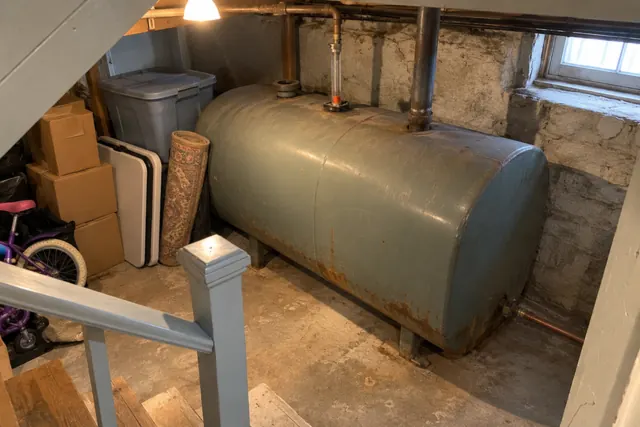
Heating oil tank tucked under the basement stairs, seen from halfway down the steps

Tank closure for a regulated UST in Ohio starts with a permit, which Ohio Adm. Code 1301:7-9-10 requires before a removal, a closure in place, a change in service or taking a tank out of service for more than 90 days. Where a local fire department holds delegated authority, the permit comes from that department. The delegated fire department list includes the Columbus Division of Fire and the Cleveland and Cincinnati fire departments. Everywhere else the permit comes from the State Fire Marshal, whose permit fee is $35 per location. The work must be supervised by a certified UST installer and inspected by a certified UST inspector, and soil samples must be collected within 24 hours of completing the excavation.

The Petroleum UST Release Compensation Board pays for cleanup after a petroleum release, not for closing a tank. Ohio Adm. Code 3737-1-09 lists costs associated with the closure or removal of a UST system among the costs the fund will not reimburse. The Board's Fund Facts on closure soil say that if a release is confirmed when the tank is removed and the owner is found eligible, some costs count as reimbursable corrective action. Those costs commonly include hauling and disposal of soil documented to exceed closure action levels, the matching backfill, and over-excavation BUSTR approved in advance. For the 2026 program year the per-tank fee is $350 with a $55,000 deductible, or $550 with an $11,000 deductible for owners of six or fewer tanks. A claim also needs a certificate of coverage, and the eligibility application is due within one year of the release. Our guide to closure in place versus UST removal explains what changes the scope of a job.

Ohio Adm. Code 1301:7-9-12 requires one copy of the written closure report to go to the State Fire Marshal, even where a delegated department in Columbus or Cleveland issued the permit. The report must arrive within 90 days of the date the samples were required to be collected. A release found during the work, including free product or lab results above action levels, must be reported to the State Fire Marshal and the local fire department within 24 hours of discovery. Ohio's program does not hold EPA state program approval, and EPA's state program page says the federal regulations, 40 CFR Part 280, also apply in states like it. Before hiring any contractor on this page, look up the supervising installer in the state's eLicense lookup under UST installer.

Ohio contractors for tank decommissioning

See all Ohio contractors

Frequently Asked Questions

Does BUSTR regulate home heating oil tanks in Ohio?

No. A tank storing heating fuel used on the premises is not a UST under Ohio Adm. Code 1301:7-9-02, and BUSTR's scope page says tanks storing heating fuel used on the premises do not require BUSTR closure. BUSTR refers homeowners to their local fire department. Under the Ohio Fire Code, removing or abandoning a residential heating oil tank of 1,100 gallons or less needs no state fire code permit. Local fire departments may run their own permit programs, so call yours before the work starts.

Who can close a UST in Ohio?

A certified UST installer must supervise the tank closure and a certified UST inspector must inspect it. The inspector has to be present at set points, including immediately before purging begins and immediately before the tank is cut open. BUSTR's permit questions page answers "No" to whether an owner can remove a UST system personally. Both license types can be checked in the state's eLicense lookup.

Where do I get a UST closure permit in Ohio?

From a delegated local fire department if your site is in one of its areas, and from the State Fire Marshal everywhere else. BUSTR publishes the delegated list, which includes Columbus, Cleveland and Cincinnati. The permit must be obtained before the work begins, and a BUSTR permit is valid for six months. The State Fire Marshal's permit fee is $35 per location, and delegated departments set their own fees.

Can a UST be closed in place in Ohio?

Only with written approval from the State Fire Marshal or a delegated inspector. Ohio Adm. Code 1301:7-9-12 accepts closure in place where nearby structures would be endangered, where removal is physically impossible, or where removal would create an unreasonable hazard. The rule states that cost cannot be the sole reason. A tank closed in place must be filled with an inert solid material, and the site assessment for closure in place calls for at least three soil borings and monitoring wells, installed and sampled within 90 days.

Does the Ohio tank fund pay for UST removal?

No. The Petroleum UST Release Compensation Board does not reimburse the cost of closing or removing a tank under Ohio Adm. Code 3737-1-09. If a release is confirmed and the Board finds the claim eligible, it can reimburse corrective action, including disposal of soil documented above closure action levels. Eligibility requires, among other things, a valid certificate of coverage for the tank when the release occurred and an application filed within one year of the release. The deductible is $55,000, or $11,000 for owners of six or fewer tanks who pay the higher per-tank fee.

For Ohio UST regulations, visit the Ohio Department of Commerce, Division of State Fire Marshal. Federal requirements are available from the EPA UST Program.

Request a Free Quote
Free Quotes