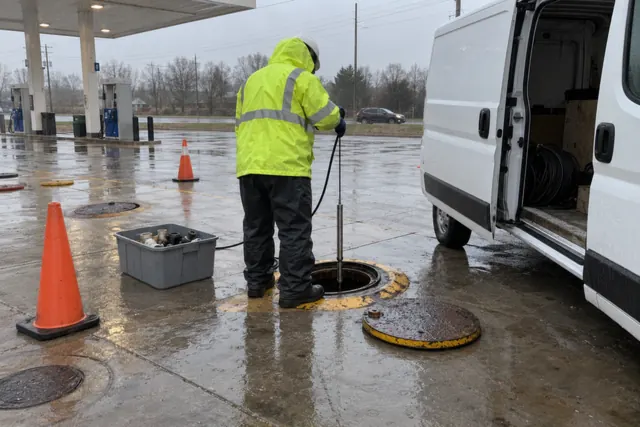
Find licensed contractors in Ohio for oil tank inspection, underground storage tank testing, tank tightness testing, leak detection, and UST compliance assessments. Serving Columbus, Cleveland, Cincinnati, Dayton, Toledo, Akron, and communities statewide.
What to Know About Oil Tank Inspection & Testing in Ohio
Ohio requires safety training for contractors performing oil tank inspection and testing on regulated
underground storage tanks. But Ohio adds a layer of complexity that most states do not have. The state delegates
day-to-day inspection enforcement authority to local fire departments. That means the fire marshal's office in
Columbus may enforce UST compliance differently than the fire department in a small town in southeastern Ohio. Testing prices stay consistent though: $500 to $2,000 for a basic tightness test. The
state sets the minimum standards, but local jurisdictions interpret and apply them with their own priorities and
timelines. For facility owners, this means knowing your local fire department's inspection expectations is just as
important as knowing the state requirements. A certified contractor who works regularly in your area will
understand both.
Underground oil tank inspection demand in Ohio is driven by the state's position as a major transportation and
industrial hub. Three interstate corridors converge in Ohio: I-70 running east-west through Columbus and Dayton,
I-71 connecting Cleveland through Columbus to Cincinnati, and I-77 running from Cleveland south through Canton and
into West Virginia. Each corridor supports dense concentrations of gas stations, truck stops, fleet facilities,
and distribution centers that require regular fuel tank inspection. The three major metros, Cleveland, Columbus,
and Cincinnati, each generate their own inspection demand from commercial, industrial, and residential properties.
Ohio's rust belt legacy adds a residential component that some newer-growth states lack. Older neighborhoods in
Cleveland, Akron, Youngstown, and Toledo have homes built in the 1940s and 1950s with underground heating oil
tanks that are still in use or were abandoned in place decades ago when homes converted to natural gas. Many of
these tanks were never properly decommissioned. The same contractors who perform underground oil tank inspection
handle oil tank removal and tank decommissioning when these forgotten systems are rediscovered during property
sales or renovation projects. For more details, see our guide on UST inspection requirements.
Oil tank inspection cost in Ohio typically ranges from $500 to $2,000 for a basic tank tightness test and $2,000
to $5,000 for comprehensive multi-tank commercial assessment. Residential underground oil tank inspection usually
runs $400 to $1,500. Ohio has an important financial backstop that many facility owners underutilize. The
Petroleum Underground Storage Tank Release Compensation Board, known as PUSTRCB, may cover eligible cleanup costs
for petroleum releases from registered tank systems. Like Minnesota's Petrofund, eligibility depends on documented
compliance history, which means regular oil tank inspection and proper record keeping are not just regulatory
requirements. They are the foundation of a financial safety net. Soil contamination from a leaking underground
storage tank in Ohio can generate environmental remediation costs of $15,000 to $75,000 or more. The PUSTRCB can
potentially reimburse a significant portion of those costs, but only if the facility maintained its required
inspections, monitoring, and registration. A skipped oil tank inspection can disqualify a facility
from reimbursement it would otherwise be eligible for.
Federal law requires EPA or the state to inspect each regulated underground storage tank at least once every three years. Owners also have duties of their own under 40 CFR 280: release detection on tanks at least every thirty days by one of several approved methods, and walkthrough inspections every thirty days and once a year. Ohio's variable geology adds inspection nuance that flat-terrain states do not face. The glaciated
western half of the state has clay-heavy soils that hold moisture against tank walls and accelerate corrosion. The
unglaciated southeastern region has thinner soils over fractured shale and sandstone where petroleum can migrate
through rock fractures in unpredictable directions. A fuel tank inspection in western Ohio may focus on corrosion
from moisture contact, while the same inspection in southeastern Ohio may prioritize leak detection methods that
account for fractured bedrock pathways. For aging residential tanks in rust belt communities where homes have
changed hands multiple times without documentation, an environmental remediation contractor can help. The right partner determines
whether a tank exists, assesses its condition, and recommends whether continued use, monitoring, or tank
decommissioning is the right path.
Do I need a certified contractor for oil tank inspection in Ohio?
Only for permitted work. Under OAC 1301:7-9-07, work that needs a permit, such as installation, removal or closure, must be overseen by a state-certified UST installer and a certified UST inspector. Routine testing that needs no permit calls for a qualified person following the manufacturer's instructions or an industry code of practice. Ohio also delegates enforcement authority to local fire departments,
which means inspection requirements and timelines can vary by jurisdiction. A certified contractor who works
regularly in your county will understand both the state standards and the local fire department's specific
expectations. Using a contractor without the right certification for permitted work, or without the training the equipment maker requires for testing, risks results that neither the state nor the local fire department will accept. That can trigger enforcement action and delay UST compliance resolution.
How much does oil tank inspection cost in Ohio?
A basic tank tightness test in Ohio typically costs $500 to $2,000 depending on tank size and accessibility.
Comprehensive underground storage tank inspection for multi-tank commercial facilities runs $2,000 to $5,000.
Residential underground oil tank inspection usually costs $400 to $1,500. Oil tank inspection cost is small
relative to what it protects. Soil contamination from a leaking underground storage tank in Ohio can trigger
environmental remediation costs of $15,000 to $75,000 or more. The PUSTRCB may reimburse eligible cleanup costs,
but only for facilities with documented compliance history. A $500 inspection maintains that eligibility.
Skipping it risks paying the full remediation cost out of pocket while a reimbursement program sits unused
because the paperwork was not maintained.
How often do underground storage tanks need to be inspected in Ohio?
Federal law requires EPA or the state to inspect each regulated underground storage tank at least once every three years. Owners also have duties of their own under 40 CFR 280: release detection on tanks at least every thirty days by one of several approved methods, and walkthrough inspections every thirty days and once a year. Local fire departments in Ohio may
impose additional requirements or more frequent inspection schedules depending on the jurisdiction. The state's
freeze-thaw cycles stress underground piping and tank joints annually, and Ohio's variable soil conditions, clay
in the west, fractured rock in the southeast, create different corrosion and migration patterns depending on
location. Ohio requires inspection of all accessible tank and piping components at least once a year, whatever the age of the tank, so annual fuel tank inspection is the
baseline here rather than an upgrade. The longer interval in Ohio's rules applies to cathodic protection testing, not to the annual walk-through. Consistent
inspection history also maintains PUSTRCB eligibility, which can be worth tens of thousands of dollars if a
release is ever discovered.
Why do local fire departments matter for tank inspection in Ohio?
Ohio delegates day-to-day underground storage tank enforcement to local fire departments rather than running all
inspections through a single state office. This means the fire marshal in Columbus, the fire department in a
small southeastern Ohio town, and the fire prevention bureau in a Cleveland suburb may each have slightly
different inspection priorities, documentation expectations, and response timelines. The state certification and
federal EPA requirements set the floor, but local jurisdictions add their own interpretation. For facility
owners, this means a certified contractor familiar with your specific local fire department's practices can help
ensure inspections meet both state and local expectations the first time. For properties near jurisdiction
boundaries, particularly in metro areas where city and county fire departments overlap, knowing which authority
has jurisdiction over your site avoids confusion during inspections and compliance filings.
What types of tank testing are available in Ohio?
Ohio contractors offer several UST testing methods adapted to the state's diverse geology and tank inventory.
Tank tightness testing measures whether a tank holds pressure without loss, detecting leaks too small for
automatic gauging. Line tightness testing checks piping connections for slow seepage at joints and fittings.
Cathodic protection testing verifies the corrosion prevention system is functioning, which is critical in
western Ohio's clay soils where sustained moisture contact accelerates metal degradation. For sites with
suspected contamination, soil sampling and groundwater monitoring are standard, with additional attention to
fractured bedrock pathways in southeastern Ohio where petroleum can migrate through rock fractures in directions
that surface soil conditions would not predict. Ground-penetrating radar is useful for locating undocumented
abandoned tanks in older rust belt neighborhoods where tank records may not exist. For aging systems where
inspection reveals declining condition, a certified contractor can advise on tank decommissioning options
appropriate for the site's geology and local fire department requirements.
For Ohio UST regulations, visit the Ohio BUSTR. Federal requirements are available from the EPA UST Program.