Find contractors in Hawaii for underground storage tank installation, fuel tank replacement, gas station tank installation, dispenser installation, piping installation, and monitoring equipment setup. Serving Honolulu, Hilo, Kailua-Kona, Kapolei, Pearl City, and communities statewide.
Costs, Permitting, and Island Logistics for Hawaii UST Installation
Installing a UST in Hawaii means working within one of the tightest regulatory environments in the Pacific. The state Department of Health oversees all underground storage tank installation through its Solid and Hazardous Waste Branch, enforcing both federal EPA technical requirements and Hawaii-specific permitting rules. Under HAR 11-280.1-20, the owner must certify each installation by one of several methods, such as an installer certified by the tank and piping manufacturers or an inspection by a licensed professional engineer. Gas stations, military fueling facilities, resort backup generators, and agricultural operations all fall under these requirements. Any installation project that skips the Department of Health permitting process faces stop-work orders and fines that can stall a project for months.
Fuel demand in Hawaii is driven by tourism, military operations, and the reality that virtually everything on the islands arrives by ship or barge. Honolulu on Oahu accounts for the largest share of UST installation activity, with gas stations serving over 900,000 residents and millions of annual visitors. Hilo and Kailua-Kona on the Big Island support fueling infrastructure for agricultural operations and growing residential communities. Kapolei's commercial development west of Honolulu has created a secondary hub for new gas station construction. Maui's resort corridor between Kahului and Lahaina generates consistent demand for fuel tank replacement at service stations and backup generator sites. The neighbor islands present a unique challenge: contractors, equipment, and tanks must be barged between islands, limiting the number of firms willing to take on outer island projects.
A single underground storage tank installation in Hawaii typically costs $75,000 to $175,000, roughly 30 to 50 percent more than comparable mainland projects. That premium reflects shipping costs for tanks and heavy equipment, limited local excavation contractors, and higher labor rates across the islands. Multi-tank gas station build-outs with dispensers, canopy work, and piping run $300,000 to $600,000 or more, with monitoring equipment adding $7,000 to $18,000 per system. Neighbor island projects add $15,000 to $40,000 in barge and mobilization fees on top of base costs. Hawaii does not maintain a state petroleum cleanup fund, so owners should budget a 15 percent contingency for unexpected soil conditions or contamination found during installation.
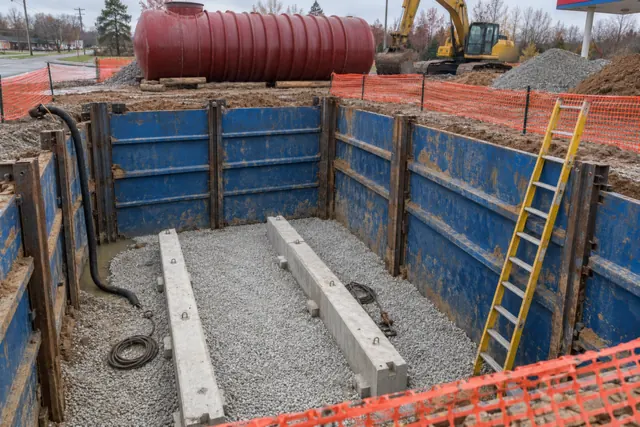
The installation process in Hawaii begins with Department of Health permit applications and site engineering, which typically take six to ten weeks. Volcanic rock and coral substrates slow excavation compared to mainland soil, so physical installation runs three to eight weeks depending on geology and project scope. After the tank is set, piping connected, and dispensers installed, the state requires tank tightness testing and leak detection system commissioning before fueling operations can begin. Owners on outer islands should confirm their contractor has mobilization experience for that island, since Oahu-based firms may quote competitive rates but add substantial travel surcharges. Request bids that itemize permitting, excavation, backfill, inter-island transport, testing, and state documentation separately so you can compare costs accurately across contractors.
Do I need a specially licensed contractor to install a UST in Hawaii?
Hawaii requires a Department of Health permit before a tank is installed, and the owner must certify the installation by one of the methods in HAR 11-280.1-20, such as an installer certified by the tank and piping manufacturers. This does not mean any general contractor can perform the work. UST installation requires specialized knowledge of tank setting, piping, leak detection, and regulatory documentation that general excavation firms typically lack. Ask your contractor for current certification from the tank and piping manufacturers before signing a contract.
How much does it cost to install an underground storage tank in Hawaii?
A single UST installation in Hawaii typically runs $75,000 to $175,000, which is 30 to 50 percent above mainland averages due to shipping, labor, and logistics. Full gas station build-outs with multiple tanks, dispensers, piping, and monitoring equipment range from $300,000 to $600,000 or more. Neighbor island projects add $15,000 to $40,000 in barge and mobilization fees on top of base costs. Monitoring equipment installation adds $7,000 to $18,000 per system. These figures assume no contamination from a previous tank is found during excavation, which would trigger additional remediation costs entirely at the owner's expense.
How long does a UST installation take in Hawaii?
Most commercial UST installations in Hawaii take 12 to 20 weeks from permit application to operational approval. Permitting and engineering require six to ten weeks. Physical installation runs three to eight weeks, with volcanic rock and coral substrates often extending timelines beyond mainland averages. State-required tightness testing and leak detection commissioning add one to two weeks. Neighbor island projects frequently take longer because equipment and crew mobilization depends on barge schedules that can shift due to weather or port congestion.
Why are tank installation costs so much higher in Hawaii than on the mainland?
Three factors drive Hawaii's premium: shipping, geology, and a limited contractor pool. Tanks, heavy excavation equipment, and construction materials must be shipped to the islands by ocean freight, adding thousands to project costs before any ground is broken. Volcanic basalt and coral substrates require specialized excavation methods that take longer and cost more than digging through mainland clay or sand. The small number of qualified UST installation contractors in Hawaii means less competitive pricing pressure than you would find in a mainland metro area. Outer island projects compound all three factors because inter-island barging adds another logistics layer.
What monitoring equipment is required for new UST installations in Hawaii?
Under HAR 11-280.1-41, tanks installed since August 9, 2013 must be checked by interstitial monitoring at least every thirty-one days, and pressurized piping also needs an automatic line leak detector. Hawaii's island environment and proximity to sensitive coastal ecosystems means the Department of Health pays close attention to release detection compliance during facility inspections. Monitoring equipment typically costs $7,000 to $18,000 per tank system in Hawaii, slightly above mainland pricing due to shipping and limited local suppliers. The equipment must be fully commissioned and tested before the state approves the facility for fueling operations. Treating monitoring as an afterthought during construction creates expensive retrofit problems that are far easier to avoid by specifying and installing the correct systems from the start.