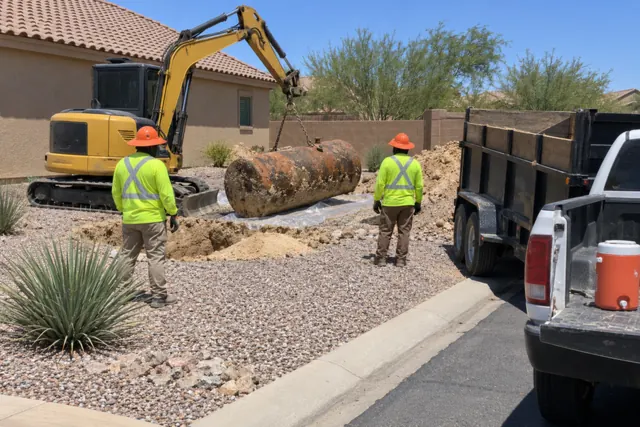
Find Tennessee contractors for oil tank removal, UST closure, UST decommissioning, commercial tank excavation, petroleum tank removal, gas station closures, and environmental remediation. Serving Nashville, Memphis, Knoxville, Chattanooga, Clarksville, Murfreesboro, and communities statewide.
How Tennessee Regulates UST Closure and the Tennessee Petroleum UST Fund
Tennessee oil tank removal runs under the TDEC UST Program. TDEC administers USTs under Tennessee Rule 0400-18-01 and federal 40 CFR 280 rules. Tennessee does not certify UST closure contractors. For commercial closure at gas stations, fleet yards, and industrial sites, the owner files a permanent closure application with a TDEC field office at least thirty days before work starts. Residential heating oil tanks are uncommon across Tennessee because natural gas and electric heating dominate, though legacy tanks occasionally surface in older Nashville, Memphis, and Knoxville neighborhoods during real estate transactions.
Tennessee tank removal work concentrates in Nashville, Memphis, Knoxville, and Chattanooga metros through gas stations, fleet yards, and industrial UST corridors along I-40, I-65, I-75, and I-24. Nashville anchors Middle Tennessee demand through music-industry fleet tanks and healthcare-corridor fueling. Memphis drives west Tennessee work through FedEx hub operations, port facilities, and I-40 gas station turnover. Knoxville cycles east Tennessee commercial tanks and Oak Ridge National Laboratory support fueling. Chattanooga sits at the junction of Tennessee Valley Authority fuel operations and I-24 corridor stations. Clarksville adds Fort Campbell military-support tank work. Smoky Mountains and Cumberland Plateau tourism gateways cycle seasonal fueling tanks.
Commercial UST closure at Tennessee gas stations typically runs $5,000 to $15,000 per tank. Residential heating oil tank removal in older Nashville, Memphis, or Knoxville neighborhoods runs $1,500 to $3,500. If soil sampling exceeds TDEC cleanup thresholds, soil remediation adds $10,000 to $50,000 or more, particularly in karst-influenced Middle Tennessee and Cumberland Plateau zones. The Tennessee Petroleum UST Fund reimburses eligible regulated-tank owners for corrective action costs after a deductible, aligned with the federal LUST Trust Fund program. Our tank removal cost guide breaks down pricing.
A typical Tennessee commercial closure starts with Tennessee 811 locates, TDEC notification, tank pumping, degassing, excavation, and soil sampling. A single-tank Nashville or Memphis closure wraps in two to three days. Multi-tank pulls stretch across a week. Soil laboratory turnaround runs seven to fourteen business days. Summer humidity and Middle Tennessee thunderstorms compress excavation windows. Before signing, confirm the contractor carries pollution liability insurance and can show a closure report from a comparable Nashville, Memphis, Knoxville, or Chattanooga job. View Tennessee UST contractors for local options, or request a quote for direct estimates.
Do I need a licensed contractor to remove an oil tank in Tennessee?
No state license applies. Tennessee Rule 0400-18-01 has no contractor certification for UST closure; the owner files a permanent closure application with TDEC at least thirty days ahead and reports closure sample results within sixty days of collection. The TDEC UST Program keeps a list of approved contractors only for cleanups that will seek Fund reimbursement. Residential heating oil tanks are uncommon in Tennessee, but Nashville, Memphis, Knoxville, and Chattanooga contractors that handle occasional removals routinely carry pollution liability insurance.
How much does oil tank removal cost in Tennessee?
Commercial UST closure at Tennessee gas stations typically runs $5,000 to $15,000 per tank. Residential heating oil tank removal in older Nashville, Memphis, or Knoxville neighborhoods runs $1,500 to $3,500. Contamination adds $10,000 to $50,000 or more, particularly in karst-influenced Middle Tennessee and Cumberland Plateau zones. Tennessee's Petroleum UST Fund may offset a portion for eligible regulated sites. See our cost guide.
How long does oil tank removal take in Tennessee?
A single-tank Nashville or Memphis commercial closure wraps in two to three days on site. Multi-tank pulls stretch across a week. Soil laboratory turnaround runs seven to fourteen business days. If sampling triggers TDEC cleanup review under 40 CFR 280, paperwork adds six to fourteen weeks. Summer thunderstorms in Middle Tennessee often compress summer excavation windows.
How does the Tennessee Petroleum UST Fund work?
The Tennessee Petroleum UST Fund reimburses eligible regulated-tank owners for a significant share of corrective action costs after a deductible, drawing on per-gallon petroleum assessments plus federal LUST Trust Fund allocations. Eligibility requires that TDEC had the tank registered before the release and that an Application for Fund Eligibility was filed within 60 days of the release, or 90 days after evidence of a suspected release later confirmed. Owners who expect reimbursement must also choose a contractor from TDEC's approved list. Nashville, Memphis, Knoxville, and Chattanooga contractors experienced in fund paperwork move claims faster.
Why does Middle Tennessee karst geology affect tank closures?
Middle Tennessee sits on karst limestone bedrock that contains sinkholes, losing streams, and underground fractures. Petroleum releases in karst terrain can travel along fractures faster than through homogeneous soil and surface in unexpected wells or springs downgradient. TDEC applies expanded soil and groundwater sampling in Nashville, Murfreesboro, Franklin, and Columbia karst zones. Contractors familiar with karst closure protocols handle sampling logistics and TDEC paperwork faster than contractors from West Tennessee flatlands.