Oil Tank Inspection & Testing Companies in Virginia
Find contractors in Virginia for tank tightness testing, leak detection, line testing, and UST compliance inspection. Serving Richmond, Norfolk, Virginia Beach, Roanoke, and communities statewide.
What to Know About Oil Tank Inspection & Testing in Virginia
Tank inspection and testing in Virginia follows strict VDEQ schedules. The Virginia DEQ UST Program enforces 9VAC25-580 technical standards, requiring active UST owners across Hampton Roads and Northern Virginia to test tank tightness, monitor lines, and verify cathodic protection on a fixed cadence. Operators must keep release-detection records for at least one year and provide them on request. A property changing hands often pulls inspection forward as part of a full Phase I environmental evaluation before financing closes. Virginia accepts third-party UST testers only when they hold the manufacturer-specific certifications listed in VDEQ guidance, so credential checks come before any pricing conversation.
Demand concentrates around Hampton Roads, Northern Virginia, and Richmond, where commercial fleet hubs and gas station density drive most testing work. Norfolk and Virginia Beach run heavy military and port-adjacent fueling infrastructure that triggers regular tightness testing, especially around naval supply lines. The I-95 corridor through Fredericksburg and Richmond hosts truck-stop UST clusters where line testing and leak detection happen on tight quarterly cycles. Alexandria and Arlington carry older urban tanks at retail fueling sites, while the Shenandoah Valley sees agricultural fueling stations that require integrity testing on aging single-wall systems. Roanoke and Lynchburg cover the southwest market, where regional carriers and fuel distributors coordinate compliance inspection runs across multiple sites in one trip.
Tightness testing in Virginia typically runs $500 to $1,200 per tank, while line testing adds $300 to $800 depending on system layout. A full UST compliance inspection covering tanks, lines, sumps, and overfill prevention generally falls between $1,000 and $3,000 per facility. Cathodic protection surveys on steel systems run $400 to $1,500, with costs rising when access is restricted or when shared piping links multiple tanks. Older retail stations in Norfolk or Richmond sit under canopies that complicate equipment staging and add hours to the visit. The Virginia Petroleum Storage Tank Fund administered by DEQ may reimburse eligible release-related corrective action costs once the deductible is met, though the fund does not cover routine compliance testing.
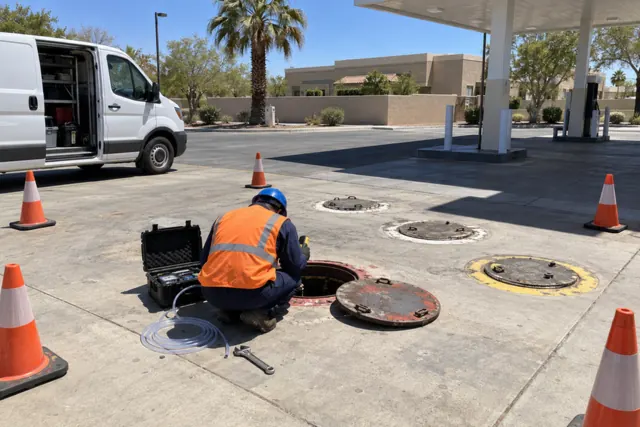
The typical Virginia inspection process starts with a site walk, then moves to tightness testing, line pressure testing, and a sump-sensor function check. Most single-site jobs in Richmond or Tidewater finish in one day, with the closure report and VDEQ-formatted documentation arriving within one to two weeks. Crews working on petroleum sites should hold current HAZWOPER training under 29 CFR 1910.120 because release-related work counts as hazardous waste operations. Before hiring, Virginia property owners should ask contractors to confirm manufacturer-specific test certifications, recent VDEQ submission history, and whether the inspection report will be uploaded directly through the VDEQ portal. Get the test method, calibration date, and report-delivery timeline in writing before scheduling the visit.
Virginia contractors for tank inspection and testing
Does Virginia require UST inspectors to hold a state license?
Virginia DEQ does not issue a state-level inspector license, but it does require that anyone performing tank tightness testing or leak detection use methods approved under 9VAC25-580 and hold current manufacturer certifications for the equipment in use. DEQ also expects inspectors to follow third-party evaluator protocols for testing methods listed on the state's accepted-methods sheet. Property owners should ask for proof of these certifications before scheduling any compliance work. Hiring an uncertified tester voids the test result for DEQ submission purposes.
How much does tank tightness testing cost in Virginia?
Standard volumetric tightness testing on a single tank in Virginia generally runs $500 to $1,200, with most retail commercial sites in Richmond or Norfolk landing around the middle of that range. Line testing adds $300 to $800 per dispenser circuit, and a full compliance inspection package covering tanks, lines, sumps, and overfill components typically falls between $1,000 and $3,000. Multi-tank facilities often qualify for bundled pricing because the crew is already on site. Always confirm whether the quote includes the DEQ-formatted closure report or if that is billed separately.
How often does Virginia require UST tightness testing?
Virginia follows the federal baseline established under 40 CFR 280 and codified at 9VAC25-580. The rule requires monthly release detection on most active UST systems and annual line tightness testing on pressurized piping that does not have continuous in-line leak detectors. Cathodic protection on steel tanks must be tested at installation and then every three years. Sump and overfill prevention equipment now requires three-year functionality testing. Operators should keep records on site for at least one year and produce them within five business days if DEQ asks.
What is the Virginia Petroleum Storage Tank Fund and does it apply to inspection costs?
The Virginia Petroleum Storage Tank Fund is a state cleanup financial mechanism administered by Virginia DEQ that reimburses eligible release-related corrective action costs once the operator meets the per-occurrence deductible. The fund applies to costs tied to a confirmed release, not to routine tightness testing or scheduled compliance inspections. If a leak is confirmed during testing, related investigation, soil sampling, and remediation costs may qualify. Eligibility depends on registration status, compliance history, and timely reporting through the DEQ release-reporting hotline. Contractors familiar with the fund often help with the application paperwork.
What happens during a UST compliance inspection in Virginia?
A typical inspection starts with a documentation review covering registration, release-detection records, and operator training certificates. The contractor then physically inspects spill buckets, overfill prevention devices, sumps, and cathodic protection components, followed by tank tightness testing and line pressure testing. Sensor function tests confirm that leak-detection electronics are calibrated and reporting correctly. The inspector compiles findings into a DEQ-formatted report, which is usually delivered within one to two weeks. If deficiencies are found, the report flags them with corrective deadlines that the operator must meet to stay in compliance.