Tank Installation Contractors in New Hampshire

Find contractors in New Hampshire for underground storage tank installation, fuel tank replacement, gas station tank installation, dispenser installation, piping installation, and monitoring equipment setup. Serving Manchester, Nashua, Concord, Portsmouth, Dover, and communities statewide.

Browse New Hampshire Contractors →

Tank Installation Costs, Permits, and Timelines in New Hampshire

Every tank installation in New Hampshire runs through the state's environmental permitting program. The state does not issue a UST-specific contractor license, but installers must meet federal EPA worker safety certification under 40 CFR 280 and secure local permits before breaking ground. Gas stations, convenience stores, fleet fueling depots, and fuel distributors all fall under these rules. The state environmental agency reviews installation plans, inspects completed systems, and can shut down projects that skip permitting or use contractors who lack proper federal installer credentials.

Fuel tank installation demand in New Hampshire concentrates along the I-93 corridor from Manchester through Concord and into the Lakes Region. Tourism traffic in that corridor supports a dense network of gas stations and convenience stores. Nashua and the southern border towns near Massachusetts see steady commercial development as population growth spills north from the Boston metro area.

Portsmouth and Dover along the Seacoast drive demand from both retail fueling and marine-adjacent fuel distribution. Rochester and Keene represent smaller but active secondary markets tied to regional trucking routes. New Hampshire's mix of year-round commuter traffic and heavy seasonal tourism creates a fueling infrastructure that operates at peak capacity during summer and fall foliage months. Station owners often expand or replace aging tank systems before the summer and foliage rush to avoid downtime during their busiest revenue periods.

A single underground storage tank installation in New Hampshire typically costs $60,000 to $160,000, reflecting the state's higher labor and material costs compared to southern or midwestern markets. Multi-tank gas station build-outs with dispensers, canopy structures, and piping run $275,000 to $525,000 or more depending on site complexity, with monitoring equipment adding $5,000 to $15,000 per system. Granite bedrock, common across much of central and northern New Hampshire, can increase excavation costs by 15 to 30 percent when blasting or specialized rock-cutting equipment is needed.

The state cleanup fund uses a scaled deductible based on how many facilities an owner operates. Deductibles start at $5,000 for one to three sites, rise to $10,000 for four to nine, and reach $20,000 or more for larger portfolios. That fund may reimburse eligible remediation costs if contamination from a previous tank is found during replacement work.

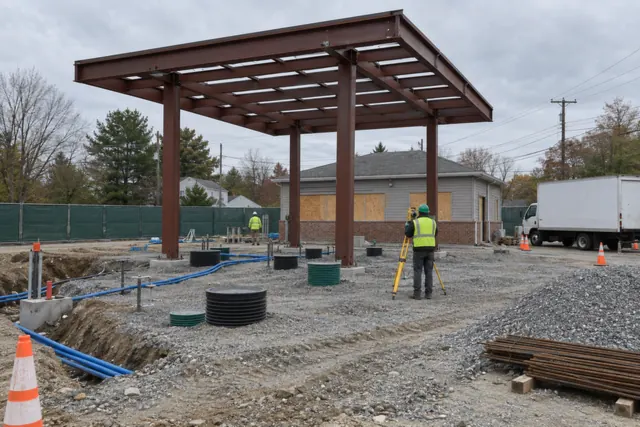
Installation projects in New Hampshire follow a sequence that starts with engineering design and permit submissions, typically requiring six to ten weeks before ground breaks. The state's freeze-thaw cycle limits practical excavation to roughly April through November. Physical installation, covering excavation, tank setting, piping, backfill, and dispenser work, takes three to seven weeks depending on tank count.

After construction, the state requires tightness testing, leak detection commissioning, and registration before fueling operations can begin. Owners replacing old single-wall tanks should plan for soil sampling beneath the existing tank footprint, because contamination found at that stage can pause the entire project. Request bids from at least two qualified contractors and verify each quote covers permitting, excavation, testing, backfill, and state documentation rather than just equipment and labor.

Tank Installation Contractors in New Hampshire

Browse contractors, see contact details, and request free quotes.

Browse New Hampshire Contractors →

Frequently Asked Questions

Does New Hampshire require a specific license to install underground storage tanks?

New Hampshire does not have a state-issued UST contractor license, but installers must meet federal EPA certification requirements under 40 CFR 280 and comply with state environmental services permitting rules. The state reviews installation plans, conducts inspections, and enforces compliance through its own regulatory program. Contractors also need local building and fire permits depending on the municipality. Before hiring, confirm your contractor holds current federal installer certification and has completed permitted UST projects in New Hampshire.

How much does a new UST installation cost in New Hampshire?

A single tank installation in New Hampshire typically runs $60,000 to $160,000 depending on tank size, material, and site conditions. Full gas station build-outs with multiple tanks, dispensers, piping, and monitoring systems range from $275,000 to $525,000 or more. Sites with granite bedrock can see excavation costs jump 15 to 30 percent due to blasting or rock-cutting requirements. Monitoring equipment adds $5,000 to $15,000 per system. These numbers include standard permitting and testing but do not cover remediation if soil contamination from a prior tank is discovered.

How long does a tank installation project take in New Hampshire?

Most commercial UST installations in New Hampshire take 12 to 18 weeks from permit application through operational approval. Engineering and permitting account for six to ten weeks of that timeline. Physical installation runs three to seven weeks depending on the number of tanks and site complexity. Frozen ground conditions between December and March can make winter excavation impractical or significantly more expensive across most of the state. Projects that uncover contamination during excavation of a previous tank can add months to the schedule while remediation is completed.

How does New Hampshire's granite bedrock affect tank installation projects?

Granite bedrock is common across central and northern New Hampshire and poses a real cost factor for underground tank installation. Excavation in bedrock areas often requires hydraulic rock hammering or controlled blasting, adding 15 to 30 percent to base excavation costs. Site engineering surveys should identify bedrock depth before bidding so contractors can price accurately. Shallow bedrock may also limit tank depth options, which affects piping grades and dispenser layout. Not every site has this problem, so a geotechnical survey before committing to a specific property can save tens of thousands of dollars.

What monitoring systems are required for new UST installations in New Hampshire?

New underground storage tanks in New Hampshire must include automatic tank gauging, line leak detectors, and interstitial monitoring for double-wall tank systems, consistent with EPA's 2015 updated UST regulations. Monitoring equipment typically costs $5,000 to $15,000 per system to install and commission. The state requires all monitoring to be operational and tested before granting approval for fueling operations. Skipping or delaying monitoring setup is not an option. Owners who treat monitoring as a final add-on rather than an integrated part of the installation often face rework costs when systems need to be reconfigured after construction is complete.

Looking for a contractor in New Hampshire?

Browse contractors, see contact details, and request free quotes.

Browse New Hampshire Contractors →

For New Hampshire UST regulations, visit the NH DES Underground Storage Tanks. Federal requirements are available from the EPA UST Program.

Related Services in New Hampshire

Find New Hampshire ContractorsRequest a Free Quote
Free Quotes