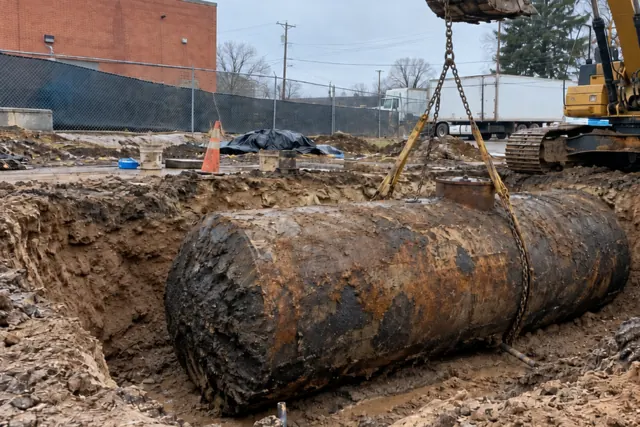
Find New Hampshire contractors for oil tank removal, UST closure, tank decommissioning, heating oil tank removal, basement tank excavation, petroleum tank removal, Seacoast tank work, and environmental remediation. Serving Manchester, Nashua, Concord, Portsmouth, Dover, Rochester, Keene, Laconia, and communities statewide.
Oil Tank Closure Under New Hampshire DES and the ODD Fund
New Hampshire's heating oil density ranks among the highest in the country. Most of the state's underground heating oil tanks date from the 1950s through 1980s, installed before natural gas service reached much of the interior. Manchester, Nashua, and Concord drive the bulk of oil tank removal work from older housing stock in the Merrimack Valley. The Seacoast around Portsmouth, Dover, and Exeter generates consistent removal work tied to one of the state's most active real estate markets. North Country and Lakes Region communities around Laconia, Wolfeboro, and Plymouth handle seasonal tank work at vacation homes and year-round residences with aging inventory.
Residential heating oil tank removal in New Hampshire typically runs $1,500 to $3,500 for a yard burial and $2,500 to $5,000 for basement tanks where equipment must pass through doorways. Commercial UST removal at gas stations or fuel depots ranges from $5,000 to $30,000 per tank depending on tank size and site access. If soil testing reveals petroleum contamination, petroleum cleanup adds $10,000 to $50,000 or more depending on plume size and groundwater proximity. The New Hampshire Oil Discharge and Disposal Cleanup Fund uses scaled deductibles starting at $5,000 for owners with one to three facilities. Deductibles rise to $30,000 for operators with twenty or more sites, and our cost guide breaks down pricing in detail.
New Hampshire regulates underground storage tank closure through the New Hampshire Department of Environmental Services. For a regulated UST, NHDES requires advance notification before tank removal, soil sampling at the excavation, and a closure report filed within required timeframes. Freeze-thaw cycles across New Hampshire winters accelerate corrosion on aging steel tanks, making delayed removal a riskier bet than in milder climates. Commercial UST work must follow federal 40 CFR 280 standards and NHDES-specific closure procedures. Residential heating oil tanks sit outside the regulated federal UST universe. New Hampshire's UST rules also exclude any tank used solely to heat a residential building under Env-Or 401.03, so NHDES requires no closure filing or soil testing for them.
A New Hampshire residential removal starts with utility locates and scheduled tank cleaning before one to three days of yard-site excavation. Basement tanks often extend to three to four days because pieces must pass through interior access, and soil sample lab results return in one to three weeks. Before hiring, confirm the contractor carries pollution liability insurance, Manchester or Seacoast project references, and familiarity with NH ODD Fund eligibility paperwork. Contractors active in your area are listed under tank contractors in New Hampshire, and you can get a free quote for direct pricing.
How much does oil tank removal cost in New Hampshire?
Residential heating oil tank removal typically costs $1,500 to $3,500 in New Hampshire when no contamination is found. Basement tanks run $2,500 to $5,000 due to access constraints. Commercial UST removal at gas stations ranges from $5,000 to $30,000 per tank. If contamination is found, remediation costs add $10,000 to $50,000 or more depending on plume size. Our cost guide breaks down pricing by tank type, contamination scenario, and NH regional drivers.
Does New Hampshire have a cleanup fund for petroleum tank contamination?
New Hampshire operates the Oil Discharge and Disposal Cleanup Fund through NHDES, funded by a per-gallon motor fuel fee. The fund uses scaled deductibles based on facility count: owners with one to three facilities pay a $5,000 deductible, while operators with twenty or more face $30,000. Eligibility requires NHDES tank registration and compliance at the time of discovery. Asking your contractor about ODD Fund eligibility before work begins saves paperwork time if contamination surfaces.
How long does a tank closure take in New Hampshire?
The physical removal of a residential tank usually takes one to two days, assuming reasonable access and unfrozen ground. Winter removals from December through March can be delayed by frost penetration that requires ground-thawing equipment. Soil sample lab results return in one to three weeks after collection. Contaminated sites extend the timeline significantly, stretching to six months or longer depending on plume size and remediation approach.
How does New Hampshire's climate affect oil tank removal timing?
Frozen ground from December through March can delay or complicate excavation, especially at North Country sites where frost depths exceed four feet. Contractors sometimes use ground-thawing blankets to extend the working season, adding cost to the project. Freeze-thaw cycles over decades accelerate external corrosion on aging steel tanks, which is why NHDES recommends proactive removal for tanks past their 20- to 30-year service life. Spring and summer are the most efficient seasons, and schedules fill quickly once the ground thaws across the state.
Do I need a licensed contractor for tank removal in New Hampshire?
NHDES requires a certified tank remover to supervise the closure of a regulated UST, but Env-Or 401.03 excludes any tank used solely to heat a residential building, so those state closure rules do not reach a home heating oil tank. Contractors must carry general liability insurance and should also hold pollution liability coverage, since standard policies exclude petroleum-related claims. Verify that any contractor you hire has direct experience with New Hampshire residential heating oil tanks, not just commercial UST work. The two involve different site conditions, equipment needs, and regulatory steps under NHDES rules.