Find contractors in Idaho for underground storage tank installation, fuel system installation, dispenser installation, and piping upgrades. Serving Boise, Nampa, Idaho Falls, Pocatello, Twin Falls, and communities statewide.
Tank Installation in Idaho: Permitting, Basalt, and What to Budget
Southern Idaho's I-84 corridor drives most tank installation activity in the state. Boise and the surrounding Treasure Valley communities of Nampa and Meridian account for the largest share of projects, pushed by population growth and commercial expansion. Idaho Falls and Pocatello anchor the eastern region with installations serving agricultural cooperatives, truck stops along I-15, and regional fuel distribution. Twin Falls supports steady demand tied to food processing and dairy in the Magic Valley, while Coeur d'Alene in northern Idaho sees occasional installations for recreational and tourism-related fueling operations. Agricultural fueling infrastructure across rural Idaho, from grain elevators to equipment yards, generates a baseline of replacement and new installation work that keeps contractors occupied year-round.
Federal standards, not a state licensing program, govern tank installation work in Idaho. The state environmental agency oversees underground storage tank notification and compliance but does not issue a separate UST installer credential. Idaho adopts the federal technical standards in 40 CFR 280 for tank placement, piping, and release detection, and its own rule, IDAPA 58.01.07, requires secondary containment only within one thousand feet of a drinking water well or public water system. The owner must give Idaho DEQ written notice thirty days before installing a new tank or piping system, and Idaho issues no state installation permit or operating certificate. Because Idaho lacks a dedicated installer license, verifying a contractor's compliance history and insurance coverage falls on the buyer rather than something the state screens for you.
A single underground storage tank installation in Idaho typically runs $50,000 to $140,000, depending on tank capacity, material, and site access. Multi-tank gas station build-outs with dispensers, canopy structures, and monitoring systems range from $225,000 to $475,000. Volcanic basalt formations in parts of the Snake River Plain can increase excavation costs by $2,000 to $6,000 when rock cutting equipment is needed. Monitoring equipment including automatic tank gauging, leak detection, and spill prevention adds $5,000 to $15,000 to the project total. Idaho does not operate a state reimbursement fund, so all project expenses including permitting fees that typically run $1,000 to $3,500 fall directly on the facility owner.
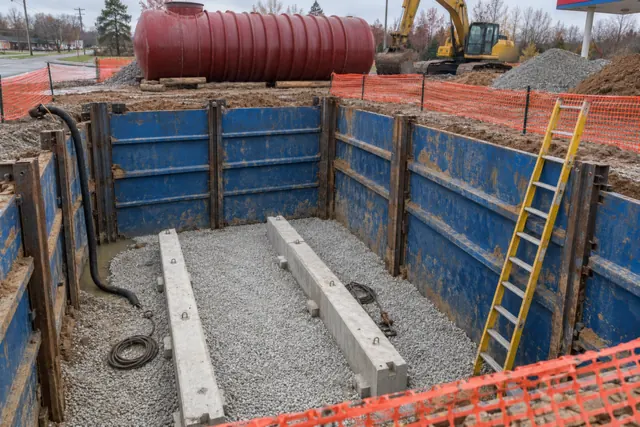
New installations begin with site engineering that includes geotechnical borings, utility location surveys, and a site plan submitted to the local fire marshal and state environmental agency. Permit review takes three to six weeks in most Idaho jurisdictions, and physical construction for a standard two-tank system runs two to four weeks from excavation through final dispenser connection. After installation, the owner certifies on the DEQ notification form that the work meets one of the methods in 40 CFR 280.20(e), such as a manufacturer-certified installer or an engineer's inspection. Do not assume soil conditions are uniform across the site. Request a geotechnical report before finalizing your budget, confirm the installer carries pollution liability insurance, and verify at least two completed Idaho installations in the past three years.
Does Idaho require a specific license to install underground storage tanks?
Idaho does not issue a state-specific UST installer license or certification. Owners must meet the federal technical standards in 40 CFR 280 as adopted by IDAPA 58.01.07, and Idaho requires secondary containment only within one thousand feet of a drinking water well or public water system. The state environmental agency receives installation notices and conducts inspections but does not maintain a pre-approved installer list. This means the responsibility for verifying contractor qualifications falls entirely on the facility owner. Check that your installer has documented experience with the specific tank type and fuel system configuration you need, and confirm they carry environmental liability insurance before any work begins.
How much does a new UST installation cost in Idaho?
A single tank installation in Idaho typically costs $50,000 to $140,000 depending on tank size, material, and site conditions. A complete multi-tank gas station build-out with dispensers and monitoring equipment runs $225,000 to $475,000. Basalt rock formations in parts of southern Idaho can add $2,000 to $6,000 in excavation costs that standard bids may not account for. Monitoring and leak detection equipment adds another $5,000 to $15,000 regardless of tank configuration. Request itemized bids that separate excavation, tank supply, piping, electrical, and monitoring so you can compare proposals on equal terms.
How long does it take to install a UST system in Idaho?
The full project timeline from initial engineering through fuel delivery typically spans three to five months in Idaho. Permitting takes three to six weeks depending on the local jurisdiction and how complete the application package is at submission. Physical construction for a two-tank system with dispensers runs two to four weeks from excavation start to final connections. Post-installation tightness testing adds one to two weeks before the system goes into service. Projects in northern Idaho that start late in the fall risk weather delays from frozen ground, so plan construction timing to wrap up before December.
How does Idaho's volcanic basalt affect tank installation projects?
Parts of southern Idaho along the Snake River Plain sit on layers of volcanic basalt formed from ancient lava flows. Standard backhoe excavation cannot cut through solid basalt efficiently, so contractors bring in hydraulic breakers or rock saws that add $2,000 to $6,000 to site preparation. Not every site in the region hits basalt at tank depth, which is why a geotechnical boring before finalizing your bid package is worth the $500 to $1,500 investment. The basalt also affects backfill requirements because fractured rock does not compact the same way as native soil around a tank. Your engineer should specify pea gravel or sand backfill if basalt is present at excavation depth.
What monitoring equipment is required on new UST systems in Idaho?
New UST systems in Idaho need spill and overfill prevention and a release detection method, and secondary containment with interstitial monitoring is required only within one thousand feet of a public water system or drinking water well. Pressurized piping runs require automatic line leak detectors that meet the federal detection standard for pressurized piping under 40 CFR 280.44. The monitoring console must provide audible or visual alarms for any detected anomaly in the interstitial space or piping system. Budget $5,000 to $15,000 for the complete monitoring package depending on the number of tanks and dispenser lines. The system must be fully operational before it goes into service, so a failed initial test means delays and costly re-work.