

What to Know About Tank Decommissioning in Minnesota
The Minnesota Pollution Control Agency (MPCA) sets the closure rules for underground storage tanks in Minnesota Rules chapter 7150. Which tank you own decides how much of that chapter applies. A tank of 1,100 gallons or less used only to store heating oil burned on the premises where it is stored is exempt by statute under Minn. Stat. 116.47, whether the premises is a house or a business. For those tanks MPCA requires no notice, no certified contractor and no site assessment, though the State Fire Code still applies. A tank that also fuels an emergency generator is fully regulated. Gas station tanks, fleet fueling tanks and other regulated USTs get the full closure process. A heating oil tank larger than 1,100 gallons sits in between: it needs an MPCA-certified contractor and both MPCA notices, but no technical closure standard.
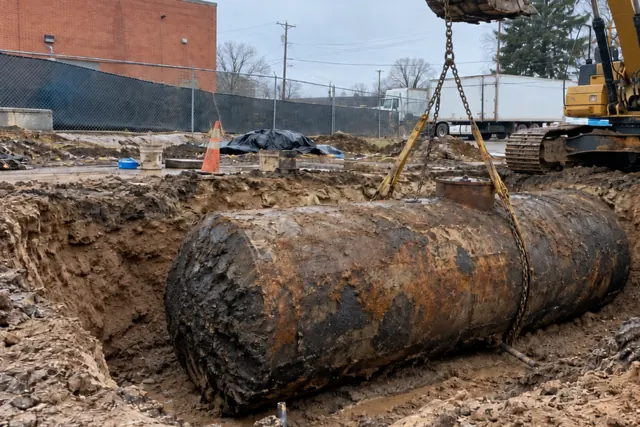
Tank closure for a regulated UST in Minnesota follows a fixed order. The owner sends MPCA a ten-day advance notice before work starts, and sends it again if the date moves by more than 48 hours. An MPCA-certified contractor does the work, with a supervisor certified for closure physically present at all critical junctures. The tank is emptied and cleaned, then removed or closed in place. Minn. R. 7150.0410 requires a tank closed in place to be completely filled with an inert solid material, free of voids, and MPCA's closure fact sheet says the local fire chief must also approve it. Before the tank closure is complete, the site is tested by laboratory analysis for a release. Within 30 days of finishing, the owner reports the tank as Removed or Closed-in-Place on MPCA's UST notification form.
Minnesota's Petrofund pays for cleanup after a release, not for routine tank removal. The Petroleum Tank Release Compensation Board oversees it and Department of Commerce staff process the applications, while MPCA must approve the cleanup work before anything is reimbursed. Under Minn. Stat. 115C.09 the board reimburses an eligible applicant 90 percent of eligible corrective action costs, with no more than $2,000,000 paid for a single release. Removing a tank qualifies only when the removal is part of a corrective action that MPCA directs or approves. MPCA's heating oil fact sheet states that both commercial and residential heating oil tanks are eligible, even though the smaller ones are exempt from its tank rules. Our guide to closure in place versus UST removal explains what changes the scope of a job.
Cities can add their own step. Minneapolis issues separate permits to remove or abandon a storage tank, including tanks holding heating fuel oil, and asks for 48 hours' notice before work starts, so ask your city before scheduling. Minn. R. 7150.0450 requires closure and site assessment records for a regulated tank to be kept for at least three years after the work. If sampling finds contamination, the rules require an immediate call to the Minnesota Duty Officer at 1-800-422-0798, and corrective action must begin. MPCA links its certified contractor list from its underground storage tank program page. For a regulated tank, the rules require the contractor to give the owner copies of the company's and the supervisor's current MPCA certificates before closure work begins. Before hiring any contractor listed on this page, ask for both and check that the company appears on MPCA's list for closure.