
Oil Tank Removal Contractors in Arizona

Find Arizona contractors for oil tank removal, UST closure, UST decommissioning, commercial tank excavation, petroleum tank removal, and environmental remediation. Serving Phoenix, Tucson, Mesa, Flagstaff, Scottsdale, Tempe, Chandler, and communities statewide.

Browse Arizona Contractors →

How Arizona Regulates UST Closure and the State Assurance Fund

Arizona oil tank removal runs through the ADEQ Underground Storage Tank program. ADEQ licenses tank service providers and administers closure under Arizona Revised Statutes Title 49 Chapter 6 and federal 40 CFR 280 rules. Commercial UST closure at gas stations, fleet yards, and industrial sites requires an ADEQ-certified UST service provider. Residential heating oil tanks are rare in Arizona because natural gas and electric heating dominate, though occasional legacy tanks surface during older Phoenix, Tucson, or Flagstaff property transactions.
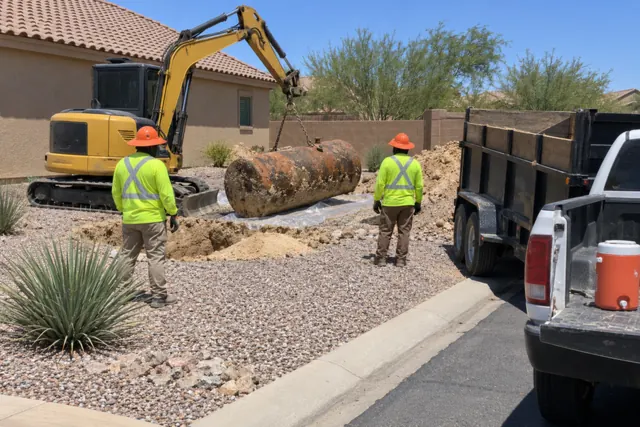
Arizona tank removal work concentrates in the Phoenix metro, including Mesa, Tempe, Chandler, and Scottsdale commercial corridors along I-10 and Loop 101. Tucson anchors southern Arizona demand through gas stations, copper mine fuel systems, and Davis-Monthan Air Force Base support contractors. Flagstaff and northern Arizona cycle high-desert commercial fleet tanks, and Yuma adds agricultural fuel storage at Imperial Valley-adjacent operations. Border-town fueling at Nogales, Douglas, and San Luis sees steady turnover. Sonoran Desert caliche soils slow excavation compared to softer alluvial sites, and Verde Valley and Mogollon Rim high-elevation sites face seasonal access constraints during monsoon runoff.

Commercial UST closure at Arizona gas stations typically runs $5,000 to $18,000 per tank depending on piping complexity and pit size. Residential heating oil tank removal, when it arises, runs $1,500 to $3,500 in older Phoenix, Tucson, or Flagstaff neighborhoods. If soil sampling exceeds ADEQ cleanup thresholds, environmental remediation adds $5,000 to $30,000 or more, particularly where shallow Sonoran Desert hardpan slows excavation. Arizona's State Assurance Fund reimburses eligible regulated-tank owners for corrective action costs after a deductible, aligned with the federal LUST Trust Fund program. Our cost guide breaks down pricing by tank size, soil condition, and site access.

A typical Arizona commercial closure starts with Arizona 811 locates, ADEQ notification, tank pumping and degassing, excavation, visual inspection, and soil sampling. A single-tank Phoenix metro closure wraps in two to three days, with multi-tank gas station pulls stretching across a week. Soil laboratory turnaround runs five to ten business days. Summer Phoenix heat routinely drives work into dawn and dusk windows when pavement temperatures stay workable. Before signing, verify the contractor holds an active ADEQ UST service provider license, carries pollution liability insurance, and can show a closure report from a comparable Phoenix, Tucson, or Flagstaff job. Ready to start? Arizona tank removal contractors or submit your quote request from professionals in your area.

Oil Tank Removal Contractors in Arizona

Browse contractors, see contact details, and request free quotes.

Browse Arizona Contractors →

Frequently Asked Questions

Do I need a licensed contractor to remove an oil tank in Arizona?

Commercial UST closure in Arizona requires an ADEQ-certified UST service provider under ARS Title 49 Chapter 6 and federal 40 CFR 280 rules. The ADEQ UST program maintains the certified-contractor list. Residential heating oil tanks fall outside the formal certification requirement, but any confirmed petroleum release still triggers ADEQ reporting. Phoenix, Tucson, and Flagstaff contractors that handle residential removals typically carry pollution liability insurance and ADEQ credentials.

How much does oil tank removal cost in Arizona?

Commercial UST closure at Arizona gas stations runs $5,000 to $18,000 per tank. The rare residential heating oil removal in older Phoenix, Tucson, or Flagstaff neighborhoods runs $1,500 to $3,500. Contamination adds $5,000 to $30,000 or more. Arizona's State Assurance Fund may offset a portion for eligible regulated sites. See our cost guide for pricing by tank size, soil condition, and site access.

How long does oil tank removal take in Arizona?

A single-tank Phoenix metro commercial closure wraps in two to three days on site, with soil laboratory results returning in five to ten business days. Multi-tank gas station pulls stretch across a week. If sampling triggers ADEQ cleanup review under 40 CFR 280, paperwork adds six to fourteen weeks. Summer Phoenix heat often compresses crews into dawn and dusk windows.

How does Arizona's State Assurance Fund work?

Arizona's State Assurance Fund, administered through ADEQ, reimburses eligible regulated-tank owners for a significant share of corrective action costs after a deductible keyed to compliance status. Tank owners must be current on registration and fund fees, and all work must be performed by ADEQ-certified service providers. Claim processing runs many months. Phoenix and Tucson contractors experienced in fund paperwork move claims faster than first-time applicants.

Do I need to remove a buried oil tank before selling an Arizona home?

Residential buried heating oil tanks are uncommon in Arizona, but when they surface during a Phoenix, Tucson, or Flagstaff real estate sale, buyers and lenders routinely treat them as a closing-blocker. Most sellers complete a tank closure, pass soil sampling, and hand buyers a clean closure report before listing. Waiting for a buyer's inspection to surface an unknown tank usually forces a rushed job or a price concession.

Looking for a contractor in Arizona?

Browse contractors, see contact details, and request free quotes.

Browse Arizona Contractors →

For Arizona UST regulations, visit the ADEQ UST Program. Federal requirements are available from the EPA UST Program.

Related Services in Arizona

Find Arizona ContractorsRequest a Free Quote
Free Quotes