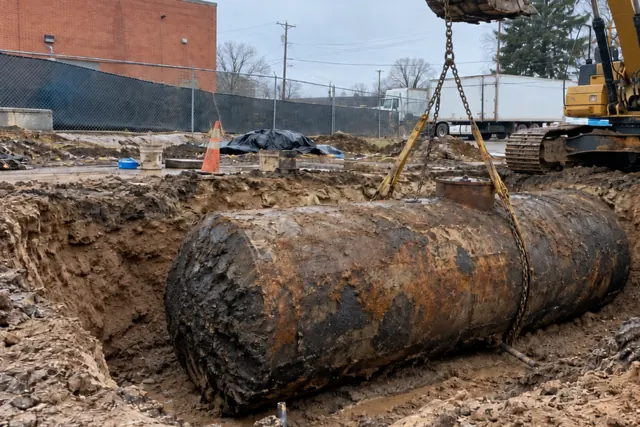
Tank Decommissioning & Closure Companies in Arizona
Licensed contractors for oil tank decommissioning, underground storage tank closure, fuel tank decommissioning, closure-in-place, soil contamination testing, and environmental remediation across Phoenix, Tucson, Mesa, Flagstaff, Yuma, and Prescott.
What to Know About Tank Decommissioning & Closure in Arizona
Oil tank decommissioning in Arizona is a commercial affair. Gas stations along the I-10 and I-40 corridors, truck
stops serving cross-country freight, mining operations scattered across the southern desert, military
installations. There is no meaningful residential heating oil market here because Arizona's climate never demanded
it. If you are closing an underground oil tank in this state, it is almost certainly tied to a commercial or
industrial property going through a use change, a facility upgrade, or a compliance deadline.
Phoenix and Tucson generate the most fuel tank decommissioning volume by far, but Mesa, Flagstaff, Yuma, and the
Prescott area see regular activity too. Arizona's licensing works differently from most states. The state
certifies individuals, not companies, so the person supervising your tank closure holds the credential directly.
That distinction matters when you are vetting contractors. Closure-in-place is straightforward in Arizona's dry,
rocky terrain, though caliche hardpan below the surface can complicate both excavation and soil sampling.
Experienced Arizona contractors know where the caliche layer sits in different parts of the Valley and plan around
it. Oil tank removal is common here too, especially for older gas station sites where the property is being
redeveloped and the new use requires a clean subsurface.
Oil tank decommissioning cost in Arizona falls in the middle range nationally. Closure-in-place for a standard
commercial underground oil tank runs $1,500 to $4,000. Full removal is $3,500 to $10,000 depending on tank size,
depth, and whether the caliche layer is involved. Soil sampling is $400 to $1,500. Where Arizona costs diverge
from other states is water. Groundwater contamination from a leaking underground storage tank triggers a more
aggressive response because aquifer protection is critical in a desert state. Environmental remediation involving
groundwater can reach $20,000 to $80,000 or more. Oil tank disposal after removal is relatively simple since
several licensed facilities in the Phoenix metro area accept decommissioned tanks.
The 30-day federal closure notification applies in Arizona just like everywhere else. The state environmental
program has its own reporting requirements on top of that, and the timeline depends partly on whether soil
contamination is found during sampling. Arizona does not operate a state cleanup trust fund the way Alabama or
Minnesota does, so tank owners bear the full cost of environmental remediation if contamination is discovered.
That makes pre-closure planning more important here. An environmental remediation contractor who understands
Arizona's groundwater sensitivity and the state's soil contamination reporting thresholds can help you avoid
surprises. UST compliance documentation should be retained permanently. Tank decommissioning records follow the
property, not the owner, and future buyers will expect a complete file.
What is the difference between oil tank decommissioning and oil tank removal in Arizona?
Think of decommissioning as the umbrella. Oil tank decommissioning is the full regulatory process for
permanently closing a tank: cleaning, notification, soil sampling, documentation. Oil tank removal is one way to
finish that process by physically digging the tank out. Closure-in-place is the other way, where the tank stays
underground after being cleaned and filled with sand or concrete. Arizona allows both. The choice depends on the
site, the budget, and whether the property is being redeveloped.
How much does oil tank decommissioning cost in Arizona?
The baseline is manageable. Closure-in-place runs $1,500 to $4,000 for a standard commercial tank. Full removal
is $3,500 to $10,000, with caliche hardpan being the variable that pushes costs toward the high end. Soil
sampling adds $400 to $1,500. Contamination changes everything. Arizona has no state cleanup trust fund, so if a
leaking underground storage tank has contaminated soil or groundwater, you are paying the full environmental
remediation bill yourself. Groundwater cases in the Phoenix area have reached $80,000 or more.
Can an oil tank be decommissioned in place in Arizona?
Yes. The tank is drained, cleaned, and cut open for inspection, then filled with sand, concrete slurry, or
another approved inert material. Soil samples get collected from the area around the tank to confirm nothing has
leaked. Arizona's dry conditions actually favor closure-in-place in some respects because less groundwater means
less contamination migration risk. The complication is caliche. That calcium carbonate layer sitting a few feet
below the surface in much of the Phoenix metro can make both the fill process and the soil sampling more
difficult than expected. A contractor who has worked Arizona sites before will know how to handle it.
Why does groundwater contamination matter more in Arizona?
Scarcity. Arizona's aquifers supply drinking water for millions of people, and the state treats any threat to
that supply aggressively. Soil contamination from a leaking tank that reaches the water table triggers a much
more intensive and expensive cleanup than contamination that stays in the upper soil layer. The state
environmental program monitors groundwater quality closely, and oil tank decommissioning sites near wellheads or
recharge zones face additional sampling requirements. This is the main reason pre-closure site assessments in
Arizona should always evaluate how deep contamination may have traveled, not just whether the surface soil is
clean.
What documentation is required after tank decommissioning in Arizona?
The full package. Advance closure notification to the state, the closure assessment report, all soil and
groundwater sampling lab results, confirmation of oil tank disposal or fill certification for closure-in-place,
and your environmental remediation contractor's final summary. Since Arizona has no cleanup trust fund, there is
no reimbursement paperwork to worry about, but that also means you cannot recover costs later if you skip steps
now. UST compliance records should be kept indefinitely. Lenders and buyers in Arizona real estate transactions
regularly ask for tank closure documentation, especially on commercial properties along the I-10 and I-17
corridors where gas stations have turned over multiple times.