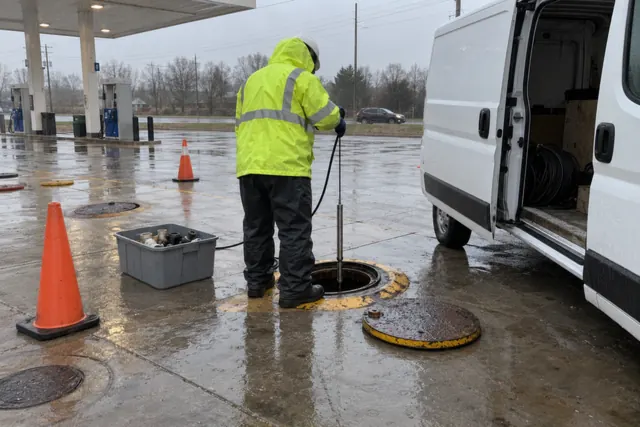
Find licensed contractors in Alaska for oil tank inspection, underground storage tank testing, tank tightness testing, leak detection, and UST compliance assessments. Serving Anchorage, Fairbanks, Juneau, Wasilla, Kenai, Palmer, and communities statewide.
What to Know About Oil Tank Inspection & Testing in Alaska
Alaska requires state certification for contractors performing underground storage tank inspection, testing,
installation, and removal. The state environmental program oversees all regulated UST work, and contractors must
hold valid credentials before conducting oil tank inspection or tank tightness testing on regulated underground
storage tanks. In Anchorage and Fairbanks, that testing starts around $1,000 per tank. Inspection is particularly critical in Alaska because many tanks serve as essential fuel
infrastructure in communities that depend entirely on stored petroleum for heating, transportation, and power
generation. A failed tank in a remote village is not just an environmental problem. It can be a survival problem,
which is why the state takes oil tank inspection compliance seriously even in the most difficult-to-reach
locations.
Oil tank inspection demand in Alaska is concentrated in the Anchorage, Fairbanks, and Juneau metropolitan areas,
but extends well beyond the road system into rural communities accessible only by air or barge. The Kenai
Peninsula has significant fueling infrastructure tied to the oil and gas industry, fishing operations, and
tourism. Fairbanks and the Interior face extreme temperature swings that stress underground oil tank systems
through repeated freeze-thaw cycles, accelerating joint failures and corrosion in ways that warmer states never
deal with. Along the Railbelt corridor between Anchorage and Fairbanks, truck stops, military installations, and
fuel distribution terminals all require periodic underground storage tank inspection and testing. Alaska's
residential heating oil market is larger than most people expect, with fuel oil still heating a significant share
of homes, particularly in Fairbanks and rural communities off the natural gas grid.
Oil tank inspection cost in Alaska is the highest in the country, reflecting the state's remote geography, limited
contractor pool, and extreme working conditions. Basic tank tightness testing for a single underground storage
tank typically starts around $1,000 to $3,000 in the Anchorage and Fairbanks areas. Costs can double or triple
for sites off the road system where equipment must be flown or barged in. A comprehensive fuel tank inspection
covering multiple tanks, line testing, and corrosion protection assessment at a commercial facility can run $5,000
to $10,000 or more. The cost of not inspecting is far worse. A leaking underground storage tank in Alaska can
contaminate soil and groundwater that remains frozen for months, trapping petroleum beneath permafrost where it
persists for years and creates environmental remediation costs of $50,000 to $200,000 or more. Early detection
through routine oil tank inspection is the only realistic way to control costs in a state where every aspect of
cleanup is more expensive.
Alaska's short construction season adds another layer of urgency to underground oil tank inspection scheduling.
Ground conditions are only workable for oil tank removal and major corrective action during roughly four to five
months of the year in most of the state, and even less in the Interior and Arctic regions. A problem discovered
during a fall inspection may not be fixable until the following spring, meaning the contamination sits and spreads
through an entire winter. Facility managers responsible for UST compliance at fuel terminals, military bases,
airports, and commercial fueling sites should schedule oil tank inspection and testing early in the season. Any issues found during underground oil tank inspection still have time for corrective action before freeze-up.
Many of the same contractors who handle fuel tank inspection also perform oil tank removal and environmental
remediation, which simplifies the process when testing reveals a problem that requires more than just a repair.
Alaska contractors for tank inspection and testing
Do I need a certified contractor for oil tank inspection in Alaska?
Yes. Alaska requires state certification for contractors performing underground storage tank inspection,
testing, and related UST work. Contractors must hold valid credentials issued through the state environmental
program before conducting oil tank inspection, tank tightness testing, or leak detection on regulated
underground storage tanks. This applies to commercial fuel tank inspection at gas stations, fuel terminals,
military installations, and industrial sites, as well as residential heating oil tank inspection where
applicable. Using a certified contractor ensures that inspection results meet state compliance standards and
will hold up during regulatory review.
How much does oil tank inspection cost in Alaska?
Alaska has the highest oil tank inspection costs in the country. Basic tank tightness testing starts around
$1,000 to $3,000 in the Anchorage and Fairbanks areas. Off-road-system sites where equipment must be flown or
barged in can easily double or triple that cost. A comprehensive fuel tank inspection at a multi-tank commercial
facility typically runs $5,000 to $10,000 or more. The reason inspection costs are high in Alaska is the same
reason skipping inspections is dangerous. Everything about environmental remediation in Alaska costs more, from
mobilizing equipment to disposing of contaminated soil. A leaking underground storage tank that goes undetected
through a winter can create a cleanup bill of $50,000 to $200,000 that makes routine oil tank inspection look
like a rounding error.
How often do underground storage tanks need to be inspected in Alaska?
Federal EPA regulations require a formal compliance inspection of most underground storage tank systems every
three years. Between inspections, facility owners must maintain continuous leak detection monitoring and keep
all testing records current. Alaska's extreme conditions make the three-year minimum especially risky for older
tank systems. Repeated freeze-thaw cycles stress tank joints and piping connections in ways that can cause
failures between scheduled inspections. Many facility managers in the Interior and on the Kenai Peninsula opt
for annual oil tank inspection to catch problems before they become emergencies. Monthly automatic tank gauge
readings and annual line leak detector checks are also part of ongoing UST compliance regardless of the formal
inspection schedule.
Why does the construction season matter for tank inspection in Alaska?
Alaska's ground is only workable for major underground storage tank work during roughly four to five months of
the year in the Anchorage area, and less in the Interior and Arctic regions. If an oil tank inspection in
September reveals a problem that requires excavation, the repair or oil tank removal may not be possible until
the following May. That means contamination from a leaking underground storage tank sits and potentially spreads
through an entire winter before anyone can act on it. Scheduling fuel tank inspection early in the construction
season, ideally by June or July, gives facility owners enough time to complete corrective action before
freeze-up. This is one of the most important and least obvious factors in Alaska UST compliance planning.
What types of tank testing are available in Alaska?
Tank tightness testing measures whether a tank is losing product by monitoring fuel levels under controlled
conditions. Line tightness testing checks the pressurized piping between underground storage tanks and
dispensers for leaks. Cathodic protection testing verifies that corrosion prevention systems on steel tanks and
metal piping are still functioning, which matters more in Alaska than in most states because moisture, salts,
and freeze-thaw cycling all accelerate corrosion. For sites where a petroleum release is suspected, soil
sampling and groundwater monitoring provide direct evidence of contamination extent. In remote Alaska locations,
soil vapor monitoring may be used as a less invasive screening method before committing to full excavation. A
state-certified environmental remediation contractor familiar with Alaska conditions can recommend the right
combination of testing methods for your site.