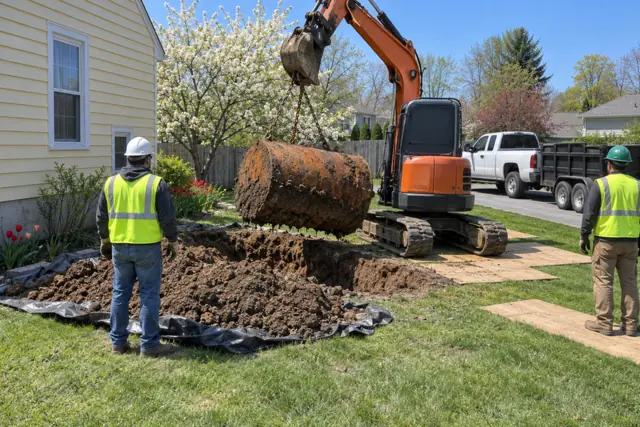
Find Alaska contractors for oil tank removal, UST closure, UST decommissioning, heating oil tank closure, basement tank excavation, soil contamination testing, and environmental remediation. Serving Anchorage, Fairbanks, North Pole, Wasilla, Palmer, Juneau, Kenai, Soldotna, and communities statewide.
Oil Tank Removal Rules and Permits in Alaska
Alaska oil tank removal is regulated by the ADEC Underground Storage Tanks program. ADEC runs the state UST registry, certifies UST workers, and oversees tank closure. Standard residential pulls run $2,000 to $5,000. The Contaminated Sites Program under the same agency handles petroleum releases once a tank fails or soil sampling shows exceedances. Regulated commercial UST work at Anchorage fueling facilities, military installations, and village fuel depots must be performed by a certified Alaska UST worker. Residential heating oil tank closure below the regulated threshold does not require state certification, though ADEC still expects documented soil sampling at closure.
Alaska's removal market concentrates on Anchorage, the Mat-Su Valley cities of Wasilla and Palmer, Fairbanks and North Pole, Juneau, and the Kenai Peninsula. Heating oil still heats more than a quarter of Alaska homes, second only to natural gas, so buried 275-gallon tanks and above-ground 500-gallon tanks are common at older single-family homes. Commercial UST work concentrates at Joint Base Elmendorf-Richardson, Eielson AFB, Ted Stevens airport fueling, and Port of Alaska dock facilities. Remote villages off the road system, from Bethel to Nome, rely on barge-delivered bulk fuel held in USTs and above-ground tanks. Older Anchorage and Fairbanks neighborhoods routinely turn up buried residential heating oil tanks during property sales and heating system conversions.
Residential oil tank removal in Alaska typically runs $2,000 to $5,000 for a standard buried tank, with basement jobs at $3,000 to $6,000 because of access constraints. Commercial petroleum tank removal at fueling facilities, military sites, and village depots generally runs $8,000 to $25,000 before remediation. If soil sampling exceeds ADEC cleanup standards, site cleanup can add $15,000 to $75,000 or more, and remote-village logistics push the top end higher. Alaska has no state reimbursement fund for residential heating oil releases; regulated commercial releases run through ADEC's Contaminated Sites Program using federal LUST funds. Our oil tank removal cost guide breaks down pricing by tank size, soil condition, and site access.
Alaska crews pace removal work around the May-to-September construction season, when ground conditions allow excavation, soil sampling, and backfill without frozen-ground complications. Fairbanks and Interior projects compress into a June-to-August window because of deeper seasonal frost. Emergency removals outside that window cost more because they require thawing enclosures, heated shelters, and limited daylight. Before hiring, verify the contractor holds active ADEC UST worker certification and pollution liability insurance, and ask about barge or air freight logistics for off-road sites. Request the contractor's closure report template and laboratory soil results retention policy, and book summer slots early because contractor availability statewide gets tight. To compare estimates from tank contractors in Alaska, get a free quote.
Do I need a licensed contractor to remove an oil tank in Alaska?
For regulated commercial UST work, ADEC requires a certified UST worker on site through the state's certification program. Residential heating oil tank closure below the regulated UST threshold does not require state certification by law. Most Alaska homeowners still hire a certified environmental contractor because soil sampling, closure documentation, and disposal logistics are hard to manage without experience. Utility locates and municipal excavation permits are required statewide regardless of tank type. Off-road sites add barge or aircraft mobilization that only remote-capable contractors can handle.
How much does oil tank removal cost in Alaska?
Residential removal in Alaska typically runs $2,000 to $5,000 for a standard buried tank and $3,000 to $6,000 for basement jobs. Commercial removal at fueling facilities, military installations, and village depots runs $8,000 to $25,000 before remediation. If soil contamination is found, environmental remediation can add $15,000 to $75,000 or more. Remote barge-access or air-access sites face the highest bracket. See our cost guide for pricing by tank size, soil condition, and site access.
How long does oil tank removal take in Alaska?
A straightforward residential tank closure in Alaska typically runs two to three days during summer, including excavation, tank lift, and initial soil sampling. Commercial tank decommissioning at fueling facilities or military installations runs five to ten days depending on tank count and access. Frozen-ground work outside the May-to-September window stretches timelines and pushes cost higher. Laboratory soil results from Anchorage and Fairbanks labs typically come back in one to three weeks. If ADEC Contaminated Sites Program review triggers on a petroleum release, cleanup can extend across several construction seasons for remote or high-volume sites.
When is the best time of year for oil tank removal in Alaska?
Late May through September is the workable window for most of Alaska, when ground conditions allow excavation, soil sampling, and backfill. Anchorage and Kenai Peninsula jobs stretch into early October in mild seasons. Fairbanks and Interior sites compress into June through August because deeper seasonal frost shortens the window. Emergency work outside the window requires heated enclosures and ground thawing, which drives a 20 to 30 percent premium. Scheduling residential jobs by February or March secures summer slots because contractor availability tightens quickly once breakup hits.
What happens to contaminated soil during Alaska tank removal projects?
Contaminated soil sampled at the tank bed typically must be excavated, profiled, and hauled to an approved disposal facility. On-site treatment options are limited in Alaska because cold temperatures slow bioremediation significantly. Permafrost and seasonal frost can trap petroleum compounds for decades, which is why ADEC Contaminated Sites sets strict soil screening levels for sensitive ecosystems. Contractors serving off-road villages sometimes stockpile soil on-site through winter for summer barge-out, which affects project timelines and cost.