

What to Know About Tank Installation in Missouri
Missouri UST installers must be registered with the Missouri Department of Agriculture and carry a financial responsibility mechanism under 10 CSR 26-2.019, though there is no exam-based installer license. The state's environmental agency oversees UST compliance through registration, permitting, and notification requirements, but does not separately license the contractors who perform the physical installation. Federal EPA technical requirements under 40 CFR 280 still apply to every new UST system in Missouri, and installers must meet manufacturer specifications for tank and piping placement. The installer must notify MDNR at least fourteen days before installation, and the owner must register the new tank within thirty days after bringing it into operation. Convenience stores, fleet fueling operations, and fuel distributors are the primary customers for new tank installations across the state.
Missouri's central location makes it a logistics crossroads, and that shows in the tank installation market. Kansas City and St. Louis anchor the two largest metro areas, where aging gas station infrastructure from the 1980s and 1990s is reaching replacement age. Springfield serves as the commercial hub for the Ozarks region, with fuel demand driven by tourism and distribution operations along the I-44 corridor. Columbia sits between the two major metros and supports fleet fueling for agricultural and university-related operations. Smaller communities along I-70 and I-35 see steady demand from truck stops and independent fuel retailers upgrading to double-wall systems, while rural cooperatives across northern Missouri replace bulk fuel storage for farm operations.
A single underground storage tank installation in Missouri typically costs between $50,000 and $150,000, depending on tank size, material, and site conditions. Multi-tank gas station buildouts with dispensers, canopies, and monitoring equipment run $250,000 to $500,000 or more, with monitoring system installation alone adding $5,000 to $15,000 on top of tank costs. Ozark region sites with rocky or karst geology can push excavation costs 15 to 25 percent higher than flat terrain projects in the Kansas City metro. Missouri does not have a dedicated state petroleum cleanup fund for new installations, but the state's Petroleum Storage Tank Insurance Fund may cover eligible releases from tanks whose owners participate in the fund. Get cost quotes from at least two contractors before committing, and ask specifically whether the quote includes soil management, backfill material, and post-installation testing.
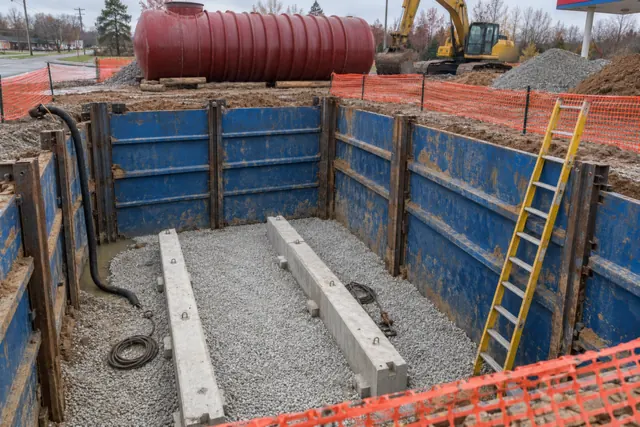
The installation process starts with site engineering and permitting, which typically takes four to eight weeks before any ground is broken. Excavation, tank setting, piping, and dispenser installation usually take two to four weeks for a single-tank project and six to ten weeks for a full gas station buildout. After installation, the system must pass tightness testing on tanks and lines before receiving fuel, and Missouri requires UST registration with release detection equipment operational from day one. Verify that your contractor carries pollution liability insurance separate from their general liability policy, because standard CGL policies have excluded pollution events since 1986. Request written confirmation of whether they handle state registration paperwork or if that responsibility falls to you.