

How Oil Tank Removal Works in West Virginia
Oil tank removal projects follow state environmental rules plus, for regulated tanks, federal 40 CFR 280. West Virginia carries a smaller commercial UST market than its neighbors but still maintains active regulatory oversight. Most tank work ties to gas stations, fleet yards, and a residential heating oil legacy concentrated in older Charleston, Huntington, Wheeling, and Eastern Panhandle neighborhoods. The West Virginia Department of Environmental Protection regulates UST closure under 33 CSR 30 and federal 40 CFR 280 requirements, with WVDEP-certified installer and remover credentials required for commercial UST work. Tanks storing heating oil for use on the premises fall outside the state UST definition at any size under W. Va. Code 22-17-3, but a spill that reaches state waters, including groundwater, must still be reported to WVDEP immediately under 47CSR11. Mountain State terrain creates unusually difficult site access for many removals, and Eastern Panhandle property transfers from the DC commuter belt routinely surface buried tanks during pre-closing inspections that the seller had no idea existed.
West Virginia's commercial UST inventory concentrates along the I-64 corridor through Charleston and Huntington, the I-79 spine from Charleston north through Morgantown, and the I-81 truck-stop corridor through the Eastern Panhandle. Coalfields communities carry a deeper inventory of industrial fuel and lubricant tanks tied to mining and rail operations. Residential heating oil work concentrates in pre-1965 housing in Charleston's South Hills, Huntington, Morgantown's older neighborhoods near WVU, Wheeling, and Parkersburg, with the Eastern Panhandle picking up Martinsburg and Berkeley County volume tied to Washington-area commuter migration. Mountain State steep-slope terrain frequently turns a basic tank pull into a multi-day excavation challenge requiring smaller equipment, longer haul distances to disposal facilities, and creative staging on hillside lots. Karst limestone bedrock across the Eastern Panhandle and Greenbrier Valley creates separate sampling concerns because petroleum can move along fractures faster than through homogeneous soil.
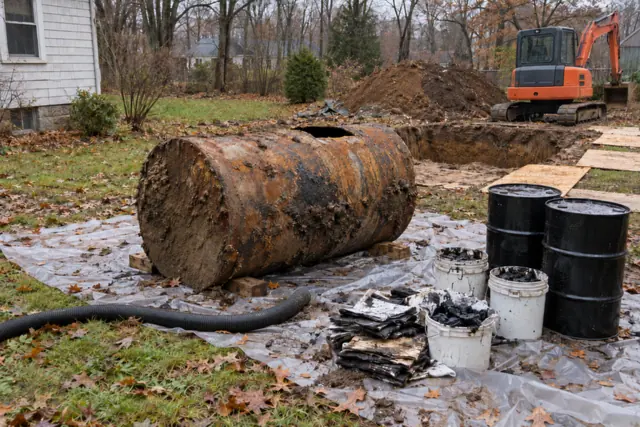
Residential oil tank removal in West Virginia typically runs $1,400 to $3,000 for a buried yard tank with clean soil and machine access. Steep-slope sites in Charleston's South Hills and Mountain State hillside lots climb to $2,500 to $5,000 because crews stage smaller equipment and haul material longer distances. Commercial UST closure at gas stations runs $5,000 to $20,000 per tank depending on piping and pit size. If post-removal soil sampling exceeds WVDEP cleanup thresholds, contamination cleanup and corrective action under 33 CSR 30 push project totals to $15,000 to $60,000 or more. Karst-influenced Eastern Panhandle sites run higher because plume delineation through fractured limestone takes more sampling. West Virginia has no EPA-approved state fund that tank owners can rely on to pay for a cleanup. WVDEP uses its Leaking Underground Storage Tank Response Funds mainly for investigations and cleanups the state runs itself, such as in an emergency or when the responsible party cannot pay. Our removal cost guide breaks down each variable.
A West Virginia residential tank removal typically wraps in one day on flat lots, with hillside Mountain State sites stretching to two or three days due to access challenges. Soil laboratory turnaround runs five to ten business days. Commercial multi-tank closures at Charleston, Huntington, and Morgantown gas stations run three to five days on site, with state review extending the closure paperwork tail by several weeks. If post-excavation sampling triggers reporting under 33 CSR 30, the site enters WVDEP corrective action with timelines stretching from months to several years for plumes reaching karst groundwater. Winter ice in the Coalfields and Mountain Highland counties plus deep snow at higher elevations both compress the practical excavation window into late spring through early fall across most of the state. Before signing a contract, ask any West Virginia contractor for proof of WVDEP installer and remover certification, pollution liability insurance, and a recent closure report from a comparable Charleston or Eastern Panhandle job. Also request written pricing for both clean-soil and contaminated outcomes. Browse West Virginia tank removal pros or get free quotes to start your project.