
Oil Tank Removal Contractors in Vermont
Find Vermont contractors for oil tank removal, UST closure, basement heating oil tank decommissioning, residential tank pulling, soil sampling, and environmental remediation. Serving Burlington, Montpelier, Rutland, Barre, Brattleboro, the Champlain Valley, the Green Mountains, and communities statewide.
Oil Tank Closure Under VTDEC and the Vermont Petroleum Cleanup Fund
Vermont sits deep in the Northeast heating oil corridor, where roughly half of all homes still rely on oil heat and where most residential basement tank removal work originates from real estate transactions rather than discretionary owner decisions. The Vermont Department of Environmental Conservation regulates UST closure under the Vermont Underground Storage Tank Rules and federal 40 CFR 280 requirements, with VTDEC-certified installers and removers required for regulated commercial UST work. Residential heating oil tanks under 1,100 gallons sit outside the formal UST license requirement, but a confirmed petroleum release still triggers reporting obligations to VTDEC under 10 V.S.A. Chapter 159. Closure work without proper notification creates problems years later when a buyer's environmental consultant audits the file. Burlington and Champlain Valley sales routinely surface buried tanks during pre-closing inspections that the seller had no idea existed.
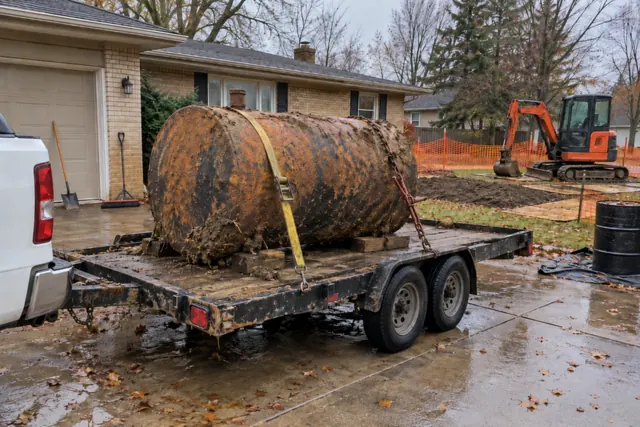
Vermont's tank removal volume concentrates in the Burlington metro and along the Champlain Valley, where pre-1970 housing stock built before natural gas service drove decades of heating oil dependence. Older neighborhoods in South Burlington, Winooski, Essex Junction, and Colchester generate steady residential basement tank work tied to property transfers. Montpelier, Barre, and Rutland add central and southern Vermont volume, with Brattleboro and Bennington picking up the southeast corner. Commercial UST inventory concentrates along the I-89 and US-7 corridors at gas stations and fleet yards that cycled through 1990s federal-deadline upgrades. The Green Mountains and Northeast Kingdom add scattered farm and small-business tanks that face longer drive times and seasonal access constraints. Vermont's clay-rich Champlain lowland soils retain hydrocarbons differently than the well-drained mountain valley sediments common further east, which shapes how contractors plan excavation and confirmatory sampling around the state.
Residential oil tank removal in Vermont typically runs $1,500 to $3,200 for a buried yard tank with clean soil and machine access. Basement-tank work in older Burlington and Montpelier homes climbs to $2,500 to $5,000 because crews dismantle tanks indoors, ventilate the space, and pass cut sections through bulkhead doors or basement windows. Commercial UST closure at gas stations runs $5,000 to $25,000 per tank depending on piping and pit size. If post-removal soil sampling exceeds VTDEC cleanup thresholds, environmental remediation and corrective action under 10 V.S.A. Chapter 159 push project totals to $15,000 to $60,000 or more. The Vermont Petroleum Cleanup Fund reimburses eligible owners for a significant portion of qualifying corrective action costs after a deductible keyed to compliance status. Federal LUST Trust Fund money also flows to commercial corrective action through VTDEC. Our oil tank removal cost guide breaks down each variable.
A Vermont residential tank removal typically wraps in one day on site, with soil laboratory turnaround running five to ten business days. Commercial multi-tank closures at Burlington, Rutland, and Montpelier gas stations run three to five days on site, with state review extending the closure paperwork tail by several weeks. If post-excavation sampling triggers reporting under 10 V.S.A. Chapter 159, the site enters VTDEC corrective action with timelines stretching from months to several years for larger plumes. Mud season in March and April plus deep winter frost in the Green Mountains and Northeast Kingdom both compress the practical excavation window into late spring through early fall across most of the state. Before signing a contract, ask any Vermont contractor for proof of VTDEC certification class for commercial UST work, pollution liability insurance, and a recent closure report from a comparable Burlington or Champlain Valley job. Also request written pricing for both clean-soil and contaminated outcomes. Looking for a starting point? View Vermont contractors or submit a quote request for direct comparisons.
Oil Tank Removal Contractors in Vermont
Browse contractors, see contact details, and request free quotes.
Browse Vermont Contractors →Frequently Asked Questions
Do I need a licensed contractor to remove an oil tank in Vermont?
Commercial UST closure in Vermont requires a contractor certified by VTDEC under the Vermont Underground Storage Tank Rules and federal 40 CFR 280 requirements. Residential heating oil tanks under 1,100 gallons sit outside the formal certification requirement. Burlington and Champlain Valley contractors that handle residential basement removals still routinely carry pollution liability insurance and VTDEC credentials because real estate buyers expect documented closure work. Unlicensed work on a regulated commercial UST blocks Vermont Petroleum Cleanup Fund eligibility and creates lender and resale problems on the next property transfer.
How much does oil tank removal cost in Vermont?
Residential basement tank removal in Vermont typically runs $2,500 to $5,000 because crews must dismantle the tank to fit pieces through bulkhead doors or basement windows. Yard-buried residential tanks range from $1,500 to $3,200 with clean soil. Commercial UST closure at gas stations starts near $5,000 per tank and climbs to $25,000 or more for multi-tank pulls in the Burlington corridor. If contamination surfaces, VTDEC-supervised cleanup adds $15,000 to $60,000 or more depending on plume extent. The Vermont Petroleum Cleanup Fund reimburses eligible owners for qualifying corrective action costs after a deductible. Our pricing guide breaks down each variable.
How does the Vermont Petroleum Cleanup Fund work?
The Vermont Petroleum Cleanup Fund (PCF) reimburses eligible Vermont tank owners for a significant share of corrective action costs following a confirmed petroleum release. Eligibility requires the tank to be registered with VTDEC where applicable, the release reported within state timeframes, all work performed by approved contractors, and the owner current on fund fees. A deductible applies based on tank-compliance status. Fund processing runs many months and requires detailed invoices, so a Burlington or Montpelier contractor experienced in PCF claims moves the paperwork noticeably faster than a first-time applicant from a smaller Champlain Valley town.
Why is mud season a problem for Vermont tank removal scheduling?
Vermont's mud season from late March through April turns rural driveways and yards into impassable wet ground that cannot support a tank truck or excavator. Combined with deep winter frost in the Green Mountains and Northeast Kingdom, the practical excavation window across most of the state runs late May through October. Burlington and Champlain Valley sites with paved access can schedule earlier and later, but Brattleboro, Rutland, and Bennington rural removals cluster into summer and early fall. Coordinating closure with VTDEC notification windows and laboratory turnaround time is easier inside that working window.
Do I need to remove a buried oil tank before selling a Vermont home?
No Vermont statute forces residential tank removal before a sale. Buyers, lenders, and inspectors in Burlington, South Burlington, Montpelier, Stowe, and the broader Champlain Valley routinely treat a buried heating oil tank as a reason to renegotiate or escrow funds. Most sellers in competitive Vermont markets complete a tank closure, pass soil sampling, and hand buyers a clean closure report before listing. Waiting for a buyer's oil tank sweep to surface an unknown tank usually forces a rushed mud-season-vulnerable job, a price concession, or a lost sale.
Browse contractors, see contact details, and request free quotes.
Browse Vermont Contractors →For Vermont UST regulations, visit the Vermont Department of Environmental Conservation. Federal requirements are available from the EPA UST Program.
