Find contractors in Vermont for underground storage tank installation, fuel system installation, dispenser installation, and piping upgrades. Serving Burlington, Montpelier, Rutland, and communities statewide.
What to Know About Tank Installation in Vermont
Vermont does not issue a state-specific UST contractor license for tank installation. The Vermont Department of Environmental Conservation oversees underground storage tank compliance under the Vermont Underground Storage Tank Rules, which set the design and installation standards every new UST must meet. The rules require tanks and piping to be installed to the manufacturer's instructions, and a new permitted tank system must be inspected by the state or a registered professional engineer and approved before backfill. Gas stations, fleet fueling facilities, and convenience stores replacing aging single-wall tanks with double-wall systems make up the majority of installation projects. Vermont also requires that all new UST systems include secondary containment, leak detection, and spill prevention equipment before they receive an operating permit.
Demand for UST installation in Vermont concentrates along the Interstate 89 and Interstate 91 corridors where fuel retail and distribution facilities serve both local traffic and seasonal tourism. Burlington and South Burlington account for the densest cluster of commercial fueling operations in the state, followed by Rutland, Brattleboro, and the Montpelier and Barre area. Vermont's cold climate creates a shorter construction window, typically May through October, which compresses scheduling and can push projects into the following year if permitting runs long. Rural general stores and agricultural cooperatives across the state also maintain UST systems for diesel and heating fuel. The small population means fewer active installation contractors operate here compared to neighboring New Hampshire or Massachusetts, so lead times for qualified crews tend to run longer.
A single underground storage tank installation in Vermont typically costs between $55,000 and $160,000, depending on tank capacity, site conditions, and whether existing infrastructure needs removal first. Multi-tank gas station buildouts with dispensers, canopy work, and monitoring systems run $275,000 to $500,000 or more, with monitoring equipment alone adding $5,000 to $15,000 per tank. Vermont's rocky terrain, high water tables, and frost depth requirements drive excavation and concrete costs higher than national averages because installation must account for seasonal ground movement. Vermont's Petroleum Cleanup Fund covers cleanup of petroleum releases, not commercial tank installation, so facility owners bear the full project expense. Financing through equipment loans or SBA programs is common for independent operators replacing end-of-life systems.
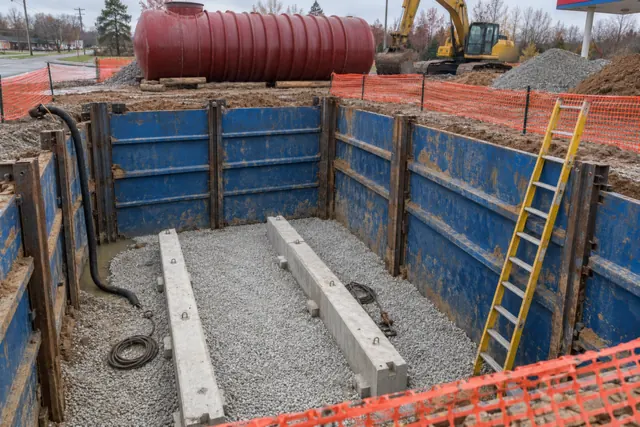
The installation process starts with a site plan submitted to the state for review, followed by local zoning and fire marshal permits. Expect the permitting phase to take four to eight weeks in most Vermont municipalities, longer if the site is near a public water supply or wetland. Once permits clear, excavation, tank setting, piping, and backfill typically take two to four weeks for a single-tank project. Before the system goes live, a contractor must complete tightness testing on all tanks and lines, install overfill prevention, and verify that leak detection equipment is operational. Ask any contractor you evaluate whether their quote includes the full scope: excavation, tank, piping, dispensers, electrical, monitoring, testing, and state notification paperwork. A bid that covers only the tank and excavation leaves you coordinating four or five additional subcontractors on your own.
Do I need a specific license to install underground storage tanks in Vermont?
Vermont does not have a state-issued UST installer license. Manufacturer certification is not required: federal rules list it as one of several ways an owner can show proper installation, and Vermont requires a state or engineer inspection before backfill. Most municipalities also require a general contractor license and fire marshal approval before work begins. You should verify that your contractor carries pollution liability insurance beyond standard commercial general liability coverage, since standard CGL policies have excluded pollution events since 1986.
How much does it cost to install a new underground storage tank in Vermont?
A single UST installation in Vermont runs between $55,000 and $160,000 for most commercial projects. That range covers the tank, excavation, piping, dispensers, and monitoring equipment. Multi-tank installations for gas stations or fleet facilities typically cost $275,000 to $500,000 depending on the number of tanks and site complexity. Rocky subsurface conditions, which are common across much of the state, can add 10 to 20 percent to excavation costs alone. Get itemized bids so you can compare what each contractor includes versus what they treat as add-ons.
How long does a UST installation project take in Vermont?
Plan for three to five months from initial permit application through final system commissioning. Permitting alone takes four to eight weeks in most towns, and sites near protected water sources face additional review periods. Physical installation runs two to four weeks for a single-tank project once the site is cleared and permits are in hand. Vermont's construction season realistically runs May through October because frozen ground makes winter excavation impractical or significantly more expensive. If your permitting extends past September, the actual installation may need to wait until the following spring.
Does Vermont's climate affect how underground storage tanks are installed?
Yes, and this is one detail that catches out-of-state contractors off guard. Vermont's frost depth reaches four to six feet in the northern part of the state, which means piping, containment sumps, and dispenser connections must be installed below that line or properly insulated. Freeze-thaw cycling also stresses backfill material and can shift tanks if bedding isn't engineered correctly. Fiberglass tanks handle the temperature swings better than steel in Vermont conditions, which is why most new installations here use fiberglass or composite systems. Spring thaw raises water tables temporarily, so installations scheduled for early season may need dewatering equipment that adds cost and time.
What happens if contamination is found during excavation for a new tank?
Discovery of contaminated soil during excavation triggers a mandatory notification to the state environmental agency, and the installation project pauses until the contamination is assessed. A Phase II environmental site assessment with soil and possibly groundwater sampling will determine the extent of the problem. Remediation costs range from $10,000 for minor localized contamination to $100,000 or more for groundwater plumes. Vermont's Petroleum Cleanup Fund may help with eligible cleanup costs above the owner's deductible, which depends on the tank's type and use. Running a Phase I ESA before you commit to a site or begin installation is the cheapest insurance against this scenario, typically costing $1,500 to $3,500.