Find contractors in Georgia for underground storage tank installation, fuel tank replacement, gas station tank build-outs, dispenser installation, piping systems, and monitoring equipment. Serving Atlanta, Savannah, Augusta, Macon, Columbus, and communities statewide.
Permitting, Costs, and Red Clay Challenges for Georgia Tank Installations
Georgia's tank installation market runs almost entirely commercial. Typical single-tank budgets land between $55,000 and $150,000. The state's Environmental Protection Division oversees UST permitting and registration, and every new underground storage tank must be registered before it accepts fuel. Georgia does not issue a state-specific UST contractor license, which means facility owners carry extra responsibility for vetting their installer's qualifications, insurance, and federal compliance knowledge. Gas stations, truck stops, fleet fueling depots, and convenience store chains account for the vast majority of installation projects. Skipping the EPD registration process or installing without proper permits can trigger enforcement actions that cost more than the installation itself.
Metro Atlanta generates the heaviest demand for fuel tank installation in Georgia, driven by population growth that consistently ranks among the fastest in the Southeast. The I-75 and I-85 corridors stretching from Dalton through Atlanta to Valdosta support a dense network of travel centers and truck stops that cycle through tank replacements every 20 to 30 years. Savannah's expanding port operations and logistics industry create steady demand for fleet fueling infrastructure along the I-16 corridor. Augusta, Macon, and Columbus each anchor regional markets where independent operators and convenience store chains are building new fueling locations. Georgia's lack of a state income tax on fuel retailers has attracted national chains that drive new construction volume above what population alone would predict.
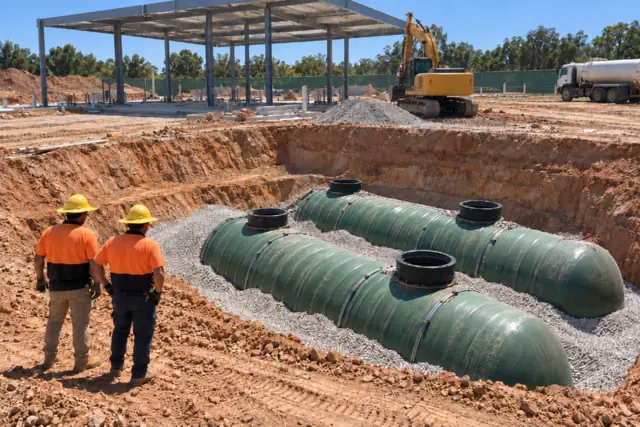
A single underground storage tank installation in Georgia typically costs $55,000 to $150,000 depending on tank capacity, material, and excavation conditions. Full multi-tank gas station build-outs with dispensers, canopy foundations, piping, and monitoring systems run $250,000 to $500,000 or higher. Monitoring equipment adds $5,000 to $15,000 per tank system. Georgia's red clay soils in the Piedmont region require careful backfill and compaction work that can add 5 to 15 percent to excavation costs compared to the sandy Coastal Plain. Georgia's GUST Trust Fund reimburses participating owners for release cleanup only above a per-occurrence deductible and does not pay to replace tanks. Owners replacing tanks at existing sites should still budget for potential contamination discovered during removal of the old system. That out-of-pocket share makes pre-installation soil sampling a smart investment rather than an optional expense.
Expect the full process to span 10 to 16 weeks from engineering to operational approval. Permitting and site design typically consume four to six weeks, followed by three to eight weeks of physical construction depending on the number of tanks. After installation, Georgia requires tightness testing, leak detection verification, and registration completion before the facility can dispense fuel. Owners replacing aging single-wall tanks should request soil sampling beneath the old footprint before the new tank goes in, since contamination found after installation creates expensive rework. Ask each bidding contractor whether their price includes EPD registration paperwork, backfill material, monitoring commissioning, and post-installation testing, because bids that exclude those line items look cheaper until the invoices arrive.
Does Georgia require a specific license to install underground storage tanks?
Georgia does not issue a state-specific UST contractor license for installation work. The state's Environmental Protection Division regulates tank registration and permitting, but it does not certify individual installers the way states like Florida or Delaware do. This puts the burden on facility owners to verify that their contractor carries appropriate liability insurance, has documented experience with EPA technical requirements, and understands Georgia's registration process. Hiring an unqualified installer in a state without a licensing backstop is a risk that shows up months later during compliance inspections.
How much does a new UST installation cost in Georgia?
Single tank installations in Georgia typically run $55,000 to $150,000 depending on tank size and site conditions. A complete gas station build-out with multiple tanks, dispensers, piping, and canopy work ranges from $250,000 to $500,000 or more. Piedmont region sites with heavy red clay may see excavation costs 5 to 15 percent above Coastal Plain projects. Monitoring equipment adds $5,000 to $15,000 per system. These ranges assume no contamination from a prior tank; if old petroleum is discovered during excavation, remediation costs fall to the owner. Owners participating in Georgia's GUST Trust Fund can be reimbursed for eligible cleanup costs above a per-occurrence deductible.
How long does a UST installation take from start to finish in Georgia?
Plan for several months in total. Site engineering and EPD permit applications consume four to six weeks. Physical construction, including excavation, tank placement, piping, and dispenser installation, typically runs three to eight weeks depending on how many tanks are going in. Post-installation tightness testing and monitoring commissioning add one to two weeks. Projects that encounter contamination from a previous tank during excavation can stall for months while cleanup is completed before the new system goes in.
Why does Georgia's red clay soil affect tank installation costs?
Georgia's Piedmont region, which runs from the fall line north through Atlanta to the mountains, sits on dense red clay that holds moisture and resists compaction differently than sandy soils. Excavation in clay takes longer and requires more equipment time than digging in the Coastal Plain's sandier ground. Backfill around the tank must be engineered to prevent settling that could stress piping connections over time. Contractors experienced in Piedmont installations use specific bedding materials and compaction methods that add cost upfront but prevent structural problems over the tank's 30-year lifespan. Coastal sites south of Macon typically have easier excavation conditions but may require higher water table management during construction.
What monitoring equipment is required on new underground storage tanks in Georgia?
All new UST installations in Georgia must meet EPA's 2015 updated requirements, which include automatic tank gauging, line leak detection, and interstitial monitoring for double-wall tank systems. The monitoring system must be fully commissioned and producing accurate readings before the facility receives approval to dispense fuel. Equipment costs typically fall between $5,000 and $15,000 per tank system. Owners sometimes treat monitoring as a final checkbox, but configuring sensors correctly during initial construction avoids the much higher cost of retrofitting a buried system after backfill is complete. Confirm that your contractor's bid explicitly includes monitoring installation and commissioning rather than listing it as a separate add-on.