

What to Know About Oil Tank Inspection & Testing in Delaware
Delaware tank inspection and testing must follow strict DNREC oversight. The DNREC Tank Management Section enforces 7 DE Admin Code 1351 and the 1989 Underground Storage Tank Act. Active commercial USTs at gas stations, fleet yards, and fueling depots must pass annual line tightness testing and triennial tank tightness testing. Property buyers in New Castle County frequently pair a property assessment with leak detection work before closing on industrial parcels. Facilities along the I-95 corridor and the Port of Wilmington face the strictest compliance inspection schedules because of Delaware River watershed proximity.
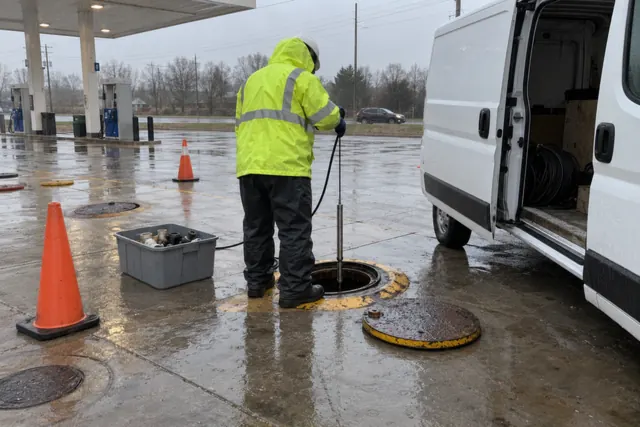
Demand for UST compliance inspection clusters in three distinct Delaware regions. Wilmington and Newark anchor the northern industrial market, where decades of refining and chemical operations along the Christina River produced a dense network of legacy commercial tanks needing integrity testing. Dover and Smyrna form the Kent County compliance hub, with state fleet operations, Dover Air Force Base perimeter contractors, and agricultural cooperatives requiring monthly monitoring documentation. Sussex County's coastal corridor, running through Lewes, Rehoboth Beach, Milford, and Georgetown, hosts seasonal fueling stations whose tightness test schedules cluster before Memorial Day weekend. Beach-town stations near Bethany and Fenwick Island also contend with elevated water tables that can mask slow leaks if leak detection equipment is poorly calibrated.
Delaware tank tightness testing typically runs $500 to $2,000 per tank, with line testing adding $300 to $800 per dispenser run. A full compliance inspection covering ATG calibration, sump integrity, spill bucket testing, and line tightness usually lands between $1,000 and $3,000 per facility. Coastal sites in Sussex County often push toward the upper end because high groundwater complicates dewatering during a hydrostatic interstitial test. Owners with lapsed monthly monitoring records often face triple costs, because failed initial tests trigger follow-up integrity testing and soil sampling. DNREC's published financing options help with tank closure or cleanup only in limited cases and do not cover routine testing, so budget for testing as a compliance cost.
A typical Delaware tank tightness test takes one to two business days per facility once scheduling, drawdown, and DNREC notification are coordinated. Contractors begin with a pre-test gauge reading, then run either a volumetric or non-volumetric tightness test depending on tank fill level. Line testing, ATG checks, and a walk-through compliance inspection usually wrap up the same week, with results filed to DNREC's Tank Management Section within 30 days. Field technicians performing remediation sampling on Delaware sites must hold current HAZWOPER training credentials under 29 CFR 1910.120, particularly at known LUST sites along the Christina River corridor. Before signing, Delaware operators should verify the contractor's DNREC tank tester certification number and request a sample report from a recent New Castle County job.