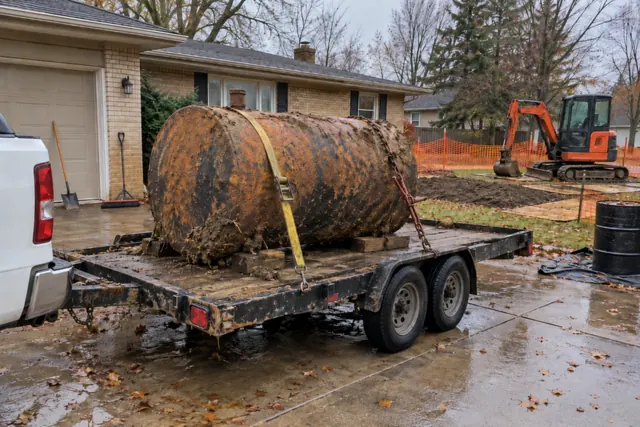
Find Connecticut contractors for heating oil tank removal, closure in place, soil testing, and cleanup of leaking home heating oil tanks, and see what DCP and DEEP require.
Who Can Remove a Home Heating Oil Tank in Connecticut?
In Connecticut, removing a home heating oil tank is home improvement work, so the contractor needs a Department of Consumer Protection registration. C.G.S. 20-419 covers removal or replacement of a residential underground heating oil tank system costing more than $200. Under 20-420, DCP registers a contractor for that work only with DEEP-approved hazardous materials training and $1,000,000 in liability insurance. DCP names the training: OSHA 40-hour HAZWOPER under 29 CFR 1910.120 with an annual 8-hour refresher, plus ICC UST Tank Decommissioning U2. You can check a registration on the state's eLicense lookup under the Home Improvement Contractor license type. For one and two family homes, the State Building Inspector has said the local building official issues the permit, and under C.G.S. 20-427 a registered contractor may not start until every required permit is issued.
Connecticut draws a line at four residential units. The DEEP residential tank FAQ defines a residential underground tank as one storing heating oil for four residential units or fewer, and DEEP's tank program covers underground heating oil tanks serving five or more units, not those serving four or fewer. Federal UST rules do not cover home heating oil tanks either, because 40 CFR 280.12 excludes any tank storing heating oil for consumptive use on the premises. Leaks are different. DEEP's release guidance says releases from tanks serving four or fewer units discovered after March 1, 2026 are regulated under the Release Based Cleanup Regulations. Heating oil is common here: DEEP reports that in 2018, 45% of Connecticut households used fuel oil or other petroleum products as the primary energy source for home heating.
DEEP sets no deadline for removing a residential tank that is not leaking, but a leaking tank must be promptly emptied and removed. The DEEP FAQ discourages closing a tank in place unless it is inaccessible or removal would endanger the foundation. The building code is stricter. For one and two family homes, the Connecticut State Building Code (section M2201.7) says an abandoned tank and its piping must be emptied, cleaned and removed. The exceptions are a tank kept for future use after a fuel conversion, or one closed in place under the code's steps, which include filling it with an inert solid and then capping and backfilling. For a removal, DEEP's homeowner FAQ, which is guidance rather than a DEEP tank rule, calls for a soil sample to be collected under the tank and piping and analyzed for Extractable Total Petroleum Hydrocarbons (ETPH) at a Connecticut certified laboratory. DEEP also asks for photos and a brief letter report from the contractor. Our guide to oil tank soil testing explains what the lab results mean.
A leak changes who does the work. The DEEP release guidance says a tank known to be leaking must be removed by a permitted spill cleanup contractor. Report any leak to the DEEP Emergency Response and Spill Prevention Division at 866-337-7745. Additional soil comes out where ETPH exceeds 500 ppm, and the owner must restore neighboring properties to pre-leak conditions. For a release covered by the 2026 regulations, a Permitted or Licensed Environmental Professional signs off on the closure report, which goes to DEEP through its online REACT system. For an older release, the contractor's letter report goes to DEEP and the local fire marshal. Compare Connecticut tank removal contractors, Connecticut remediation contractors for a leak, or request a quote.
Do I need a licensed contractor to remove an oil tank in Connecticut?
You need a registered one. Connecticut law counts removal or replacement of a residential underground heating oil tank system costing more than $200 as home improvement. The contractor must therefore hold a Department of Consumer Protection home improvement registration under C.G.S. 20-419 and 20-420. For this work, DCP also requires $1,000,000 in liability insurance, OSHA 40-hour HAZWOPER training with annual refreshers, and ICC UST Tank Decommissioning U2 training. Check the registration on the state's eLicense lookup before you sign. The lookup confirms the registration but not the training or insurance, so ask the contractor for those certificates. If the tank is already known to be leaking, a permitted spill cleanup contractor must remove it.
How much does oil tank removal cost in Connecticut?
Nationally, a clean removal of a standard 275 to 550 gallon residential underground tank runs $1,500 to $3,500. That is a national planning range, not a Connecticut price. The ETPH soil sample that DEEP's FAQ calls for, plus any removal of stained soil, adds to the bill, so ask for written pricing that covers both a clean result and a leak. Our removal cost guide explains what drives the national range.
Can I leave an old oil tank in the ground in Connecticut?
Sometimes. The DEEP FAQ sets no removal deadline for a tank that is not leaking, but DEEP discourages closing a tank in place unless it is inaccessible or removal would endanger the foundation. DEEP also tells owners to ask the local fire marshal about any local ordinance on tank abandonment. For one and two family homes, the Connecticut State Building Code (section M2201.7) requires an abandoned tank to be emptied, cleaned and removed with its piping. The exceptions are a tank kept for future use after a fuel conversion, or one closed in place under the code's steps. Those steps include notifying the authorities, removing all oil and residue, making the tank vapor safe, filling it with an inert solid, then capping and backfilling. Our guide to closing an oil tank in place compares the two options.
What happens if my Connecticut oil tank leaked?
Report it to the DEEP Emergency Response and Spill Prevention Division at 866-337-7745. The DEEP release guidance says a tank known to be leaking must be removed by a permitted spill cleanup contractor, and impacts to drinking water or surface water must also be handled by one. Additional soil comes out where ETPH exceeds 500 ppm. Leaks discovered after March 1, 2026 fall under the Release Based Cleanup Regulations, so a Permitted or Licensed Environmental Professional signs off and the closure report goes to DEEP through REACT. DEEP says a letter report with the lab results is generally accepted by lending institutions, buyers and realtors.
Do I need to remove an oil tank before selling my Connecticut house?
The DEEP FAQ sets no removal deadline for a tank that is not leaking, but in most sales the seller must disclose it. The Department of Consumer Protection's Residential Property Condition Report, required under C.G.S. 20-327b for homes of four units or fewer, asks whether there is an underground storage tank, its age and location, and any known problems. It also asks whether a tank was removed, when, and by whom, and asks for the written removal records. A seller who fails to provide the report must credit the buyer $500 at closing under C.G.S. 20-327c. Some transfers are exempt, such as sales by executors or after a foreclosure. Our guide on removing an oil tank before selling a house covers what buyers and lenders usually ask for.