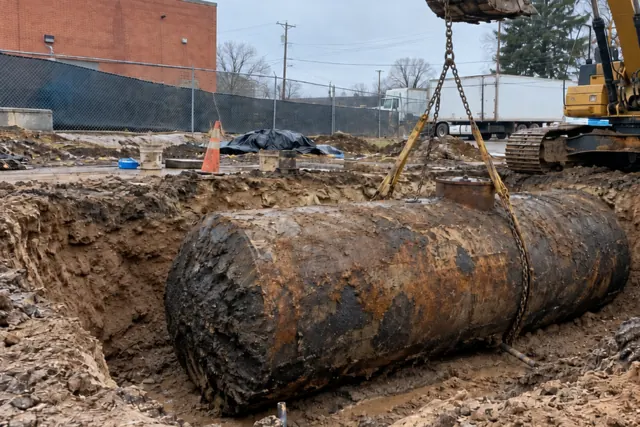
Find South Dakota contractors for oil tank removal, UST closure, UST decommissioning, commercial tank excavation, petroleum tank removal, farm fuel system closure, and environmental remediation. Serving Sioux Falls, Rapid City, Aberdeen, Brookings, Watertown, Pierre, and communities statewide.
How South Dakota Regulates UST Closure and the Petroleum Release Compensation Fund
South Dakota oil tank removal runs through the South Dakota DANR Underground Storage Tanks program. SDDANR administers USTs under South Dakota Administrative Rule 74:56:01 and federal 40 CFR 280 rules. South Dakota does not certify tank installers or removers. For commercial UST closure at gas stations, fleet yards, and industrial sites, the owner must notify DANR at least thirty days ahead, and the person collecting closure soil samples must be state certified. Residential heating oil tanks are uncommon in South Dakota because natural gas and propane dominate, though legacy tanks occasionally surface in older Sioux Falls and Rapid City neighborhoods during real estate transactions.
South Dakota tank removal work concentrates in the Sioux Falls metro along I-29 and I-90 through gas stations, fleet yards, and bank-headquarters fueling networks. Rapid City anchors western South Dakota demand through gas stations, Ellsworth Air Force Base support, and Black Hills tourism fueling at Mount Rushmore, Deadwood, and Custer State Park. Aberdeen, Brookings, and Watertown add regional commercial UST work, and Pierre handles state-government fleet tanks. Agricultural fuel storage across corn and soybean counties from Yankton to Aberdeen drives farm-transition closure work. Missouri River bluff and Badlands sites face soil and access challenges. Winter frost halts excavation from November through March.
Commercial UST closure at South Dakota gas stations typically runs $4,000 to $12,000 per tank. Residential heating oil tank removal in older Sioux Falls or Rapid City neighborhoods runs $1,500 to $3,500. If soil sampling exceeds SDDANR cleanup thresholds, site remediation adds $10,000 to $40,000 or more, with Missouri River floodplain sites triggering expanded sampling. The South Dakota Petroleum Release Compensation Fund reimburses eligible regulated-tank owners for corrective action costs after a deductible, aligned with the federal LUST Trust Fund program. Our tank removal cost guide breaks down pricing.
A typical South Dakota commercial closure starts with South Dakota 811 locates, SDDANR notification, tank pumping, degassing, excavation, and soil sampling. A single-tank Sioux Falls or Rapid City closure wraps in two to three days. Multi-tank pulls stretch across a week. Soil laboratory turnaround runs seven to fourteen business days. Winter frost from November through March compresses excavation into April through October. Before signing, confirm who will collect the closure samples under state certification, and ask for a closure report from a comparable Sioux Falls, Rapid City, or Black Hills job. South Dakota tank removal pros are listed in our directory, or get free quotes to gather pricing.
Do I need a licensed contractor to remove an oil tank in South Dakota?
No state license applies to the removal itself. South Dakota Administrative Rule 74:56:01:54 requires the owner to notify DANR at least thirty days before closure and to check the excavation area for releases, alongside federal 40 CFR 280 rules. The South Dakota DANR UST program says the person collecting closure soil or groundwater samples must be certified by the state. Residential heating oil tanks are uncommon in South Dakota, but Sioux Falls, Rapid City, and Aberdeen contractors that handle occasional residential removals routinely carry pollution liability insurance.
How much does oil tank removal cost in South Dakota?
Commercial UST closure at South Dakota gas stations typically runs $4,000 to $12,000 per tank. Residential heating oil tank removal in older Sioux Falls or Rapid City neighborhoods runs $1,500 to $3,500. Contamination adds $10,000 to $40,000 or more, particularly in Missouri River floodplain zones. South Dakota's Petroleum Release Compensation Fund may offset a portion for eligible regulated sites. See our cost guide.
How long does oil tank removal take in South Dakota?
A single-tank Sioux Falls or Rapid City commercial closure wraps in two to three days on site. Multi-tank pulls stretch across a week. Soil laboratory turnaround runs seven to fourteen business days. If sampling triggers SDDANR cleanup review under 40 CFR 280, paperwork adds six to fourteen weeks. Winter frost from November through March compresses most excavation work into April through October.
How does the South Dakota Petroleum Release Compensation Fund work?
The South Dakota Petroleum Release Compensation Fund reimburses eligible regulated-tank owners for a significant share of corrective action costs after a deductible, drawing on per-gallon petroleum assessments plus federal LUST Trust Fund allocations. Most tank owners are covered automatically, with no pre-registration. The release must be reported as the rules require, the tank must have been in substantial compliance, and costs need PRCF approval before they are incurred. Cleanup consultants must be certified through the Board of Technical Professions. Sioux Falls, Rapid City, and rural South Dakota contractors experienced in fund paperwork move claims faster.
Do Black Hills tourism-corridor tanks face special requirements?
Black Hills gas stations near Mount Rushmore, Deadwood, Custer State Park, and Spearfish support tourism fueling with seasonal peaks that drive tank-system stress. SDDANR applies standard UST closure rules, but Missouri River bluff and Black Hills-adjacent karst sites sometimes trigger expanded soil and groundwater sampling. Contractors familiar with Rapid City and Black Hills closure logistics handle equipment access and SDDANR paperwork faster than Sioux Falls-only operators. Winter access also compresses Black Hills work into summer and fall.