Tank Decommissioning Contractors in Maine

Find licensed contractors in Maine for oil tank decommissioning, underground storage tank closure, closure in place, oil tank disposal, buried oil tank closure, basement oil tank work, soil contamination testing, and environmental remediation. Serving Portland, Lewiston, Bangor, South Portland, Augusta, Biddeford, and communities statewide.

Browse Maine Contractors →

Oil Tank Decommissioning Rules in Maine

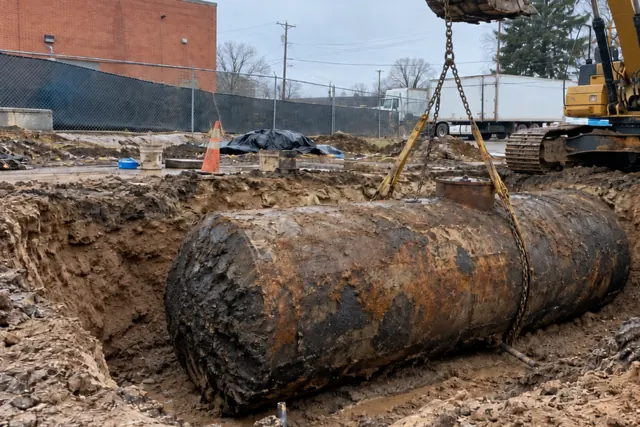
This page is about closing a buried oil tank at a house or a business in Maine. It is not about the Maine Yankee nuclear plant, whose decommissioning dominates the search results for this phrase and has nothing to do with oil tanks. With that out of the way, Maine gives a clear answer where most states hedge. Under 38 M.R.S. 566-A, an underground oil storage tank taken out of service for more than 12 months must be properly abandoned, and an abandoned tank must be removed. Tank removal is the default here, and tank closure by any other method is the exception you have to qualify for. No state in the country leans on heating oil the way Maine does, so a great many Portland and Lewiston properties built before the 1990s are carrying a tank this rule reaches.

The statute allows only four ways out of physical removal, and every one is a physical constraint rather than a matter of preference or cost. Closure in place is available where the tank sits beneath a building or other permanent structure, or where its size or construction means it cannot be removed. It is also available where heavy equipment cannot reach the tank, or where pulling it would endanger the structural integrity of nearby tanks. That list is why a Bangor basement tank under a load bearing slab is usually closed in place while an identical tank in a South Portland side yard comes out. Before any of it happens, written notice of intent to abandon goes to the state and to the fire department with jurisdiction, and the state's rules set a 10 day notification period. A closing date three weeks out does not leave room for tank abandonment that has not been noticed yet.

Registration is the piece Maine owners most often miss. Underground oil storage tanks are registered with the state, and a single family homeowner is exempt from the registration fee rather than from registration itself. Those are not the same exemption, and assuming the first means the second is how an unregistered tank surfaces during a sale. On cost, Maine spans a wider band than most states because the housing stock does. A basement tank pulled through a bulkhead is a different job from an underground storage tank in fractured Augusta bedrock. It is different again on a MidCoast property with a long gravel approach. The quotes reflect that rather than any inconsistency between firms. Closure in place for a clean residential underground tank runs $2,000 to $5,000, full oil tank removal with excavation runs $5,000 to $15,000, and soil sampling adds $500 to $2,000. Shallow bedrock moves petroleum through fractures quickly, and remediation once groundwater is involved reaches $15,000 to $100,000.

Maine does have a fund, which changes the arithmetic and which almost nothing in this search field mentions. The state's Ground and Surface Waters Clean-up Fund covers cleanup at consumptive use heating oil facilities. Under 38 M.R.S. 568-A a facility holding under 2,000 gallons in aggregate carries a $2,000 deductible for each listed compliance duty that was not met. Eligibility turns on compliance, which is another reason registration and the notice matter. On who may do the work, Maine certifies underground oil storage tank installers through a dedicated board, and 566-A requires that abandoned tanks holding Class 1 liquids be removed under the direct on site supervision of a certified installer. Crews working a contaminated excavation also carry worker safety training for the exposure. Browse Maine UST contractors or request quotes, and read 38 M.R.S. 566-A and 38 M.R.S. 568-A before you accept anyone's summary of them.

Tank Decommissioning Contractors in Maine

Browse contractors, see contact details, and request free quotes.

Browse Maine Contractors →

Frequently Asked Questions

Is oil tank removal required in Maine, or is closure in place allowed?

Removal is required, and closure in place is the exception. Under 38 M.R.S. 566-A a tank out of service more than 12 months must be properly abandoned, and an abandoned tank must be removed unless removal is not physically possible or practicable. The statute lists four qualifying situations: the tank is under a building or other permanent structure, its size or construction prevents removal, heavy equipment cannot reach it, or removal would endanger nearby tanks. Cost and convenience are not on that list.

Are residential heating oil tanks regulated in Maine?

Yes. Underground oil storage tanks in Maine are registered with the state, and the abandonment rules in 38 M.R.S. 566-A contain no carve out for residential or home heating oil tanks. Single family homeowners are exempt from paying the registration fee, which is not the same as being exempt from registering. That distinction catches people, because an owner who believes the tank was never the state's business often discovers otherwise partway through a Portland closing.

Does Maine have a state fund that covers residential heating oil tank cleanup?

Yes. The Ground and Surface Waters Clean-up Fund reaches cleanup at consumptive use heating oil facilities, including home systems. Under 38 M.R.S. 568-A a facility with less than 2,000 gallons of aggregate storage carries a $2,000 deductible for each listed compliance failure, and facilities at or above 2,000 gallons carry $5,000 and $10,000 figures. Coverage is tied to having met the underlying compliance duties, so an unregistered underground storage tank or a skipped notice can cost more at tank closure than the paperwork would have.

Who is allowed to remove an underground oil tank in Maine?

Maine certifies underground oil storage tank installers through a dedicated state board. For abandoned tanks that held Class 1 liquids, 38 M.R.S. 566-A requires removal under the direct on site supervision of a certified installer. Treat that as the first question on any Maine tank removal quote. Ask for the certification number of the individual who will actually be standing at the excavation, not just the company name, because the statute attaches the requirement to on site supervision rather than to the business.

What is the 10 day notice requirement for tank work in Maine?

Written notice of an intent to abandon an underground oil storage tank goes to the state and to the fire department in whose jurisdiction the tank sits, before the work happens. The state's underground oil storage rules set a 10 day notification period. It applies to residential and commercial tanks alike. The window exists so the state can decide whether to attend. For anyone working to a real estate timeline this is the first thing to file, because every later step waits on it.

Can a basement oil tank be closed in place in Maine?

Often yes, because basement tanks tend to satisfy the statutory exceptions. A tank beneath a permanent structure, or one that heavy equipment cannot reach, qualifies on its face. The tank is drained, cleaned, and filled with an inert material, and samples are collected where they can be reached. What does not qualify is an accessible yard tank that the owner would simply rather not dig up, and a contractor who offers closure in place for one of those is proposing something the statute does not permit.

Do I have to deal with the tank before selling my home in Maine?

The obligation does not come from the sale, it comes from the tank being out of service. Once an underground oil tank has been unused for more than 12 months the abandonment duty in 566-A has already attached, whether or not the property is on the market. In practice most Maine buyers' lenders ask for closure documentation anyway, and an unresolved tank with no paperwork will stall a sale in the southern part of the state. Handling it before listing usually costs less than the concession a buyer asks for after finding it.

Looking for a contractor in Maine?

Browse contractors, see contact details, and request free quotes.

Browse Maine Contractors →

For Maine UST regulations, visit the Maine DEP Underground Oil Storage. Federal requirements are available from the EPA UST Program.

Related Services in Maine

Find Maine ContractorsRequest a Free Quote
Free Quotes