Find licensed Maine contractors for oil tank removal, UST decommissioning, heating oil tank closure, basement tank excavation, soil contamination testing, and environmental remediation. Serving Portland, Bangor, Lewiston, Auburn, South Portland, Scarborough, and communities statewide.
What to Know About Oil Tank Removal in Maine
Maine has the highest per-capita heating oil usage in the country, and thousands of homes across Portland, Bangor, and the Downeast coast still run on buried heating oil tanks regulated by MEDEP. The Maine DEP Underground Oil Storage program requires written notice at least ten business days before any residential underground tank closure begins. Chapter 691 of Maine DEP rules governs how underground oil storage facilities must be closed, alongside federal 40 CFR 280 for regulated commercial tanks. It requires a closure site assessment for most tanks, but not for a heating oil tank whose oil was used on the same property. Property owners cannot legally pump, abandon, or partially close a tank without notifying the state through their contractor first.
Southern Maine dominates the residential tank market. Homes in Portland, South Portland, Cape Elizabeth, Falmouth, Scarborough, and the Kennebunk-York coastal band were mostly built between the 1920s and 1970s with buried heating oil tanks that are now 40 to 80 years old. Lewiston and Auburn carry a similar inventory through their historic mill-era neighborhoods. Commercial UST closure work concentrates around the Portland waterfront, Bangor fuel depots, and older roadside filling stations along Route 1 and I-95. Oil tank sweeps have become standard during Portland-area real estate inspections, and a buried tank flagged mid-sale routinely delays closing until excavation and soil documentation are complete.
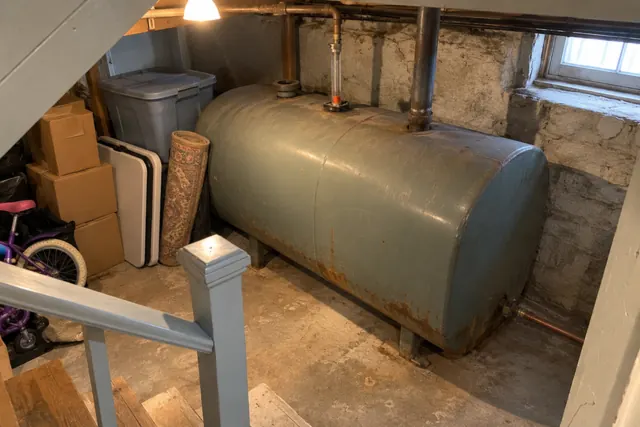
Residential pricing across southern Maine runs $1,800 to $3,800 for a standard buried tank with clean soil and open access. Basement heating oil tank work in older Portland and Bangor homes climbs to $2,500 to $4,500 because crews cut the tank inside and hoist sections through bulkheads. Commercial UST closure at coastal fuel terminals and inland gas stations starts around $5,000 per tank and climbs with piping and pit size. If contamination surfaces during excavation, site cleanup adds $8,000 to $40,000 or more. Maine's Ground Water Oil Clean-up Fund reimburses eligible residential heating oil releases after a $2,500 deductible, aligned with federal LUST Trust Fund backing and keeping owner exposure lower than in most New England states. The figure comes from the state's own rule. Our [oil tank removal cost](/oil-tank-removal-cost/) guide breaks down what drives the final invoice.
A straightforward southern Maine residential job finishes in one day on site, with soil sample results returning in five to ten business days. Basement work in Portland's older Munjoy Hill and West End homes stretches into a second day when crews cut the tank inside the foundation. If sampling flags petroleum, the project converts to a corrective action case under Maine DEP oversight, with timelines running from weeks to many months. Before signing a contract, ask for the contractor's Maine underground oil storage tank service registration, a recent closure report, and written pricing for both clean-soil and contaminated outcomes. Looking for a starting point? find a tank contractor in Maine or request a free quote for direct comparisons.
Do I need a licensed contractor to remove an oil tank in Maine?
Maine does not license homeowners, and a certified installer from the Board of Underground Storage Tank Installers must supervise removal only when the tank held gasoline or another Class 1 liquid, which leaves out heating oil tanks. The state does require written notice at least ten business days before closure. A contractor familiar with Maine's Chapter 691 rules can handle the notice and the closure paperwork. Unregistered work blocks Ground Water Oil Clean-up Fund eligibility, creates liability for future contamination, and often derails real estate sales when buyers request state-acceptable documentation.
How much does oil tank removal cost in Maine?
Standard residential buried tank closure runs $1,800 to $3,800 in Portland, Lewiston, and the southern Maine coastal markets with clean soil and accessible ground. Basement jobs in older homes climb to $2,500 to $4,500 because crews cut tanks inside foundations and hoist pieces through bulkheads. Commercial UST closure at coastal fuel terminals and inland stations starts near $5,000 per tank. Contamination extends every bracket, though Maine's Ground Water Oil Clean-up Fund may offset a meaningful share for eligible residential releases. Our pricing guide breaks out each variable.
Is soil testing required after a tank removal in Maine?
Maine DEP Chapter 691 rules require a closure site assessment for most underground tanks, but they exempt a heating oil tank whose oil was used on the same property. Tank service providers use field instruments to check for vapor readings and visible staining, then collect confirmatory laboratory samples if anything flags. If petroleum is found, the release must be reported to Maine DEP within two hours, and the site enters a corrective action track. Testing produces the clean closure report that Maine real estate buyers and lenders expect, and it unlocks Ground Water Oil Clean-up Fund reimbursement if contamination surfaces later.
Does Maine's Ground Water Oil Clean-up Fund cover residential tank cleanups?
Yes. Maine operates one of the few New England funds that explicitly covers residential heating oil tank releases. The Ground Water Oil Clean-up Fund reimburses eligible homeowners for corrective action costs after a $2,500 deductible, with a per-incident cap that runs into the hundreds of thousands of dollars for serious plumes. The figure comes from the state's own rule. Eligibility requires the release to be reported to Maine DEP, the work to be performed by a registered tank service provider, and the owner to be current on fund fees at the time of release. A contractor who has submitted successful claims moves the process faster than a homeowner going it alone.
Do I need to remove a buried oil tank before selling a Maine home?
No Maine statute requires removal just because a home is sold. A tank out of service for more than a year must be closed, normally by removal, under 38 M.R.S. 566-A, and the seller must give the buyer written notice of the tank. Buyers, agents, and lenders in Portland, Cape Elizabeth, Falmouth, Kennebunkport, and the Bangor area routinely treat a buried heating oil tank as a reason to walk, renegotiate, or require escrow. Most sellers in competitive southern Maine markets complete a tank closure, pass soil testing, and hand buyers a Maine DEP-acceptable closure report at listing. Waiting for a buyer's oil tank sweep to surface an unknown tank usually forces a rushed job, a price concession, or a failed deal.