

What to Know About Tank Decommissioning in Oklahoma
In Oklahoma, petroleum underground storage tanks are regulated by the Oklahoma Corporation Commission (OCC) through its Petroleum Storage Tank Division in Oklahoma City, not by the Department of Environmental Quality. Under 17 O.S. 305, DEQ has jurisdiction over tanks holding hazardous substances and over other substances or facilities outside the Corporation Commission's jurisdiction. State law in 17 O.S. 304 excludes tanks storing heating oil for consumptive use on the premises, at any size and at homes or businesses. It also excludes farm and residential tanks of 1,100 gallons or less used for noncommercial purposes, whatever regulated substance they hold. A farm UST over 1,100 gallons is regulated. So are emergency generator tanks, gas station tanks and other commercial USTs, which go through the full tank closure process below.
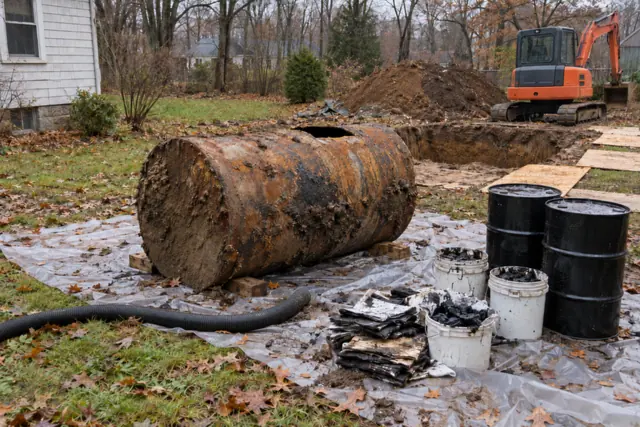
The OCC rules in Chapter 25 set the steps. The owner notifies the Petroleum Storage Tank Division at least 14 days before the tank removal on its scheduling form, and the division must confirm the date. A Licensed UST Remover must be on the job site during all removal activities, beginning with break-out of concrete, and using an unlicensed remover carries a $5,000 fine. All closure sampling must be supervised by a Licensed Environmental Consultant. Tanks and lines must be removed unless a Commission order grants a variance, so closure in place is the exception. The closure report goes to the division within 45 days.
The Oklahoma Petroleum Storage Tank Indemnity Fund pays for corrective action after an eligible release, not for closing a tank. Under 17 O.S. 327.3, it does not pay for removing or disposing of storage tanks unless removal is required by a corrective action plan the Commission approved. The co-payment cannot exceed $5,000, and reimbursement is capped at $2,500,000 per occurrence. The owner must have been in substantial compliance with the rules when the release was reported. Costs incurred before a confirmed release or a suspicion of release investigation are not reimbursed unless the division approves emergency response costs in advance. Leaks from excluded tanks such as heating oil tanks are not covered. Our guide to closure in place versus UST removal explains what changes the scope of a closure job.
A release found during a tank closure must be reported to the OCC within 24 hours, and the division's release reporting page lists the phone numbers and email. Closure assessment records must be kept for at least three years. While a tank system is still present, the landowner counts as an owner under the rules, unless the tank was taken out of service before November 8, 1984. A new owner must notify the division within 30 days of a sale. The OCC publishes current lists of Licensed UST Removers, installers and environmental consultants on its licensees page. Before hiring any contractor on this page, confirm the remover and the consultant appear on those lists.