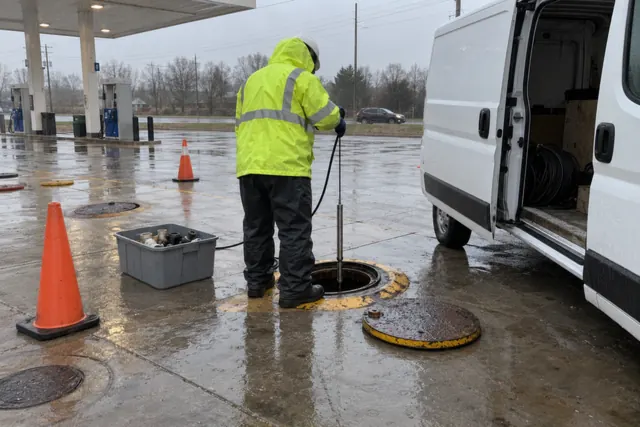
Oil Tank Inspection & Testing Companies in New Jersey
Find licensed contractors in New Jersey for oil tank inspection, underground storage tank testing, tank tightness testing, leak detection, and UST compliance assessments. Serving Newark, Jersey City, Trenton, Edison, Toms River, Cherry Hill, and communities statewide.
What to Know About Oil Tank Inspection & Testing in New Jersey
New Jersey requires mandatory HAZWOPER certification for all contractors performing oil tank inspection and testing,
and the requirement applies to residential and commercial work equally. That makes New Jersey one of the strictest
states in the country for underground tank regulation. There is no category of tank work in New Jersey where an
uncertified contractor can legally operate. The state enforces this aggressively because of what is at stake. New
Jersey is the most densely populated state in the country. Tens of thousands of older homes, particularly
pre-1960s construction in northern and central New Jersey, were built with underground heating oil tanks that are
now 60 to 70 years old. A leaking underground oil tank in a New Jersey neighborhood does not just affect one
property. The houses are close enough together that soil contamination migrates to neighboring lots, turning one
homeowner's problem into a multi-property environmental event.
Underground oil tank inspection demand in New Jersey is among the highest in the country, driven by two
overlapping markets. The commercial side follows the I-95 corridor and the New Jersey Turnpike from the George
Washington Bridge through Newark, Edison, and Trenton to the Delaware River crossings. Gas stations, fleet
facilities, and industrial operations along this corridor require regular fuel tank inspection and UST compliance
assessments. The residential side is where New Jersey stands apart. Real estate transaction volume in New Jersey
is enormous, and oil tank inspection has become a standard part of the home buying process in communities where
underground heating oil tanks are common. Bergen County, Essex County, Morris County, Monmouth County, and Ocean
County see particularly high inspection demand. A home inspector who identifies a potential underground oil tank
is not qualified to perform the specialized testing required. That work needs a state-certified contractor with
tank-specific equipment. Many of the same contractors who perform underground oil tank inspection also handle oil
tank removal and tank decommissioning when a pre-sale inspection reveals a tank that has reached the end of its
useful life. For more details, see our guide on oil tank sweep testing process.
Oil tank inspection cost in New Jersey typically ranges from $400 to $1,500 for a residential underground oil tank
and $500 to $2,000 for a basic commercial tank tightness test. Comprehensive multi-tank facility assessments run
$2,000 to $6,000. For residential buyers, the oil tank inspection cost is a small fraction of the purchase price,
but the liability it prevents is not small at all. New Jersey holds property owners strictly responsible for
contamination on their land regardless of who caused it. A buyer who closes on a house without an oil tank
inspection and later discovers soil contamination from a tank the previous owner abandoned is fully responsible
for cleanup. Environmental remediation for a residential heating oil release in New Jersey routinely costs $20,000
to $100,000 or more. In dense neighborhoods where contamination crosses property lines, costs can escalate further
when neighboring homeowners and their attorneys get involved. A $500 inspection before closing is the most
effective way to avoid inheriting a six-figure environmental liability.
Federal law requires EPA or the state to inspect each regulated underground storage tank at least once every three years. Owners also have duties of their own under 40 CFR 280: release detection on tanks at least every thirty days by one of several approved methods, and walkthrough inspections every thirty days and once a year.
Residential underground oil tanks in New Jersey have no mandated inspection schedule, but the real estate market
has created a de facto requirement. Mortgage lenders, title companies, and buyers routinely require a clean tank
test before closing. For homeowners not currently selling, New Jersey's environmental liability rules create a
strong incentive to know the condition of a buried tank before a problem develops. Any underground oil tank over
30 years old in New Jersey's clay and sandy coastal soils is at elevated risk for corrosion failure. An
environmental remediation contractor familiar with New Jersey's strict liability framework can assess whether a
tank still has serviceable life. The same review weighs whether closer monitoring is warranted, or whether tank decommissioning is the
financially prudent decision before a slow leak turns a known tank into an unknown liability.
New Jersey contractors for tank inspection and testing
Do I need a certified contractor for oil tank inspection in New Jersey?
Yes, and New Jersey enforces this more strictly than most states. State certification is mandatory for all oil
tank inspection and fuel tank inspection work, residential and commercial alike. There is no exemption for
smaller tanks, older systems, or residential properties. Using an uncertified contractor produces inspection
results the state will not accept, which can derail a real estate transaction or leave a facility out of
compliance. In a state where strict environmental liability means the current property owner pays for cleanup
regardless of who installed the tank, ensuring every inspection is performed by a state-certified contractor is
not optional. It is the foundation of legal and financial protection.
How much does oil tank inspection cost in New Jersey?
Residential underground oil tank inspection in New Jersey typically costs $400 to $1,500 depending on tank size,
depth, and accessibility. Commercial tank tightness testing runs $500 to $2,000, with comprehensive multi-tank
assessments at $2,000 to $6,000. Oil tank inspection cost is a fraction of what a missed problem generates. New
Jersey's strict liability rules mean the current property owner is responsible for soil contamination cleanup
regardless of when the tank was installed or who caused the leak. Environmental remediation for a residential
heating oil release routinely costs $20,000 to $100,000. In dense neighborhoods where a leaking underground
storage tank causes soil contamination that crosses property lines, costs escalate further with legal claims
from affected neighbors. A $500 inspection is the cheapest form of protection available.
How often do underground storage tanks need to be inspected in New Jersey?
Federal law requires EPA or the state to inspect each regulated underground storage tank at least once every three years. Owners also have duties of their own under 40 CFR 280: release detection on tanks at least every thirty days by one of several approved methods, and walkthrough inspections every thirty days and once a year. Residential underground oil tanks have no
mandated inspection schedule in New Jersey, but the real estate market has created an effective requirement.
Mortgage lenders and title companies routinely require a clean tank test before closing. For homeowners not
selling, the practical guideline is to schedule a fuel tank inspection every three to five years for tanks under
30 years old, and every one to two years for tanks over 30. New Jersey's mix of clay soils in the north and
sandy coastal soils in the south both create corrosion conditions that shorten tank life, just through different
mechanisms. Clay retains moisture against the tank wall. Sandy soil allows water to flow past the tank
continuously. Both accelerate metal degradation over time.
Can I sell my house with an underground oil tank in New Jersey?
You can, but most buyers, lenders, and title companies will require a tank tightness test before closing. A
clean test result keeps the transaction moving. A failed test gives you the opportunity to address the problem
on your timeline rather than under pressure from a buyer's deadline. If the tank passes, you sell with
confidence. If the tank fails, you have three options: repair, tank decommissioning and removal, or abandonment
in place with proper closure procedures. All three require a state-certified contractor. The worst outcome is
discovering a tank problem after a buyer's inspector finds it. That puts you in the weakest negotiating
position and often leads to price reductions far larger than the cost of proactive oil tank inspection and
resolution would have been.
What types of tank testing are available in New Jersey?
New Jersey contractors offer several UST testing methods for both residential and commercial systems. Tank
tightness testing measures whether a tank holds pressure without loss, detecting leaks too small for visual
observation or automatic gauging. Line tightness testing checks piping between the tank and fill point for slow
seepage at connections. Cathodic protection testing verifies the corrosion prevention system is working, which
is important in both New Jersey's northern clay soils and southern sandy coastal soils. For properties where
contamination is suspected, soil sampling determines whether petroleum has migrated beyond the tank zone, and
groundwater monitoring verifies whether a release has reached the water table. Ground-penetrating radar is
commonly used in New Jersey to locate abandoned tanks that may not appear on property records, a frequent
scenario in pre-1960s homes that have changed hands multiple times without anyone documenting the tank.