

What to Know About Site Assessment in District of Columbia
Property transactions in Washington, DC trigger site assessments more frequently than in most jurisdictions. A standard Phase I inside the District prices at $2,000 to $4,500. The District operates its own UST regulatory program through its environmental agency, which oversees registration, closure, and release response for all underground storage tanks within city limits. DC is not a state, but it functions as one for UST regulatory purposes under federal EPA delegation.
Any property with current or former petroleum storage requires investigation before sale, refinancing, or redevelopment. Commercial fueling facilities, federal government properties, and mixed-use developments built on former gas station parcels drive the bulk of assessment demand. The District does not issue a UST-specific HAZWOPER training. Phase I work used for federal liability protection must be run by an environmental professional under 40 CFR 312.10, and a licensed PE or PG with relevant experience is one way to meet that rule. DOEE does license and certify UST installers, removers and testers under 20 DCMR Chapter 65, though that credential covers tank work rather than Phase I or Phase II assessments.
Demand for site assessments in DC concentrates along older commercial corridors where gas stations operated for decades before being redeveloped. The U Street and H Street NE corridors have seen dozens of former fueling sites converted to mixed-use buildings. Phase I ESAs are standard on nearly every commercial acquisition in those neighborhoods. Georgetown's waterfront redevelopment area carries legacy contamination risk from historic industrial and fuel storage operations along the Potomac.
Anacostia and neighborhoods east of the river have aging commercial parcels with undocumented tank histories that surface during city-led revitalization efforts. Federal properties and embassy compounds occasionally require assessment work when leases turn over or buildings are decommissioned. DC's real estate market moves fast, and compressed transaction timelines mean Phase I turnaround expectations are tighter here than in most markets.
Phase I ESAs in Washington, DC typically cost $2,000 to $4,500, reflecting the higher professional fee structure in a major metro area. Phase II investigations run $4,000 to $12,000 for standard commercial parcels, with costs climbing above $15,000 for sites with multiple suspected tank locations or complex subsurface conditions. Individual soil boring locations cost $500 to $1,500 each in DC due to permitting requirements and limited site access in dense urban settings.
Lab analysis adds $200 to $600 per sample. The District does not operate a traditional petroleum cleanup reimbursement fund like many states do. Property owners and responsible parties bear investigation and remediation costs directly, which makes the Phase I a particularly high-stakes document in DC transactions. Lenders financing commercial acquisitions in the District almost universally require a current Phase I before closing.
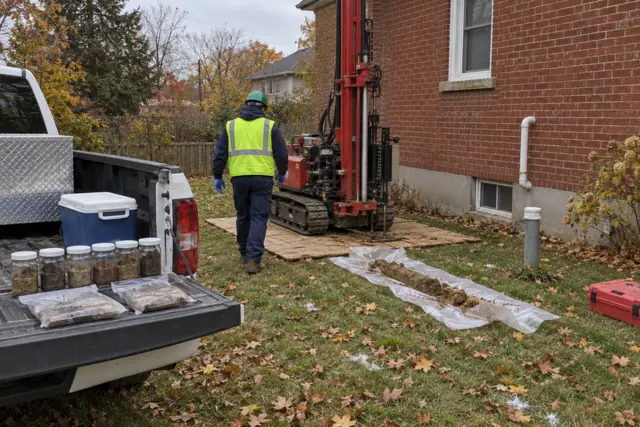
A typical Phase I engagement in DC starts with a records search through the District's environmental database and federal EPA records. A physical inspection of the property and adjoining parcels follows. Expect the Phase I report in two to four weeks from the engagement date. If recognized environmental conditions are identified, Phase II drilling usually requires a public space permit from the District's transportation department. That permit can add one to two weeks to the project timeline. Soil and groundwater samples are collected over one to three days of field work, with lab results returned in two to three weeks.
The complete Phase II report arrives six to ten weeks after field mobilization. Before selecting a firm, verify they have completed assessments within DC specifically, not just in Maryland or Virginia suburbs. Urban drilling in the District involves traffic control, utility clearance, and space constraints that suburban firms may not be equipped to handle efficiently. Request a proposal with all permits, drilling, lab fees, and reporting bundled into one fixed cost.