

Why Mississippi Tank Installation Projects Vary by Region
Three highway corridors drive most of Mississippi's tank installation demand. I-55 from Jackson south to the Louisiana border, the Gulf Coast around Gulfport and Biloxi, and I-20 connecting Vicksburg to Meridian see the heaviest project volume. Jackson's metro area accounts for the largest share of new gas station construction and tank replacement projects. Hattiesburg and the Pine Belt region see steady activity from truck stops serving the timber and poultry industries. Smaller towns across the Delta rely on aging single-wall systems that increasingly need full replacement rather than repair. Fleet operators and agricultural cooperatives in rural counties install private fueling systems that carry the same permitting and inspection requirements as commercial retail stations.
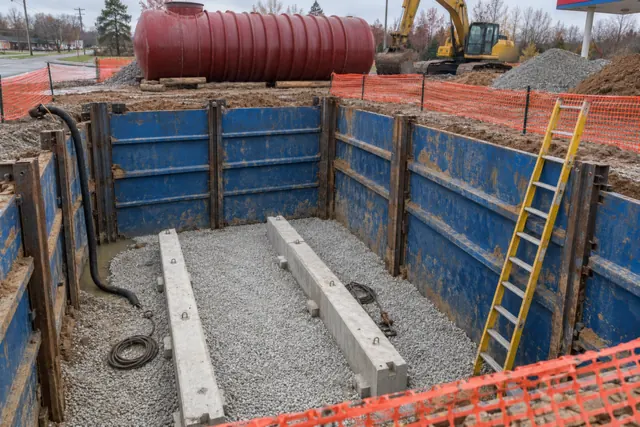
A single underground storage tank installation in Mississippi typically costs $50,000 to $140,000, depending on tank size, material, and site conditions. Multi-tank gas station buildouts with dispensers, canopy, and piping run $250,000 to $450,000 or more, with monitoring equipment adding $5,000 to $15,000 per tank system. Sandy coastal soils near Gulfport can reduce excavation costs, while the heavy clay soils common in the Delta region require more extensive backfill preparation and sometimes dewatering, pushing costs higher. Mississippi does maintain a state cleanup fund that may reimburse eligible remediation costs if contamination is discovered during an old tank removal tied to a replacement project. The fund does not cover new installation costs.
Mississippi's state environmental agency regulates underground storage tanks and requires contractors to hold a state-issued UST license before performing any installation work. No tank can go into the ground until the owner files MDEQ's Notice of Upcoming Installation 30 days in advance of the planned installation date. The state follows federal EPA technical requirements for double-wall containment, spill prevention, overfill protection, and release detection on every new system. Convenience store operators and fuel distributors building new sites need both the MDEQ installation notice and any local building or fire marshal approvals before breaking ground. Skipping the state notification step does not just delay your project; it can result in fines and a stop-work order that costs more than filing the notice on time.
The installation process starts with site engineering and soil borings, followed by the MDEQ installation notice and local permit applications. Expect four to eight weeks for permitting alone, with the actual construction taking two to four weeks for a standard single-tank project. Before the first fuel delivery, MDEQ rules require spill prevention equipment and secondary containment to be tested and overfill prevention inspected, and an MDEQ-certified installer must be on site for each critical step. Owners who skip the pre-construction soil boring sometimes discover high water tables or unsuitable soils after excavation has started, turning a straightforward install into a costly redesign. Confirm that any contractor you hire holds a current Mississippi UST license, carries adequate insurance for underground work, and can provide references from at least two completed installations in similar soil conditions.