

How Oil Tank Removal Works in Alabama
Alabama oil tank removal is administered by the Alabama Department of Environmental Management. ADEM oversees UST registration, closure notifications, and release response under Ala. Admin. Code chapter 335-6-15 and the federal 40 CFR 280 rules. Closing a regulated UST at a gas station, fleet yard, or industrial site must be supervised by an individual certified by an ADEM-approved certifying organization. Residential heating oil tanks sit outside the regulated universe, and few Alabama homes heat with oil in any case. Owners closing a commercial tank must file a 30-day closure notice with ADEM, and soil sampling at the tank bed is required before backfill.
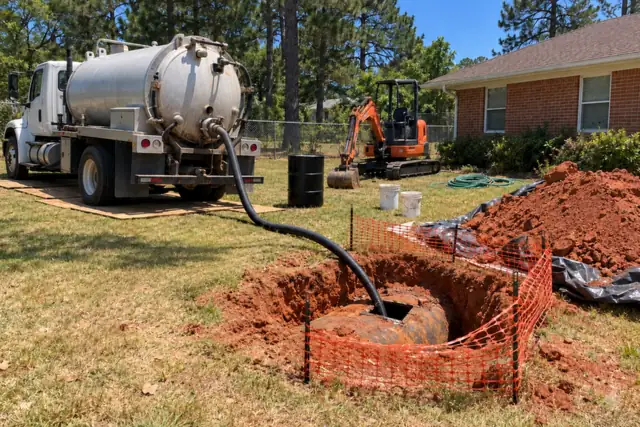
Alabama tank removal demand concentrates in Birmingham metro, Mobile's Gulf Coast industrial corridor, Huntsville's aerospace footprint, and the Montgomery state-government fueling fleet. Commercial UST turnover runs heaviest at gas stations along I-65, I-20, and I-10 through Mobile and Baldwin County, plus Port of Mobile petroleum terminals and Birmingham rail-fed distribution yards. Redstone Arsenal and Huntsville defense contractor campuses generate steady fleet-fuel tank closure work as 1990s infrastructure ages out. Alabama's residential oil-heat market stays near zero: about two-thirds of Alabama homes heat with electricity and about a quarter with natural gas, according to Census Bureau survey data, while fuel oil heats about one home in a thousand. Coastal humidity and red-clay subsoils in Mobile and Baldwin counties accelerate tank corrosion, which pushes closure timelines on older single-wall steel inventory.
Commercial oil tank removal in Alabama typically runs $5,000 to $15,000 per tank for a single-wall UST, with multi-tank gas station closures reaching $20,000 to $60,000 at larger layouts. Excavation access, tank depth, and proximity to fuel dispensers drive most cost variation at working gas stations. If soil sampling returns petroleum above ADEM corrective action limits, environmental remediation adds $10,000 to $50,000 or more, especially at Mobile Bay sites with shallow groundwater. Alabama's Underground and Aboveground Storage Tank Trust Fund reimburses eligible owners for qualifying corrective-action costs on pre-authorized cleanup. Our guide breaks down what tank removal costs by tank size, contamination scenario, and site access.
An Alabama commercial closure starts with Alabama 811 locates, a 30-day ADEM closure notice, and tank degassing, then one to three days of excavation for a single tank. Multi-tank gas station closures stretch to three to seven days depending on layout and product type, with soil sampling collected the day the tank comes out. Certified-lab turnaround runs one to three weeks, and remediation extends the timeline weeks to months if a release triggers ADEM corrective-action review. Before hiring, confirm that the person supervising the closure holds a current certification from an ADEM-approved certifying organization, that the firm carries pollution liability insurance, and that it can give recent Gulf Coast or Birmingham references. Browse Alabama UST contractors or request a quote to start your project.