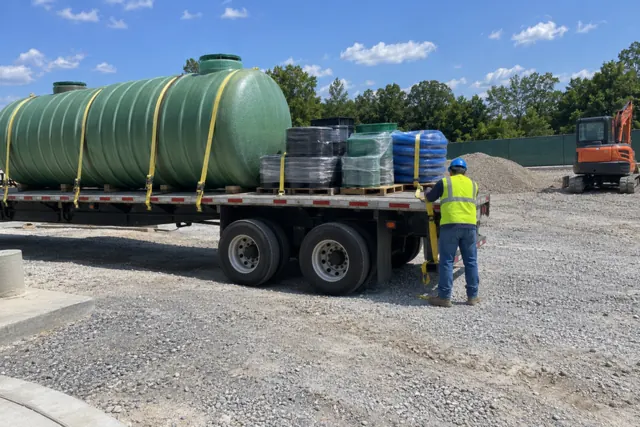
Find contractors in South Carolina for underground storage tank installation, fuel system build-outs, dispenser installation, piping systems, tank replacement, and monitoring equipment. Serving Charleston, Columbia, Greenville, Myrtle Beach, Spartanburg, and communities statewide.
Installing Underground Storage Tanks in South Carolina
Every tank installation in South Carolina must be certified under state rules. The owner certifies it on the Permit to Operate application, using a manufacturer-certified installer, an engineer's or Department inspection, or another method Regulation 61-92 allows. Certified installs price between $50,000 and $145,000 for a single tank. Every new tank must be registered and permitted before it receives product. Installations must comply with both federal EPA technical requirements and state-specific rules covering spill prevention, overfill protection, and leak detection.
A single underground storage tank installation in South Carolina typically runs $50,000 to $145,000, with variation driven by tank capacity, material choice, and local soil conditions. Multi-tank gas station build-outs with dispensers, canopy work, piping, and monitoring systems range from $240,000 to $475,000, with monitoring equipment alone adding $5,000 to $15,000 per tank system. Coastal sites near Charleston, Beaufort, or Myrtle Beach often face higher excavation costs due to high water tables that require dewatering during construction. The SUPERB fund does not reimburse installation costs, so owners replacing aging tanks at existing sites should budget separately for contamination. It does cover site rehabilitation after a release. S.C. Code Ann. 44-2-40 sets an owner share per occurrence, and the SUPERB Account and SUPERB Financial Responsibility Fund together provide coverage above it. Pre-installation soil sampling beneath an old tank footprint catches problems early, before new equipment goes in the ground.
Charleston's growth as a logistics hub and cruise port generates steady demand for tank installation along the I-26 corridor, from fleet fueling infrastructure to new gas station construction. Columbia, as the state capital, anchors a central market where government fleet facilities and commercial fueling stations cluster near the I-20 and I-77 interchange. Greenville and Spartanburg drive projects tied to the manufacturing boom that BMW, Michelin, and their supply chains have fueled along the I-85 corridor. Myrtle Beach and Hilton Head support seasonal tourism economies where fuel demand spikes heavily in summer, pushing convenience store chains to expand fueling capacity. Rural areas along I-95 between Florence and Hardeeville also see periodic tank replacement projects at aging truck stops serving the East Coast freight corridor.
The typical installation timeline runs 8 to 14 weeks from site engineering through operational approval. Permitting and design usually consume three to five weeks, physical construction runs four to seven weeks depending on tank count, and post-installation testing adds one to two weeks. After installation, the state requires tightness testing, leak detection verification, and monitoring system commissioning before the facility can dispense fuel. When comparing bids, ask whether each contractor's price includes registration paperwork, engineered backfill, monitoring commissioning, and post-installation compliance testing. Bids that separate those items as add-ons look cheaper on paper until the final invoice arrives.
Do contractors need a state certification to install USTs in South Carolina?
South Carolina does not require a single state installer credential for UST installation. Under R.61-92 Section 280.20, the owner certifies the installation on the Permit to Operate application by one of several methods, such as a manufacturer-certified installer, a professional engineer's inspection, or a Department inspection. The Site Rehabilitation Contractor Certification applies to release assessment and cleanup, not to installation or closure. Ask which certification method your installer will use before signing any contract.
How much does a new underground storage tank installation cost in South Carolina?
Single tank installations typically fall between $50,000 and $145,000 in South Carolina, depending on tank size, material choice, and site-specific excavation conditions. Full gas station build-outs with multiple tanks, dispensers, piping, and monitoring equipment range from $240,000 to $475,000. Coastal properties with high water tables may see excavation costs run 10 to 20 percent above inland sites due to dewatering requirements. Monitoring equipment adds $5,000 to $15,000 per system. These figures assume clean soil at the site; contamination found during old tank removal is a separate cost, though the SUPERB Account can pay eligible site rehabilitation above the owner's share.
How long does a UST installation project take in South Carolina?
Most projects run 8 to 14 weeks from initial engineering through final operational approval. Permitting and design consume three to five weeks, while physical construction takes four to seven weeks depending on how many tanks are being installed. Post-installation testing and state registration add one to two weeks at the end. Projects at existing sites where an old tank must come out first can extend the timeline by two to four weeks. That window stretches further if soil sampling reveals contamination that requires remediation before the new system goes in.
How does South Carolina's coastal water table affect tank installation?
Much of the Lowcountry from Charleston to Hilton Head sits on a water table that can be as shallow as two to four feet below grade during wet seasons. Installing a 10,000-gallon tank in those conditions requires active dewatering throughout excavation, which adds equipment cost and construction time. Buoyancy is a real engineering concern for empty tanks in saturated soils, so contractors must install proper anti-flotation measures such as concrete hold-down slabs or deadman anchors. Inland sites along the Piedmont from Greenville to Rock Hill rarely face these issues, which is one reason coastal bids tend to run higher. If your site is within 20 miles of the coast, ask specifically how the contractor plans to manage groundwater during the dig.
What monitoring equipment is required on new tanks installed in South Carolina?
Every new UST installation in South Carolina must be secondarily contained and use interstitial monitoring under R.61-92 Section 280.20, with an automatic line leak detector on pressurized piping, in line with EPA's 2015 updated federal requirements. The monitoring system must be fully commissioned and producing valid readings before the state approves the facility to dispense fuel. Equipment costs typically run $5,000 to $15,000 per tank system depending on the level of automation. Owners often treat monitoring as a last-step checkbox, but getting sensors configured correctly during initial construction costs a fraction of what it takes to retrofit a buried system after backfill. Make sure your contractor's bid explicitly includes monitoring installation, commissioning, and the initial calibration testing rather than listing those as separate charges.