
Oil Tank Removal Contractors in Delaware

Find Delaware contractors for oil tank removal, UST closure, tank decommissioning, heating oil tank removal, basement tank excavation, petroleum tank removal, coastal site work, and environmental remediation. Serving Wilmington, Dover, Newark, Middletown, Georgetown, Seaford, and communities statewide.

Browse Delaware Contractors →

How Oil Tank Removal Works in Delaware

Delaware's heating oil tank legacy runs heaviest in northern New Castle County. Wilmington, Newark, and Brandywine Hundred sit along the I-95 corridor where mid-century subdivisions commonly installed buried oil tanks as the default heat source. Home sales routinely surface these tanks during property inspections, and lenders will not finance a purchase until the tank is resolved through oil tank removal or documented closure. Central Delaware around Dover and Smyrna sees mixed residential and commercial work tied to aging suburban development and older Route 13 fueling sites. Sussex County handles more commercial UST closure along beach-community service stations and agricultural storage at Georgetown and Seaford operations.
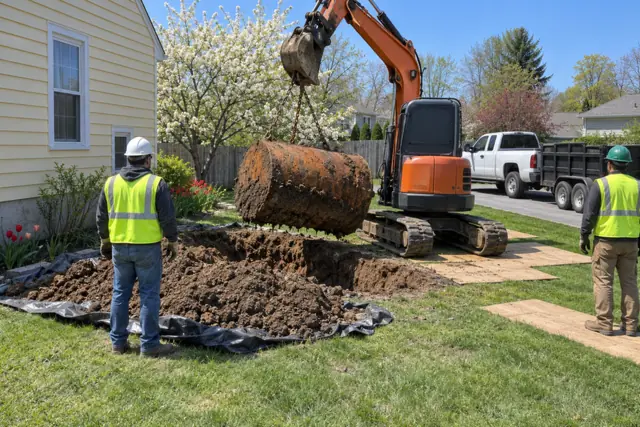
Delaware oil tank work is overseen by the DNREC Tank Management Section. DNREC requires advance notification before any regulated UST is pulled, along with soil sampling at the tank bed and closure documentation filed within 30 days of removal. Residential heating oil tank work sits outside the federal UST program but must still follow DNREC closure procedures under state rules. Commercial UST work requires contractors registered with DNREC and following federal 40 CFR 280 standards. Failing to notify DNREC or file post-closure documentation typically means repeating work at the owner's expense.

Residential tank removal in Delaware typically costs $1,500 to $3,500 for a standard yard burial, with basement tanks running $2,500 to $5,000 because of access constraints through confined indoor spaces. Commercial UST removal at gas stations or fleet facilities ranges from $5,000 to $25,000 per tank depending on tank size and site conditions. If soil sampling exceeds DNREC cleanup standards, environmental remediation adds $10,000 to $50,000 or more, with higher figures at Sussex County coastal sites where shallow water tables accelerate plume migration. Delaware operates the UST Financial Responsibility Fund through DNREC, which may reimburse qualifying corrective-action costs for eligible regulated tank owners. Our cost guide breaks down pricing by tank location, contamination scenario, and regional cost differences across Delaware.

A Delaware residential removal typically runs one to three days from excavation through backfill when soil samples come back clean. Basement tank removals add labor hours because pieces must pass through doorways and stairwells, extending the timeline by a day or two. Soil lab results take one to three weeks, and closure paperwork filed with DNREC takes several weeks more before final acceptance. Before hiring, verify the contractor holds active DNREC registration, carries pollution liability insurance, and can show recent Wilmington or Dover-area closure references. Compare local options at tank contractors in Delaware or get a free quote for written pricing.

Oil Tank Removal Contractors in Delaware

Browse contractors, see contact details, and request free quotes.

Browse Delaware Contractors →

Frequently Asked Questions

Do I need a licensed contractor for oil tank removal in Delaware?

Commercial UST work in Delaware requires contractors registered with DNREC's Tank Management Section and carrying state-approved environmental credentials. Residential heating oil tank work does not require a specific state license, but contractors must follow DNREC closure procedures and carry appropriate pollution liability insurance. Hiring an unqualified contractor can result in rejected closure documentation, which means repeating work at your expense. Ask any contractor for DNREC registration proof and recent Wilmington, Dover, or Newark project references.

How much does oil tank removal cost in Delaware?

Residential oil tank removal in Delaware typically runs $1,500 to $3,500 for a standard yard burial and $2,500 to $5,000 for basement tanks. Commercial UST removal at gas stations ranges from $5,000 to $25,000 per tank based on size and site conditions. If soil testing reveals contamination, remediation costs add $10,000 to $50,000 or more depending on plume size and groundwater depth. Our cost guide breaks down pricing by tank type, contamination scenario, and regional differences.

Does Delaware have a cleanup fund for petroleum tank releases?

Delaware operates the UST Financial Responsibility Fund through DNREC, funded by tank registration fees and per-gallon surcharges on motor fuel. The fund reimburses eligible owners for corrective-action costs on qualifying regulated-UST releases. Residential heating oil tanks below the regulated threshold generally fall outside fund eligibility. Owners should file program paperwork before starting cleanup because pre-authorization affects reimbursement.

Do Delaware coastal sites face extra challenges during tank removal?

Sussex County coastal sites commonly sit over shallow groundwater that can intersect the tank pit during excavation. When an older tank has leaked, petroleum reaches shallow groundwater faster and spreads farther than it would in drier soils farther inland. This means contamination plumes in beach and bay communities tend to be larger and more costly to remediate. Rehoboth, Lewes, and Dewey Beach property removals may require dewatering equipment and produced-water handling as regulated waste. Contractors working Sussex sites should carry coastal-site references and the right equipment for high-water-table conditions.

How long does a tank closure take in Delaware?

A residential tank closure takes one to three days of on-site work when no contamination is found. Basement tanks typically add one to two days for disassembly and interior-access logistics. Soil lab results come back in one to three weeks after collection. Closure documentation review by DNREC takes several weeks more, with the entire process wrapping up six to eight weeks on a clean site. Sussex County projects near the coast may run longer if groundwater dewatering or coastal permit coordination is required.

Looking for a contractor in Delaware?

Browse contractors, see contact details, and request free quotes.

Browse Delaware Contractors →

For Delaware UST regulations, visit the DNREC Tank Management Section. Federal requirements are available from the EPA UST Program.

Related Services in Delaware

Find Delaware ContractorsRequest a Free Quote
Free Quotes