

What to Know About Oil Tank Removal in Kansas
Kansas oil tank removal has a long refining and pipeline history, which gives the state an outsized inventory of aging underground tanks relative to its population. The Kansas Department of Health and Environment Storage Tank Section licenses UST contractors and regulates closure work under the Kansas Storage Tank Act (K.S.A. 65-34,100) and K.A.R. 28-44. KDHE requires a 30-day advance notice before any permanent closure begins and a 24-hour release report when contamination is confirmed. A KDHE-licensed storage tank contractor must perform the excavation, collect soil samples, and file the closure report. Property owners cannot legally abandon or partially close a regulated tank without that license.
Commercial UST turnover concentrates across the Wichita and Kansas City metros, with gas stations, truck stops, and fleet yards cycling tanks since the 1990s federal deadlines. Refinery-legacy towns like El Dorado, McPherson, and Coffeyville carry a deeper inventory of industrial tanks tied to long-running refining and chemical operations. Johnson County suburbs through Overland Park, Olathe, Lenexa, and Leawood add steady commercial activity, and Topeka, Lawrence, Manhattan, and Salina cover the central and eastern corridor. Western Kansas wheat and feedlot country from Dodge City and Garden City to Hutchinson carries scattered on-farm and co-op bulk fuel tanks above the Ogallala Aquifer, which drives unusually tight groundwater sensitivity.
Residential pricing across the Wichita and Kansas City metros runs $1,200 to $2,600 for a standard buried tank with clean soil and machine access. Tight urban lots and basement-adjacent tanks in older Wichita College Hill and Topeka Westboro neighborhoods climb to $2,500 to $4,500. Commercial UST closure at Kansas gas stations starts around $4,500 per tank and climbs with piping and pit size. Farm fuel tank removal in rural counties runs $2,000 to $5,500 depending on tank count and access. If contamination surfaces during excavation, environmental cleanup adds $10,000 to $50,000 or more, particularly in western Kansas where Ogallala Aquifer protection triggers expanded sampling. Kansas's Kansas State Fire Marshal reimburses eligible owners for a significant share of corrective action costs after a deductible keyed to compliance status. Our oil tank removal cost guide breaks down what drives the final invoice.
A straightforward Kansas residential job wraps in one day on site, with soil laboratory results returning in five to ten business days. Commercial multi-tank closures at Wichita, Overland Park, and Topeka gas stations run three to five days. Spring tornado season from March through June and winter frost in the Flint Hills and western plains both push most scheduling into summer and early fall. If sampling flags petroleum, the site enters corrective action under KDHE oversight with timelines running weeks to months. Before signing a contract, ask for the contractor's KDHE storage tank license class, a recent Kansas closure report, and written pricing for both clean-soil and contaminated outcomes. View Kansas tank removal contractors for local options, or submit your quote request for direct estimates.
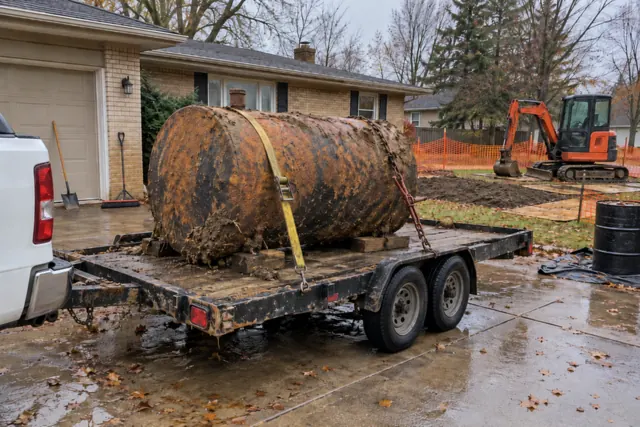
Oil tank removal in Kansas generates materials that must be tracked from the site to an approved disposal facility. Residual product is pumped and manifested. Tank shells go to a scrap yard or licensed salvage operator. Contaminated soil, when present, is characterized by sampling and hauled to a permitted landfill or treatment facility. The KDHE closure report lists where each stream went and includes the manifest numbers. Hazardous-waste levels trigger federal 40 CFR 262 manifest rules on top of the state's own disposal requirements. Contractors licensed to perform oil tank removal in Kansas are expected to maintain the chain-of-custody paperwork for the full disposal trail. Missing or incomplete manifests are one of the most common reasons a closure report is kicked back for revision, which delays site sign-off and can push the project past budget.