

What to Know About Tank Decommissioning in Maryland
The Maryland Department of the Environment (MDE) regulates oil storage tanks through its Oil Control Program, which oversees their installation, operation and removal, including underground storage tanks (USTs). Maryland draws its lines differently from the federal rules. The UST definition in COMAR 26.10.02.02 leaves out a farm or residential tank with a capacity of 1,100 gallons or less that stores motor fuel or heating oil for noncommercial purposes, but only while it is in use. Once such a tank is no longer in use, it becomes subject to the closure rules in COMAR 26.10.10. Residential and farm tanks over 1,100 gallons are regulated, and so is a heating oil UST at a business, which is exempt from several operating rules but not from tank closure.
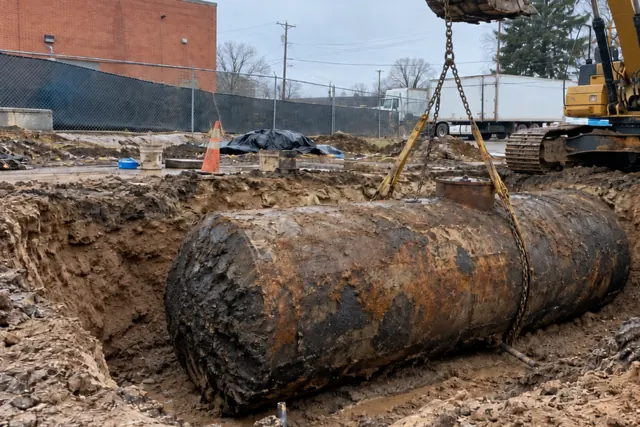
An unused home heating oil tank in Maryland cannot simply be left as it is. MDE's residential and farm tank closure fact sheet states that once a tank is no longer used to store fuel at a residential or farm property, it must be removed or closed in place. The work is done under the on-site supervision and direction of a Maryland-certified UST System Technician or Remover. MDE advises closing a tank in place only when it is under a building or removing it would endanger the structural integrity of a building. MDE's residential heating oil page adds that the program does not require prior notice of the closure. A written closure report is needed only if a spill, release or discharge occurred or MDE directs one. The same fact sheet calls for soil samples from at least 2 feet below the tank bottom when a tank is closed in place, and post-excavation soil samples when it is removed. It also says a local fire, health or planning department may require a permit. In Baltimore County, the Ground Water Management section handles residential tank removal, and the county's removal notification form requires an inspection to be arranged with that section before a residential or farm tank under 1,100 gallons comes out.
For a regulated UST, COMAR 26.10.10.02 requires written notice to MDE at least 30 days before the tank closure begins, on MDE's form, and a confirmation 48 hours in advance. The closure must be performed by or under the supervision of a certified UST system technician or remover. Removal is the standard method. Abandonment in place requires MDE's approval and a report signed by a professional engineer confirming that removal would harm a building foundation or other important structure, and the tank must be completely filled with a solid, inert, flowable material. After a site assessment, the certified technician or remover signs a closure report that goes to MDE within 45 days, and the owner keeps the closure documentation for at least 5 years.
Maryland's tank cleanup reimbursement programs are closed. MDE's 2025 report on the Oil Contaminated Site Environmental Cleanup Fund says the commercial reimbursement program closed at the end of fiscal year 2013. MDE states that its Residential Heating Oil Tank System Site Rehabilitation Program is no longer active, and it accepted reimbursement applications only through July 1, 2024. EPA's list of State Financial Assurance Funds places Maryland among the states with no EPA-approved state fund. Contamination found during the work must be reported to MDE within 2 hours of discovery under COMAR 26.10.08.01. MDE's certification search shows the current certification status of UST technicians, heating oil technicians, removers and inspectors. Before hiring any contractor on this page, ask which certified person will be on site and look that person up.