Oil Tank Inspection & Testing Companies in North Carolina
Find contractors in North Carolina for tank tightness testing, UST compliance inspection, line testing, and leak detection. Serving Charlotte, Raleigh, Greensboro, Durham, and communities statewide.
What to Know About Oil Tank Inspection & Testing in North Carolina
North Carolina sets strict tank inspection and testing deadlines on active UST systems. The North Carolina DEQ UST Section enforces 15A NCAC 02N rules that govern tightness testing, leak detection methods, and monthly monitoring records for any facility storing petroleum underground. Operators in Charlotte, Raleigh, and along the Piedmont I-85 corridor schedule tank tightness testing every three years for steel systems and run annual line testing on pressurized piping. Before buying a former gas station or property with a buried tank, North Carolina buyers commonly order a Phase I ESA to flag historical UST activity. That early review often triggers expanded testing during due diligence.
Demand for UST compliance inspection concentrates around the Research Triangle metros of Raleigh, Durham, and Cary, where retail fuel sites cluster along I-40. The Charlotte banking corridor and the western Piedmont communities of Winston-Salem, Greensboro, and High Point host hundreds of convenience-store fuel facilities that need recurring tank tightness test coverage. Coastal Plain volume comes out of Wilmington, Jacksonville near Camp Lejeune, and Fayetteville near Fort Bragg. Military and port operators there rely on leak detection sign-offs to keep federal contracts active. Mountain counties around Asheville face costlier mobilization, while agricultural fueling in the eastern tobacco belt around Greenville drives integrity testing volume for cooperatives.
In North Carolina, a single tank tightness test typically runs $500 to $1,800. Most Piedmont contractors quote around $750 for a steel tank, with adjustments for size and access. A full UST compliance inspection covering piping, dispensers, monitoring, and recordkeeping ranges from $1,000 to $3,000, while line testing on pressurized piping falls between $300 and $800 per line. Cathodic protection testing required every three years on steel systems runs $400 to $1,200, and bundled multi-test packages typically save 10 to 15 percent on the per-test rate. Eligible release-related costs may be reimbursed through the North Carolina Commercial Leaking UST Cleanup Fund. The state's non-commercial fund, which once covered residential heating oil sites, was phased out by Session Law 2015-241 Section 14.16A.
North Carolina inspection cycles begin with NCDEQ records review, with results submitted within 30 days using NCDEQ-prescribed forms. Tank tightness testing on a single-tank site in the Charlotte or Raleigh markets usually finishes in one day. A multi-tank gas station along the Piedmont I-85 or coastal I-40 corridors needs two to three days for full line testing and cathodic protection survey. Before signing, Asheville and Greensboro property owners alike should confirm the contractor has current HAZWOPER training credentials under 29 CFR 1910.120 and uses tightness testing equipment certified under the National Work Group on Leak Detection Evaluations protocol. Ask for a sample closure report and a written submittal timeline before paying any deposit.
North Carolina contractors for tank inspection and testing
Does North Carolina require a state license for tank tightness testing?
North Carolina does not issue a stand-alone UST tester license. NCDEQ requires testing equipment to meet third-party evaluation standards under the National Work Group on Leak Detection Evaluations list. Contractors performing integrity testing across the Piedmont and coastal markets typically hold state contractor credentials, OSHA HAZWOPER certification, and equipment-specific manufacturer training. Property owners should verify the firm carries pollution liability insurance and request equipment certification documentation before scheduling. Confirm the contractor will sign and submit the NCDEQ-prescribed test report.
How much does a tank tightness test cost in North Carolina?
A single-tank tightness test in North Carolina typically runs $500 to $1,800, with most Triangle and Piedmont contractors quoting around $750 for a 1,000-gallon steel tank. Multi-tank gas station packages bundling tightness testing, line testing, and cathodic protection survey run $2,500 to $5,500 depending on tank count and access. Coastal sites near Wilmington and mountain sites around Asheville often add mobilization fees of $200 to $500. Annual full compliance inspection ranges from $1,000 to $3,000. Bundling multiple test types with a single visit usually reduces the per-test cost.
How often does North Carolina require UST tank inspection?
Active UST systems in North Carolina must run release detection every 30 days under 15A NCAC 02N. Pressurized piping requires an annual line tightness test or monthly statistical inventory analysis. Steel tanks with cathodic protection require a CP survey every three years and within six months of system installation or repair. Walkthrough inspections of spill prevention equipment are required every 30 days with a full annual walkthrough each calendar year. Records must be retained at least three years for DEQ inspectors, and skipping a cycle voids cleanup fund eligibility for any later release.
Will the North Carolina UST Cleanup Fund reimburse testing costs?
The North Carolina Commercial Leaking UST Fund reimburses corrective action costs after a confirmed release, not routine integrity testing or compliance inspection bills. Under N.C.G.S. 143-215.94B(b)(3) the owner of a tank that met the applicable performance standards pays the first $20,000 per occurrence, and NCDEQ administers the fund. The separate non-commercial fund that once covered residential heating oil tank releases was phased out by Session Law 2015-241 Section 14.16A. If a tank tightness test in Charlotte, Raleigh, or Asheville uncovers a release, follow-up assessment and remediation may qualify for reimbursement. Operators should file the initial release notification within 24 hours to preserve fund eligibility.
What happens during a UST compliance inspection in North Carolina?
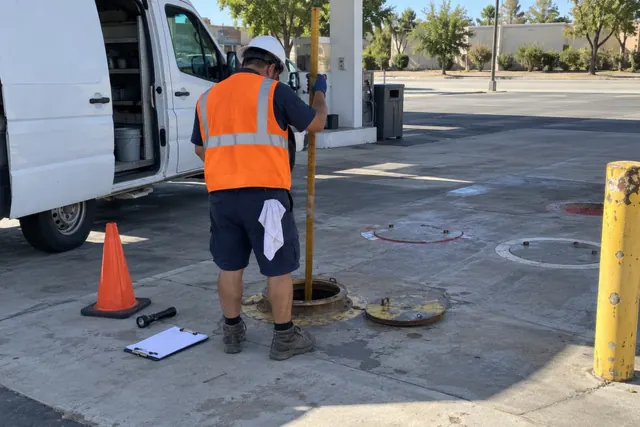
A North Carolina UST compliance inspection typically begins with the contractor reviewing facility records: monthly release detection logs, CP test results, walkthrough checklists, and operator training certificates. The technician visually inspects spill buckets, overfill prevention, sumps, and dispenser pans. Functional checks run on automatic tank gauges and line leak detectors at Piedmont and Research Triangle sites. Pressurized lines get hydrostatic or vacuum-style line testing, while suction systems are evaluated against the design exemption rules. The inspector issues a written report flagging deficiencies and the corrective timeline NCDEQ expects.