Find contractors in Florida for underground storage tank installation, fuel system installation, dispenser installation, and piping installation. Serving Miami, Tampa, Jacksonville, Orlando, and communities statewide.
How Florida's Water Table Shapes UST Installation Projects
Florida's population growth drives steady demand for new tank installations statewide. The I-95 corridor from Miami through Fort Lauderdale, West Palm Beach, and Jacksonville generates the heaviest project volume. Tampa Bay, Orlando, and the I-4 corridor between them see consistent new convenience store and fuel retail construction. Southwest Florida from Naples to Fort Myers and Panhandle communities along I-10 from Pensacola to Tallahassee support growing commercial fleet and retail fueling installations. Tourism-driven demand in the Keys and Central Florida theme park corridors creates fuel throughput requiring larger multi-tank systems, and rural agricultural counties still operate aging single-wall tanks that need full replacement.
A single underground storage tank installation in Florida typically costs $55,000 to $160,000 depending on tank size, material, and site conditions. Multi-tank gas station build-outs with dispensers, piping, and monitoring systems run $250,000 to $500,000 or more. Florida's high water table adds cost because excavations require dewatering, and buoyancy anchoring systems are mandatory to prevent empty tanks from floating upward in saturated soil. Monitoring equipment runs $5,000 to $15,000 per system, while permitting fees, engineering drawings, and third-party inspections add $8,000 to $20,000 to most projects. The Inland Protection Trust Fund does not cover new installation costs, and it will not cover a future release from the new system either. Its programs are keyed to discharge dates that have passed, with PLRIP bands ending 12/31/1998 and PCPP covering discharges before 01/01/1995. Registration is still required, but it buys compliance, not fund eligibility.
Florida's high water table changes everything about UST installation. The state requires a Pollutant Storage System Contractor certified by the Department of Business and Professional Regulation for installation that disturbs the backfill, and all new installations must meet federal EPA technical requirements plus state-specific standards for Florida's hydrogeology. Double-wall tanks with interstitial monitoring are the standard statewide because the shallow water table leaves zero margin for undetected releases. Gas stations, convenience stores, fleet fueling operations, and marina fuel systems all fall under these requirements, so facility owners should expect permitting to take longer than in states with simpler geology.
Site engineering comes first, accounting for soil type, water table depth, and setback requirements from property lines and buildings. Excavation and dewatering happen simultaneously on most Florida sites, followed by bedding preparation, tank placement, and backfill with clean pea gravel or sand. Piping connections, dispenser installation, and electronic monitoring setup follow tank placement. The full process for a single-tank installation takes two to four weeks of field work, though permitting and engineering add four to eight weeks before ground is broken. Ask any prospective installer for current certification from the Department of Business and Professional Regulation, proof of pollution liability insurance, and references from projects in your region. A contractor experienced with Miami-Dade's limestone geology may not be the best fit for a Panhandle site with sandy clay soils.
Does Florida require a specific license for UST installation contractors?
Florida requires underground storage tank installation that disturbs the backfill to be done by a Pollutant Storage System Contractor certified by the Department of Business and Professional Regulation under Rule 62-761.200. This certification is separate from a general contractor license and covers work specifically related to storage tank systems. Contractors must demonstrate competency in tank handling, piping installation, and leak detection system setup. Hiring an uncertified contractor puts the facility owner at risk because the state may not accept the installation for compliance purposes, and you would bear the cost of corrections.
How much does it cost to install a new underground storage tank in Florida?
A single UST installation in Florida typically runs $55,000 to $160,000 depending on tank capacity and site complexity. Multi-tank gas station projects with dispensers, canopy, and full piping systems cost $250,000 to $500,000 or more. High water table conditions add $10,000 to $30,000 for dewatering and buoyancy anchoring compared to drier sites. Monitoring system installation adds another $5,000 to $15,000. These ranges assume no unusual soil contamination at the site from a previous tank system.
How long does a typical UST installation project take in Florida?
Engineering, permitting, and plan review take four to eight weeks before any fieldwork begins. The physical installation for a single tank takes two to four weeks, including excavation, tank setting, piping, and dispenser connections. Multi-tank projects can take six to twelve weeks of field work. Plan the paperwork too: under Rule 62-761.400, FDEP must receive the registration form at least thirty days before installation at a new facility, and a Certified Contractors form goes to the County within twenty-one days after. Weather delays are common during Florida's summer rainy season from June through September, when daily storms can flood open excavations and halt work for days at a time.
Why does Florida's water table make tank installation more expensive?
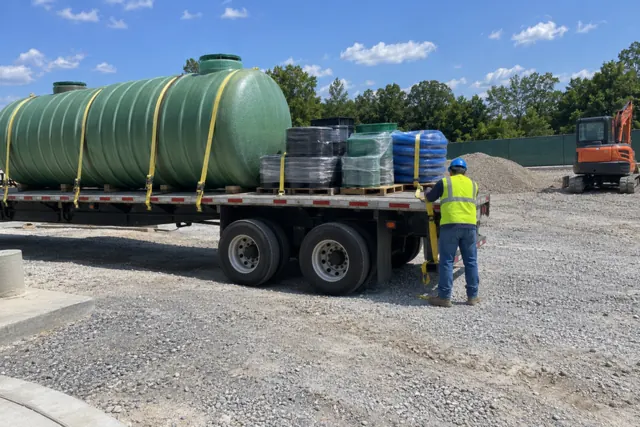
Much of Florida has a water table sitting three to eight feet below grade, and in coastal areas it can be even shallower. Excavations for UST installation routinely hit groundwater, requiring continuous dewatering pumps running throughout the dig. Empty tanks placed in saturated soil will float upward unless anchored with concrete hold-down slabs or strap systems, which adds material and labor costs. Double-wall tanks with continuous interstitial monitoring are standard because the proximity of groundwater to the tank means any release reaches the water table almost immediately. These requirements are not optional in Florida, and skipping them creates both regulatory violations and serious environmental liability.
What monitoring systems are required for new UST installations in Florida?
New underground storage tank installations in Florida must have secondary containment built for interstitial monitoring of the entire tank under Rule 62-761.500. Line leak detectors are required on all pressurized piping. Electronic monitoring systems must be capable of generating alarms when a potential release is detected, and records must be maintained for state inspection. Most facility owners spend $5,000 to $15,000 on monitoring equipment per tank system. Choosing a monitoring platform that integrates with remote alert systems saves time on compliance reporting and catches problems before they become expensive cleanups.