

What to Know About Oil Tank Inspection & Testing in Nevada
Nevada requires state certification for contractors performing oil tank inspection and testing on regulated underground storage tanks. The certification covers commercial and industrial tank systems, which is effectively the entire market. Nevada has virtually no residential heating oil infrastructure. The desert climate means almost no one heats with oil. Commercial testing starts at $500 for a single tightness test. The underground tank population is entirely commercial: gas stations, truck stops, fleet maintenance facilities, mining operations, and one category of facility that sets Nevada apart from every other state in this directory. Las Vegas and Reno are home to dozens of large casino resorts, convention centers, and hotel complexes that maintain backup diesel fuel storage for emergency generators. These are not small systems. A major resort on the Las Vegas Strip may have multiple underground tanks holding tens of thousands of gallons of diesel. The consequences of a fuel release beneath a property worth hundreds of millions of dollars go far beyond a regulatory fine.
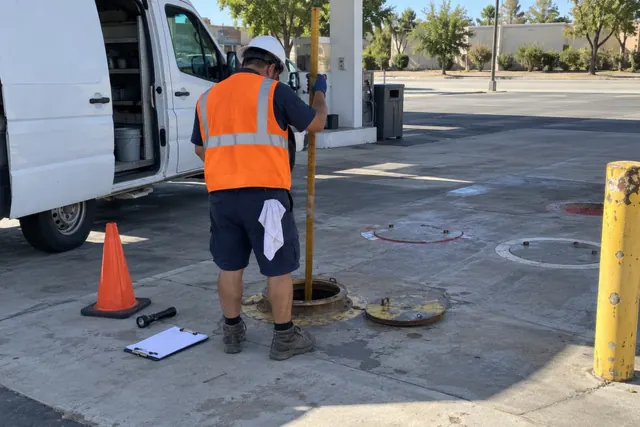
Underground oil tank inspection demand in Nevada concentrates almost entirely in two metro areas. The Las Vegas valley, including Henderson and North Las Vegas, accounts for the majority of the state's regulated tank population. Gas stations along the I-15 corridor, fleet yards serving the logistics industry, and the casino resort fuel systems described above drive consistent fuel tank inspection demand. Reno and Sparks support a second concentration tied to the I-80 corridor, the growing warehouse and distribution sector, and mining industry support operations. Between those two metros, rural Nevada has scattered fueling stations serving highway travelers and mining sites, but the distances are vast and the contractor pool is thin. Many of the same contractors who perform underground oil tank inspection across Nevada also handle oil tank removal and tank decommissioning when aging systems need to come out of the ground. Older gas stations along rural highways where the original tanks have been in service for decades drive much of that crossover work.
Oil tank inspection cost in Nevada typically ranges from $500 to $2,500 for a basic tank tightness test and $2,000 to $6,000 for comprehensive multi-tank assessment at larger facilities. Casino and resort fuel systems with multiple large-capacity tanks often run toward the upper end of those ranges due to system complexity and access constraints beneath active properties. The cost comparison that drives the decision is not between contractor quotes. Nevada's extreme heat accelerates the chemical degradation of tank coatings, gaskets, and flexible piping connections in ways that cooler climates do not experience. A tank system operating in soil that regularly reaches 130 degrees at shallow depth ages faster than the same system buried in Minnesota or Montana. And because Nevada is one of the driest states in the country, any groundwater contamination from a leaking underground storage tank is taken extremely seriously. Water scarcity means soil contamination that reaches groundwater threatens a resource the state cannot afford to lose. Environmental remediation costs in Nevada routinely reach $15,000 to $100,000 or more, with heightened enforcement near the limited groundwater resources that Las Vegas and rural communities depend on.
Federal law requires EPA or the state to inspect each regulated underground storage tank at least once every three years. Owners also have duties of their own under 40 CFR 280: release detection on tanks at least every thirty days by one of several approved methods, and walkthrough inspections every thirty days and once a year. Nevada's heat adds a degradation factor that many facility owners underestimate. Flexible connectors and gaskets that are rated for 20-year service life in temperate climates may deteriorate in 12 to 15 years under sustained desert heat. Cathodic protection systems can also underperform in Nevada's extremely dry, low-conductivity desert soils, reducing the corrosion protection that the tank design depends on. For casino resorts and large commercial facilities where a fuel release could disrupt operations and generate headlines, scheduling fuel tank inspection annually rather than waiting for the three-year federal minimum is standard practice. For older systems where inspection reveals heat-related degradation or declining cathodic protection readings, an environmental remediation contractor can help evaluate whether tank decommissioning and replacement with modern systems designed for desert conditions is the more cost-effective path than continued repair.