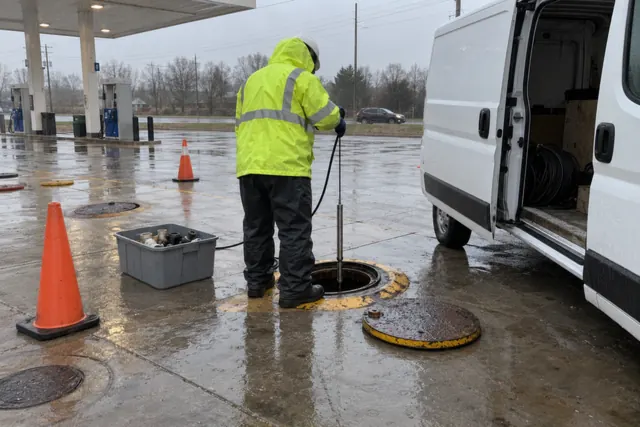
Find licensed contractors in Kansas for oil tank inspection, underground storage tank testing, tank tightness testing, leak detection, and UST compliance assessments. Serving Wichita, Kansas City, Topeka, Lawrence, Salina, Hutchinson, and communities statewide.
What to Know About Oil Tank Inspection & Testing in Kansas
Kansas requires hazardous materials training for contractors performing oil tank inspection and testing on regulated
underground storage tanks. What makes Kansas unusual is the size of the certified contractor pool. Fewer than 20
companies hold active credentials statewide. That small number is not a sign of low demand. Kansas sits at the
crossroads of I-70 and I-35, two of the busiest freight corridors in the country, and the fueling infrastructure
that supports that traffic stretches across the state in every direction. The problem is scheduling. When a
facility owner in western Kansas needs a fuel tank inspection, the closest certified contractor may be three hours
away in Wichita, and their calendar may be booked weeks out.
Most underground oil tank inspection work in Kansas falls into two categories. The eastern third of the state,
anchored by the Kansas City metro, Topeka, and Lawrence, has the highest density of commercial fueling stations,
fleet yards, and industrial facilities. Wichita and its surrounding counties support a second concentration tied
to the aviation manufacturing sector and regional distribution. But beyond those metro areas, Kansas has hundreds
of small-town gas stations, agricultural fueling cooperatives, and grain elevator fuel depots that were built
decades ago and have never changed hands. Many of these rural sites still operate on original single-wall steel
tanks from the 1970s and 1980s. The same contractors who handle underground oil tank inspection across the state
also perform oil tank removal and tank decommissioning when aging systems reach end of life, which is increasingly
common at these rural sites.
Oil tank inspection cost in Kansas typically runs $500 to $2,500 for a basic tank tightness test and $2,000 to
$6,000 for comprehensive multi-tank facility assessment. Cost varies significantly by location. A station along
I-35 near Wichita is a routine job. A single-tank site in rural northwest Kansas with no paved access road is not.
But the cost comparison that matters is not between contractors. It is between a $1,000 fuel tank inspection and
the $15,000 to $100,000 in environmental remediation that a leaking underground storage tank can generate when
contamination reaches groundwater. Kansas geology adds a specific wrinkle here. Much of central and western Kansas
sits over the Ogallala Aquifer, one of the most important freshwater resources in the country. A petroleum release
that reaches the Ogallala is not a local cleanup problem. It is a regional water supply threat that triggers
aggressive state oversight.
Federal law requires EPA or the state to inspect each regulated underground storage tank at least once every three years. Owners also have duties of their own under 40 CFR 280: release detection on tanks at least every thirty days by one of several approved methods, and walkthrough inspections every thirty days and once a year. UST
compliance in Kansas carries an extra layer of practical urgency because of the small contractor pool. If a
facility fails its three-year inspection, it does not just face regulatory consequences. It faces a wait for a
certified contractor to come back and reinspect, and that wait can shut down fueling operations. For facility
owners with tanks approaching 30 or 40 years of service, the practical choice is often between ongoing inspection
costs and full tank decommissioning followed by replacement with modern double-wall systems. An environmental
remediation contractor familiar with Kansas conditions can help evaluate which path makes more financial sense
before the state forces the decision.
Kansas contractors for tank inspection and testing
Do I need a certified contractor for oil tank inspection in Kansas?
Yes. Kansas requires state certification for contractors performing oil tank inspection and fuel tank inspection
on regulated underground storage tanks. The certified contractor pool in Kansas is one of the smallest in the
Midwest, which means scheduling can take longer than facility owners expect. Planning inspections well ahead of
compliance deadlines is important. Using an uncertified contractor risks producing inspection documentation the
state will not accept, requiring a complete reinspection by a qualified professional.
How much does oil tank inspection cost in Kansas?
A basic tank tightness test in Kansas typically costs $500 to $2,500 depending on tank size, site access, and
location. Comprehensive underground storage tank inspection at multi-tank commercial facilities runs $2,000 to
$6,000. Oil tank inspection cost is generally higher for rural sites in western Kansas where travel distance
adds to contractor time. The cost that matters most is the one you avoid. A leaking underground storage tank
over the Ogallala Aquifer can trigger environmental remediation costs of $15,000 to $100,000 or more, turning a
skipped $1,000 inspection into the most expensive decision a facility owner makes that year.
How often do underground storage tanks need to be inspected in Kansas?
Federal law requires EPA or the state to inspect each regulated underground storage tank at least once every three years. Owners also have duties of their own under 40 CFR 280: release detection on tanks at least every thirty days by one of several approved methods, and walkthrough inspections every thirty days and once a year. Because the certified contractor pool
is small, waiting until the last month before a compliance deadline to schedule an inspection is risky.
Contractors may be fully booked, and a missed inspection can trigger enforcement action that interrupts fueling
operations. Kansas weather adds mechanical stress to aging tank systems. Temperature swings from summer heat to
winter freeze put repeated strain on underground piping joints, making the three-year interval a minimum, not a
guarantee that problems will wait.
Why does the Ogallala Aquifer matter for tank inspection in Kansas?
The Ogallala Aquifer underlies much of central and western Kansas and supplies drinking water and irrigation for
a large portion of the state. Underground oil tanks that leak petroleum into soil above the Ogallala create
contamination that can migrate into this aquifer, turning a single-site problem into a regional water supply
issue. State regulators treat petroleum releases in Ogallala recharge zones with heightened urgency, which means
more aggressive cleanup requirements and higher remediation costs. Routine oil tank inspection and tank
tightness testing are the primary tools for catching small leaks before they reach groundwater depth. For
facilities over the Ogallala, the cost of skipping an inspection is not just financial. It is environmental in a
way that draws serious regulatory attention.
What types of tank testing are available in Kansas?
Kansas contractors offer several underground storage tank inspection methods. Tank tightness testing measures
whether a tank holds pressure without loss, detecting leaks too small for automatic gauging to catch. Line
tightness testing checks piping runs between the tank and dispenser for slow seepage at joints and fittings.
Cathodic protection testing verifies that the tank's corrosion prevention system is still functioning within
design parameters. For sites with suspected contamination, groundwater monitoring well sampling and soil vapor
surveys help determine whether petroleum has migrated beyond the tank excavation zone. At aging rural sites
where inspection reveals significant corrosion or repeated marginal results, a certified contractor can advise
whether continued monitoring or full tank decommissioning and replacement is the better long-term investment.