NACE certification is now issued by AMPP, the Association for Materials Protection and Performance. AMPP absorbed NACE International when the legacy body merged with SSPC in January 2021, and the four cathodic protection credentials, CP1 Tester through CP4 Specialist, still appear in state UST programs and the federal rule at 40 CFR 280.31. Even though AMPP branding replaced NACE on the certificate itself, the credential still controls who can legally sign off on annual rectifier checks and three year potential surveys for underground storage tank owners and corrosion technicians.
This guide covers what the four AMPP cathodic protection credentials authorize, how the exam tracks work, what courses cost and how long they take, and how state UST regulators rely on NACE certification to satisfy federal corrosion monitoring requirements. It also addresses the most common practical question: whether a tank owner needs to send a staff member through CP1 training, or hire an outside contractor whose technicians already hold the credential.
The short version for hiring managers is that any contractor performing cathodic protection testing on regulated USTs needs documented proof of training that satisfies 40 CFR 280.31(b). AMPP CP1 Tester is the credential nearly every state implementation agency recognizes by name. State programs vary on whether they accept equivalent training, but no state rejects the CP1 credential, which makes it the safe default for any environmental firm that touches steel tanks with sacrificial anodes or impressed current systems.
Pricing for the CP1 course currently runs about $2,300 for AMPP members and $2,800 for nonmembers. The multi day course is followed by a written exam, and the credential carries a three year renewal cycle that requires continuing education credit. Course offerings have moved largely online since 2022, though hands on lab sessions for CP2 and above still require in person attendance at AMPP regional training centers.
NACE Became AMPP: What the 2021 Merger Means for Existing Credentials
NACE International and SSPC, the Society for Protective Coatings, completed their merger on January 5, 2021, forming AMPP. Before that date, NACE issued the Cathodic Protection Tester credential and SSPC issued the Coatings Inspector Program certification under the legacy Protective Coatings Inspector name. Both legacy programs were folded into AMPP, and current credentials are issued under the AMPP name with the same exam content and the same numeric tier structure as the legacy NACE program.
Existing NACE credential holders did not lose their certifications. Anyone who held an active CP1 Tester, CP2 Technician, CP3 Technologist, or CP4 Specialist designation on the merger date kept that credential and continues to renew it through the AMPP portal. The certificate itself was reissued under AMPP branding at the first renewal cycle, but the underlying credential and its scope of authority remained unchanged.
State UST regulators have been slow to update their cathodic protection testing rules to match the new branding. Many state implementation agency documents still reference NACE certification explicitly, and field inspectors often ask for a NACE card by that name. AMPP credentials carry the legacy NACE numbering on the back of every active certificate to address this gap, and the AMPP website maintains a verification lookup that accepts both legacy NACE numbers and current AMPP numbers.
For the rest of this guide, references to NACE certification and AMPP certification describe the same credential. The two terms are functionally interchangeable, and the search query that brings most readers here remains the older NACE term. Industry usage will likely transition over the next five years as legacy certificates renew under the new brand and state agency documents get refreshed.
The Four CP Credential Tiers: CP1 Tester Through CP4 Specialist
AMPP issues four cathodic protection credentials, numbered CP1 through CP4, each authorizing progressively more technical work. The CP1 Tester credential is the entry level certification and the one referenced directly in federal regulatory text. CP1 holders can perform structure to electrolyte potential measurements on UST systems and document the results, which satisfies the testing portion of 40 CFR 280.31(b).
CP2 Technician is the second tier and authorizes the holder to perform cathodic protection inspections, troubleshoot system failures, and recommend corrective action. CP2 candidates must complete the CP1 program first, then sit through a longer multi day course that covers rectifier maintenance, anode bed evaluation, and reading interference patterns from foreign structures. The CP2 exam includes a hands on lab component that CP1 does not.
CP3 Technologist and CP4 Specialist are the engineering tier credentials, intended for system designers and project managers who oversee multiple cathodic protection installations across pipeline, marine, and UST applications. CP3 candidates need prior CP2 certification plus documented field experience, and the CP3 course runs roughly twice the length of CP1. CP4 is the terminal designation and requires a degree in engineering or a related technical field plus several years of supervised design work.
For most underground storage tank applications, CP1 Tester is the only credential that matters under any version of NACE certification. The vast majority of state UST programs require nothing higher than CP1 for routine three year potential surveys and annual rectifier checks on impressed current systems. CP2 and above add value for contractors who design new cathodic protection systems or troubleshoot complex interference issues, but they are not required to satisfy the federal testing rule.
What Each Credential Authorizes on UST Cathodic Protection Systems
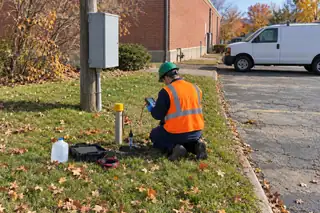
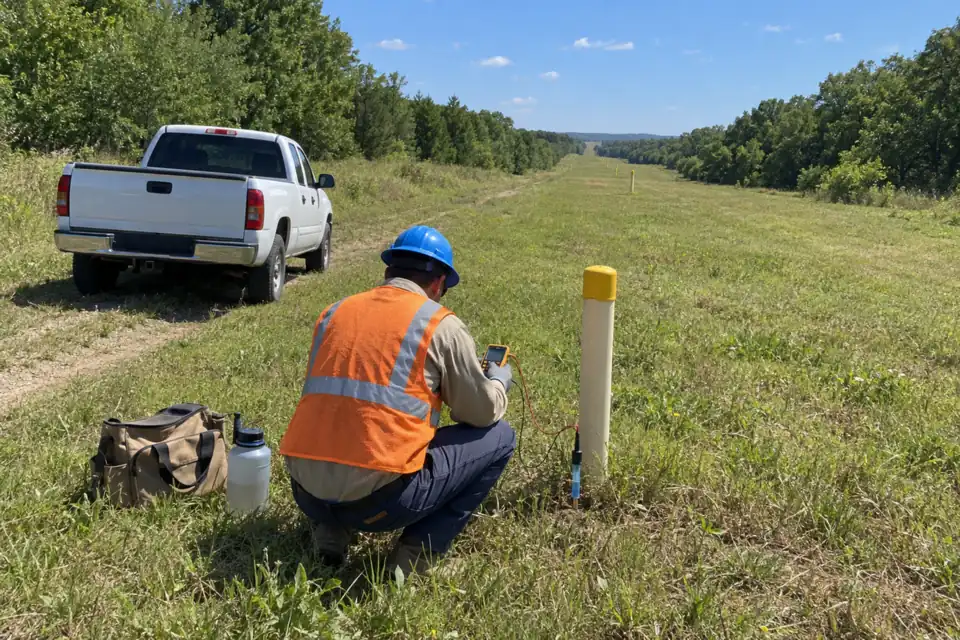
CP1 Tester authority covers the routine field tasks that 40 CFR 280.31 requires on every regulated UST with a corrosion protection system. That work includes structure to electrolyte potential surveys using a high impedance voltmeter, copper sulfate reference electrode placement, and documentation of the minus 0.85 volt criterion described in NACE SP0285, with field measurement procedures following NACE TM0497. CP1 holders also conduct rectifier output readings, anode bed continuity checks, and pass through current measurements where the system uses impressed current rather than sacrificial anodes.
CP2 Technician authority extends to cathodic protection inspections that go beyond pass fail testing. CP2 holders can recommend system modifications when readings fall outside protective criteria, identify interference current from nearby pipelines or transit systems, and oversee installation of test stations, anodes, and reference electrodes. A CP2 credential is typically required for any environmental firm that bids on tank decommissioning projects involving cathodic protection assessment under tank inspection testing and similar state programs.
CP3 Technologist authority adds system design responsibility. A CP3 can engineer the layout of a new impressed current system, specify rectifier output, calculate anode mass and spacing, and seal design drawings under the supervision of a licensed professional engineer. This tier is rare in straight UST work because most tank cathodic protection systems are sized from manufacturer tables. CP3 designations show up more often in pipeline and waterfront marine projects where the engineering is bespoke, including coastal sites where shoreline tank fields need complex anode bed design.
CP4 Specialist authority is essentially a stamp of professional standing rather than a separate task category. CP4 holders can perform any task within the CP1 through CP3 scope and also sign off as the responsible engineer of record on large multi facility cathodic protection programs. For underground storage tank work specifically, CP4 holders most often appear as expert witnesses in litigation or as third party reviewers on remediation projects where corrosion is in dispute.
How 40 CFR 280.31 Treats AMPP Certification for State UST Testing
The federal UST regulation at 40 CFR 280.31 requires owners of cathodically protected steel tanks to test the system within six months of installation and at least every three years afterward. The same rule requires that any impressed current rectifier be inspected every 60 days to confirm proper operation. The regulation specifies that testing must be performed by a person trained to recognize cathodic protection criteria, which the EPA implementation guidance interprets as a NACE certified or AMPP certified cathodic protection tester.
State implementation agencies translate this federal requirement into different documentation standards. New Jersey requires the testing technician to provide their AMPP certification number on every cathodic protection report submitted to the department, while Pennsylvania accepts equivalent training as long as the trainer documents a curriculum covering the same testing methods. Florida, Texas, and California all default to AMPP CP1 as the recognized credential, though most contractors in these states default to NACE certification as the lowest friction path.
The phrase trained to recognize cathodic protection criteria has been litigated in state administrative cases dozens of times since the rule took effect in 1988. The consistent finding across these cases is that an active AMPP CP1 credential is sufficient on its face, while undocumented in house training is rejected unless the contractor can produce a written program and proof of student completion. This is why most contractors and most state inspectors default to asking for the credential rather than evaluating training records on their own.
For UST owners hiring a cathodic protection tester in any state, the practical rule is to verify the technician holds an active AMPP CP1 credential before authorizing the work. The AMPP credential lookup tool is the authoritative source, and verification takes about 30 seconds with the technician name or credential number. Reports submitted to state agencies without a credential number attached are routinely flagged for resubmission, which can push compliance documentation out of the three year window.
Exam Structure, Prerequisites, and Typical Preparation Timelines
The AMPP CP1 Tester program is a five day classroom course followed by a written exam on the final day. Course content covers cathodic protection theory, reference electrode use, rectifier reading, criteria for protection under NACE SP0285, and basic troubleshooting. The current course fee runs about $2,300 for AMPP members and $2,800 for nonmembers, with member status itself costing roughly $215 per year. Course offerings include in person sessions at AMPP regional centers and online sessions with proctored remote exams.
Prerequisites for CP1 are limited to a high school diploma or equivalent plus basic familiarity with electrical concepts. No prior field experience is required, though most petroleum site technicians already hold an OSHA 40 hour HAZWOPER certificate because environmental work at fuel terminals and former gas stations routinely requires both credentials side by side. AMPP publishes a recommended self study reading list, but the five day course is designed to take a complete beginner through the material. The reported first time pass rate for CP1 hovers between 70 and 80 percent according to AMPP industry data, with the most common failure point being the electrical calculation section.
CP2 Technician requires an active CP1 credential plus documented field experience, typically six months to one year of work performing cathodic protection testing under supervision. The CP2 course runs six days including a hands on lab portion that cannot be completed remotely. Course fees run roughly $2,800 for members and $3,400 for nonmembers. Pass rates for CP2 are lower than CP1, generally in the 60 to 65 percent range, because the lab component requires demonstrated proficiency rather than classroom recall.
Total preparation time from zero to CP1 credential is roughly two to three months including registration, course attendance, and the exam window. CP2 adds another six to twelve months because the field experience prerequisite cannot be compressed. Contractors planning to use AMPP credentials as part of a staffing strategy for environmental services should budget at least six months from decision to first credentialed technician on the bench.
Renewal Cycles, Continuing Education, and Credential Maintenance
All AMPP CP credentials carry a three year renewal cycle. Renewal requires the holder to log continuing education credits, called Professional Development Hours or PDH, through the AMPP member portal. CP1 renewal requires 16 PDH over the three year cycle. CP2 requires 24 PDH, CP3 requires 32, and CP4 requires 40. PDH can come from AMPP webinars, conference attendance, additional training courses, or documented technical writing in trade publications.
Renewal fees apply at each three year cycle. CP1 renewal costs roughly $325 for members and $475 for nonmembers, with CP2 through CP4 renewal fees scaling upward. Late renewals carry a reinstatement surcharge and a 60 day grace period, after which the credential lapses and the holder must retake the relevant exam to restore it. Contractors who let CP1 lapse often discover the problem mid project when a state agency rejects a cathodic protection report submitted by a lapsed tester.
Continuing education runs the gamut from formal AMPP courses to free webinar attendance. The most commonly used PDH sources for CP1 holders are the annual AMPP Conference and Expo, which typically yields 20 to 30 PDH across multiple sessions, and AMPP technical webinars, which run between one and four PDH each. State chapters of AMPP also offer local technical sessions that count toward PDH requirements and tend to be cheaper than the national conference. The AMPP portal sends renewal reminders 90, 60, and 30 days before expiration to make tracking easier.
Tracking who holds which credential and when each one expires is the single most common failure mode for environmental firms that bill cathodic protection work to state agencies.
Hiring a Credentialed Contractor Versus Pursuing Your Own Credential
For an individual tank owner with one or two UST systems, hiring an AMPP certified contractor with current NACE certification almost always beats putting a staff member through CP1. The credential investment runs roughly $3,000 in fees and a five day course, plus ongoing renewal cost, against contractor rates of $200 to $450 per cathodic protection test per tank. Unless a property owner has more than 15 to 20 tanks under management, the math favors hiring out the testing work to a credentialed third party.
Environmental firms and full service UST contractors face the opposite calculus. Contractors who perform cathodic protection testing as a recurring service line need at least one CP1 tester on staff to satisfy customer documentation requirements and to bid on state contracts. The credentialed technician becomes a billable asset because their AMPP number unlocks state agency acceptance of submitted reports, and most environmental firms calculate the credential payback period at six to nine months of normal testing volume.
When evaluating an outside contractor for cathodic protection work, the find a UST contractor directory lists firms by state with credential information shown on individual profiles. The minimum verification is an active AMPP CP1 credential on at least one technician, with a credential number that validates through the AMPP lookup. Beyond that baseline, look for firms whose technicians hold CP2 or above if your system involves impressed current rather than sacrificial anodes, and ask whether the same technician will perform all three year recurring tests.
For tank owners weighing whether to invest in CP1 for an existing maintenance employee, the deciding factor is usually fleet size and bid frequency. A municipality with 30 fueling stations and a strong internal preventive maintenance team often justifies the investment, especially when paired with UST operator training for the same staff. A single property owner with one heating oil tank or a small gas station with two USTs rarely does. The credential pays back through volume, and the volume threshold sits around 15 tanks under continuous management.