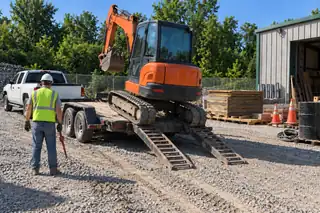
Confined space training is the OSHA qualification any worker needs before entering a permit-required space. On a UST site that includes the interior of a cleaned tank, a fuel vault, or a below grade containment sump. The federal floor lives in 29 CFR 1910.146 for general industry and 29 CFR 1926 Subpart AA for construction, with OSHA civil penalties reaching $16,131 per serious violation as of 2026.
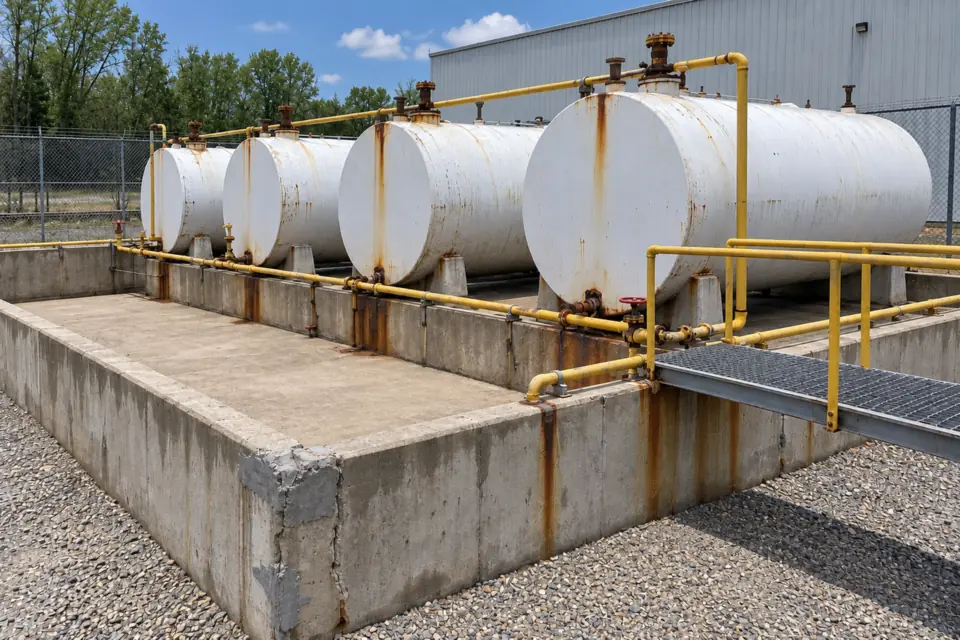
Three roles must complete confined space training before any permit-required entry begins: the authorized entrant who goes inside, the attendant who stays outside the opening, and the entry supervisor who signs the written permit. Tank cleaning crews, environmental contractors, and excavation teams entering below grade containment all fall under the rule.
OSHA data shows confined spaces kill roughly 90 to 100 workers per year across all industries, and about 60 percent of those deaths involve would be rescuers who entered without proper training. UST sites carry above average risk because residual hydrocarbon vapors, oxygen displacement during inerting, and sludge off gassing push the atmosphere outside safe limits within minutes.

What counts as a confined space on a UST site
A confined space under 29 CFR 1910.146 has three traits: it is large enough for a worker to enter and perform work, has restricted means of entry or exit, and is not designed for continuous human occupancy. On a UST site this captures the inside of a tank after cleaning, a sump or vault holding dispenser plumbing, a below grade containment box around a fill port, and certain manholes within the spill containment system.
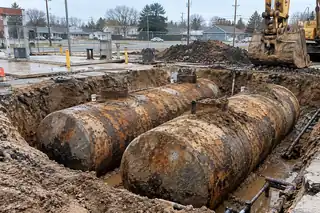
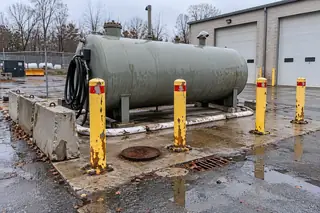
The most common confined entries on UST work are tank interiors during sludge removal or final inspection, fuel vaults at airport hydrant systems, double walled tank interstitial spaces during pressure testing, and dispenser sumps when sensor wiring fails. Each space has its own atmospheric profile and its own rescue access challenge. A 10,000 gallon gasoline tank pulled from a service station carries a different LEL signature than a 1,000 gallon heating oil tank pulled from a residential basement. A tank that sat with residual product for 15 to 20 years can release benzene vapor for hours after final product removal, and the tank cleaning crew is often the first work group to face that hazard.
A facility designating Class B operators under UST operator training requirements still keeps confined space duties separate. Operator training under 40 CFR 280 covers compliance management, recordkeeping policy, and release reporting. Confined space training covers the physical entry: atmosphere checks, communication, retrieval gear, and rescue arrangement. The two qualifications do not substitute for each other. An OSHA inspector will ask for both when a UST cleaning or removal is underway.
Permit-required versus non-permit: the line that triggers training
OSHA splits confined spaces into two categories. A non-permit confined space has no atmospheric or physical hazard that could cause death or serious harm. A permit-required confined space contains, has the potential to contain, or could trap a worker in an actual or potential hazard. Almost every confined space on an active UST site falls into the permit-required category because residual hydrocarbons return the moment ventilation stops. The distinction matters because it dictates the training, equipment, and documentation that must be in place before any worker breaks the plane of the opening.
A space can be reclassified to non-permit only after positive engineering controls eliminate every hazard, including atmospheric, engulfment, configuration, and energy hazards. Eliminating the hazard does not mean controlling it through PPE. It means physically removing the source. A vapor freed tank under forced ventilation is still permit-required because the hazard returns the moment the fan stops. The reclassification certificate must be signed by the entry supervisor and kept on file with the program records.
For every permit-required entry, the employer must issue a written entry permit. The document lists authorized entrants and attendants, the date and authorized duration of the work, atmospheric monitoring results before and during the operation, the rescue services contacted, and the supervisor signature. The permit stays at the opening for the duration of the work. It is filed for at least one year afterward and reviewed at least annually. Any worker who enters or attends must complete confined space training before work begins.
The three OSHA roles: entrant, attendant, supervisor
An authorized entrant is the worker who physically enters the space. The entrant must know the hazards listed on the permit, how to use atmospheric monitoring equipment, how to use any required communication or retrieval gear, and how to recognize the signs of exposure. The entrant self reports to the attendant whenever their condition changes and exits immediately on any evacuation signal. Entrants typically wear a full body harness with the retrieval line attached at the dorsal D ring throughout the operation.
The attendant stays outside the opening for the full duration of the work. Duties include continuous head counts, monitoring atmospheric readings, watching for outside hazards approaching the space, and ordering evacuation when conditions deteriorate. Critically, the attendant must never enter the space themselves, even during a rescue. The single rule violated most often in confined space fatalities is the attendant entering to help a downed entrant.
The entry supervisor signs the permit and verifies that all preconditions are met before authorizing entry. Verification covers ventilation, isolation of energy sources under 29 CFR 1910.147 lockout tagout requirements, atmospheric monitoring results, rescue service availability, and entrant and attendant qualifications. Construction work brings a fourth role under 29 CFR 1926 Subpart AA: the competent person who identifies confined spaces on a job site. The competent person walks the site, classifies any permit-required space exposed by the dig, and verifies the contractor's training matches the classification. See the tank cleaning guide for how these roles split on a typical UST cleaning job.
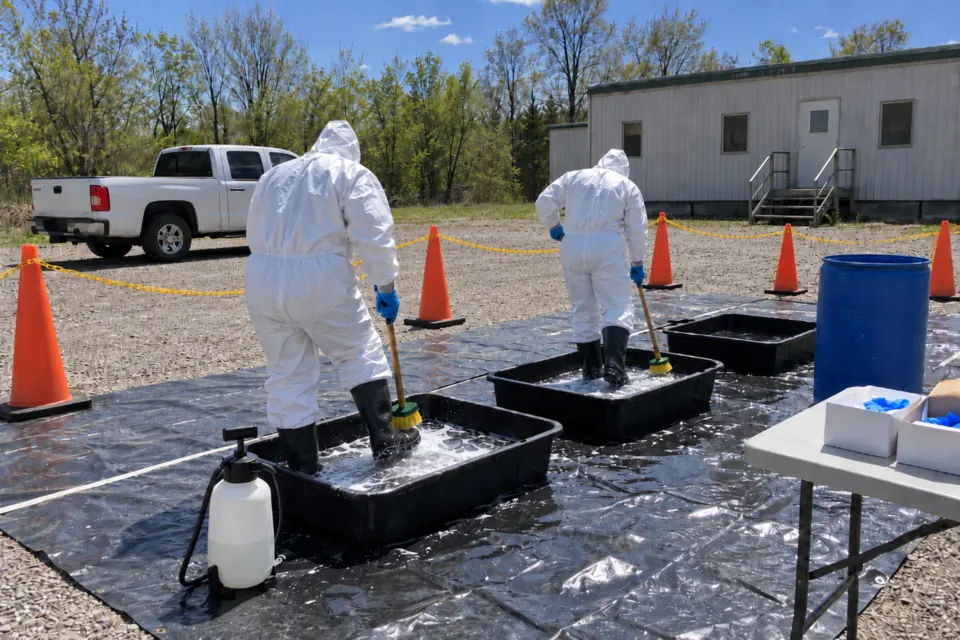
Atmospheric monitoring and the four gas rule
Atmospheric monitoring is the heart of confined space safety. OSHA requires the supervisor to test the atmosphere for oxygen first, then for flammable gases and vapors, and finally for toxic air contaminants. On a UST site the standard configuration is a four gas detector reading oxygen, LEL, hydrogen sulfide, and carbon monoxide. Acceptable conditions per 29 CFR 1910.146 are oxygen between 19.5 percent and 23.5 percent, flammable atmosphere below 10 percent of the lower explosive limit, hydrogen sulfide below 10 parts per million, and carbon monoxide below 25 parts per million. NIOSH classifies any atmosphere above these thresholds as immediately dangerous to life and health, or IDLH.
Pre entry monitoring alone is not sufficient. The atmosphere can shift the moment a worker begins to disturb sludge, switch on a pump, or break a seal. Continuous monitoring during the entire operation is required when permit conditions cannot be confirmed stable. Detectors typically alarm at 10 percent LEL, 19.5 percent or 23.5 percent oxygen, and the applicable toxic gas threshold. The attendant tracks readings and orders evacuation on any alarm.
A four gas monitor that has not been bump tested is not a tool, it is a paperweight. OSHA does not specify a bump test interval, but ANSI Z117.1 and most manufacturers call for a bump test before every shift and a full calibration every 30 days. Records of both must travel with the meter. A contractor showing up with an uncalibrated detector should be turned away from the site. Sample readings should be logged on the written permit at intervals no longer than every 15 minutes for the duration of work.
Rescue plans and why on site rescue capability is non negotiable
OSHA requires a rescue plan in place before any permit-required entry begins. The plan must identify who performs rescue, how they will reach the entrant, what equipment will be on hand, and how response time matches the hazard. Calling 911 does not count as a rescue plan unless the responding agency has a confirmed confined space team trained for that specific work. Most municipal fire departments are not equipped or trained for UST confined space rescue. A worker who collapses from low oxygen has roughly 4 to 6 minutes before brain injury becomes permanent.
An off site rescue team that needs 12 minutes to arrive at a worker who collapsed from low oxygen 4 minutes ago is not a rescue plan, it is a body recovery plan.
For any vertical entry over 5 feet deep, a full body harness and retrieval line are required, with the line connected to a mechanical retrieval device positioned over the opening. The device must lift the entrant clear without anyone entering. Horizontal entries with curves or restrictive passages may exempt the retrieval requirement if the gear would create a greater hazard, but the employer must document the determination. Rescue practice is required at least once every 12 months using a manikin or simulated victim, and skipping the drill is a common OSHA citation. Programs that integrate rescue practice with HAZWOPER training tend to score better on inspections because the muscle memory carries across both disciplines.
Training providers and what to look for in a curriculum
Training providers structure confined space training in three formats: an 8 hour entrant and attendant course, a 16 hour entry supervisor course, and a 24 hour confined space rescue technician course. The 8 hour and 16 hour options cover the core OSHA topics. The 24 hour rescue course adds practical exercises in a tower or props facility. UST contractors typically need at least one supervisor on staff and a small bench of entrants and attendants. Refresher training is recommended annually and required whenever the program identifies deficient performance or a new hazard appears in the work environment.
Online confined space training is acceptable for the lecture portion of entrant and attendant courses under OSHA letters of interpretation. Hands on portions, especially gas detector use and retrieval gear practice, cannot be delivered remotely. A compliant program blends an online module with a half day in person session for skills demonstration. State plan states like California, which operates Cal/OSHA under Title 8 Section 5157, layer their own equivalent requirements on the federal floor. A defensible curriculum covers the legal framework under 29 CFR 1910.146 and 29 CFR 1926 Subpart AA, atmospheric monitoring fundamentals, equipment use, role specific duties, rescue procedures, and a written and practical assessment.
Course pricing varies by format. An online entrant attendant course typically runs $50 to $150 per worker, while an in person 8 hour course is usually $200 to $400 per worker. A 16 hour supervisor course lands at $400 to $700, and a 24 hour rescue technician course runs $800 to $1,500. Many providers will run a private session on a contractor's yard for $2,500 to $5,000 per day. Pair the cost projection with the UST removal cost guide when bidding a job that requires confined entry.
Hiring a contractor with documented confined space training
Before awarding any UST work involving confined entry, ask the contractor for several documents up front. Request the written confined space program required under 29 CFR 1910.146 paragraph (c) and recent entry permits from their last three jobs. Also request current confined space certification cards for every entrant and attendant, calibration logs for atmospheric monitoring equipment, and a copy of the rescue plan with contact details for the rescue service. A contractor who cannot produce these on request has gaps that will surface during the job.
The written program should specify the spaces the contractor enters, the equipment list, the training schedule, the rescue arrangement, and the program review interval. Programs reviewed less than once a year are out of date. Programs with no documented entries in the last 12 months suggest the contractor is selling a service they do not actually perform. A contractor pricing a tank decommissioning or oil tank removal job well below market may be excluding confined space costs. Properly priced confined space work adds $1,500 to $5,000 to a typical tank cleaning bid to cover the four gas detector, retrieval gear, qualified attendant time, and rescue contract.
Confined space training affects every UST project that involves opening a tank or vault. Owners planning a site assessment, a tank installation, or large commercial work should ask the same documentation questions before signing a scope. Use the find a contractor directory to browse companies by state. The request a quote form sends project details to contractors near the site.