In Vermont, the owner of a leaking heating oil tank pays a $250 deductible and a state fund pays the uninsured rest of an approved cleanup, up to set limits. Next door in Massachusetts, no state fund pays for a leaking home tank at all, and the state Division of Insurance says most home policies do not include oil leak coverage unless the owner adds it.
The 12 states in this report are the ones where fuel oil or kerosene heats at least 5% of occupied homes, and together they hold 4.09 million of the country's 4.65 million oil-heated homes, according to Census Bureau estimates for 2024. We scored each on four protections, one point each when it is in force or open now to homeowners generally.
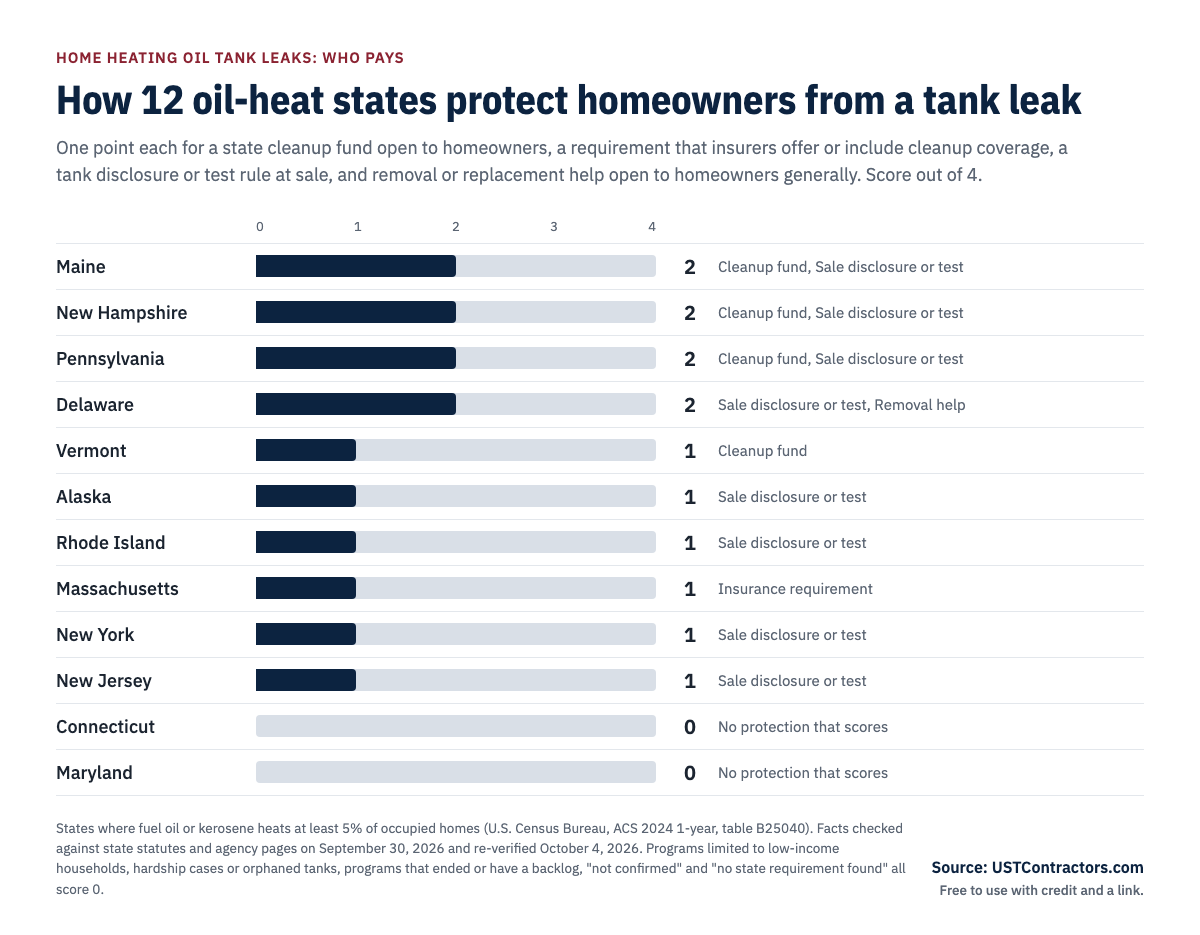
Two of the protections are about money: a state fund that pays to clean up a leaking home tank, and state help to remove or replace an old one. The other two are rules: a requirement that insurers offer or include cleanup coverage, and a rule that a seller must disclose a known tank or test or remove it. The full table and chart are below with a downloadable copy, and every state has its own section with the agency to call.
How the 12 states score
Four states share the top score of 2 out of 4: Maine, New Hampshire, Pennsylvania and Delaware. None reached 3, because no state has more than one of the three harder protections: an open cleanup fund, a requirement that insurers offer cleanup coverage, and tank help open to all homeowners. The open funds also differ widely in what they pay. Vermont's covers up to $1,000,000 for a buried tank after a $250 deductible, while Pennsylvania's tops out at $4,000 per tank after a $1,000 deductible.
Eight states have no cleanup fund open to homeowners generally today. Massachusetts, New York and Rhode Island have no cleanup fund for home tanks. Connecticut's paid only for cleanups completed by December 1, 2001, and Maryland's stopped taking applications in 2024. New Jersey's still takes applications, but NJDEP's fund page says new ones face a one-year wait. Delaware's pays only in hardship cases or for orphaned tanks, such as one a homeowner inherited and never used, and Alaska's application file returned an error when we checked on October 4, 2026, so we could not confirm that its one-time money is still available.
Sale rules are the most common protection. Eight of the 12 states require a seller to disclose a known tank, though five of them name only buried tanks; selling a house with an underground oil tank covers what buyers and lenders tend to ask for. Help to replace an aging tank is easier to find than help with a spill, but in eight states the only help we found to remove or replace a tank that has not leaked, without switching to a new heating system, has an income limit, and the table shows it without scoring it.
| State | Oil-heated homes (share of homes) | State cleanup fund for home tanks | Insurers must offer cleanup coverage | Seller must disclose a known tank | Tank test or removal at sale | Help to remove or replace a tank | Score (0 to 4) |
|---|---|---|---|---|---|---|---|
| Maine | 309,159 (50.3%) | Open | No state requirement found | Required (buried tanks only) | No state requirement found | Low-income only | 2 |
| New Hampshire | 211,416 (37.0%) | Open | Not confirmed | Required (buried tanks only) | No state requirement found | Low-income only | 2 |
| Pennsylvania | 685,083 (12.8%) | Open | No state requirement found | Required (buried tanks only) | No | No | 2 |
| Delaware | 27,950 (6.8%) | Hardship or orphaned tanks only | No state requirement found | Required (buried tanks only) | No | Open | 2 |
| Vermont | 101,281 (35.5%) | Open | Liability only (regulator rule) | No (tank rules require notice of the rules at transfer) | No | Income-limited | 1 |
| Alaska | 75,381 (27.5%) | Not confirmed | No state requirement found | Required (buyer can waive) | No | Income-limited | 1 |
| Rhode Island | 113,718 (25.4%) | No | No state requirement found | Required (buried tanks only) | No state requirement found | Not confirmed | 1 |
| Massachusetts | 572,376 (20.2%) | No | Offer required (buying is optional) | No | No | Income-limited | 1 |
| New York | 1,143,783 (14.6%) | No | No | Required | No state requirement found | Low-income only | 1 |
| New Jersey | 198,050 (5.6%) | Waitlist | No state requirement found | Required | No state requirement found | Low-income only | 1 |
| Connecticut | 509,593 (35.0%) | Ended (2001-12-01) | Not confirmed | No (seller may pay a $500 credit instead) | No | Low-income only | 0 |
| Maryland | 140,292 (5.8%) | Ended (2024-06-30) | No state requirement found | No (seller may sign a disclaimer instead) | No | No | 0 |
Maine, New Hampshire and Vermont
Maine
Maine's Ground and Surface Waters Clean-up and Response Fund covers leaks from home heating oil tanks, whether the tank sits in the basement or in the ground. The owner pays a $500 deductible when the household's aboveground tanks, indoor or outdoor, hold less than 1,320 gallons in all, or $2,500 for a buried tank, and must apply within 180 days of reporting the leak. The fund will not pay to remove or replace a tank or its piping. It also leaves out a leak found after October 1, 1998 from a buried tank, or a buried fuel line, made of anything other than fiberglass, cathodically protected steel or another approved noncorrosive material. That exclusion does not reach an aboveground home heating oil setup with tanks of 660 gallons or less (1,320 gallons in all), so a basement tank with a buried steel line is still covered. Sellers must list underground oil tanks on the state's property disclosure statement, and DEP pays to replace high-risk tanks for income-eligible owners through Community Action Agencies. Maine's insurance code and its Bureau of Insurance set no rule we could find on oil leak coverage. Report a leak to Maine DEP at 1-800-482-0777, day or night.
New Hampshire
New Hampshire's Petroleum Reimbursement Fund pays for state-required cleanup of a leaking home heating oil tank, indoors, outdoors or buried, after a $500 deductible, or $100 for an owner getting Safetank help, and up to $500,000. It pays only what private insurance does not, only if the tank met state rules, including NFPA 31 and NHDES best management practices, and only for work NHDES approves in advance, except emergency response. Since August 4, 2026, sellers of one to four family homes must disclose a buried home heating oil tank in writing, and a buried home heating oil tank must be removed once it is taken out of use, unless removal would undermine a building, in which case it may be closed in place. The Safetank program pays income-qualified owners up to $4,000 to upgrade or replace an aboveground tank and up to $4,500 to remove or close a buried one, limits a 2025 law raised from $3,300 and $2,500. Whether insurers must cover a leak is not confirmed. A state insurance rule says a home policy that covers the house or belongings must also cover a pollution release caused by a peril the policy names, and the insurance department said in a March 2022 news release that no admitted insurer in the state then covered home heating oil spills. Call the Department of Environmental Services at (603) 271-3899 on weekdays, or State Police dispatch at (603) 223-4381 after hours.
Vermont
Vermont's Petroleum Cleanup Fund pays uninsured cleanup costs from a leaking home heating oil tank, buried or aboveground, after the owner pays the first $250. It covers up to $1,000,000 per site for a buried tank and $50,000 for an aboveground one, as long as the state approves the cleanup plan first and the claim comes before July 1, 2029. A state environmental agency presentation dated May 21, 2026 showed the fund's heating oil account with a negative balance and listed freezing spill payments as one option, so confirm with DEC before counting on a payment. Lower-income owners can get state grants to close, remove, replace or upgrade a tank, and for an aboveground or basement tank the household income limit is $75,000. Selling a buried tank triggers a duty under the state's tank rules to tell the buyer in writing that those rules exist, but no state law requires the seller to disclose the tank itself, so the table does not count it. The state insurance regulator does not let home policies exclude pollution liability, so a policy's liability coverage cannot refuse claims by others over a leak just because pollution is involved, but no rule we found requires coverage for cleaning up your own property. Report a leak to the Department of Environmental Conservation at 802-828-1138 on weekdays, or the hazmat line at 800-641-5005 any time.
Connecticut, Rhode Island and Massachusetts
Connecticut
Connecticut paid to clean up leaks found when buried home heating oil tanks came out, but only for cleanups completed by December 1, 2001, with applications postmarked by December 31, 2001. The owner paid a first share that rose with income, and households earning over $500,000 got nothing. The state environmental agency now says there is no DEEP funding for removing, replacing or cleaning up a leaking home tank, and the state's wider UST Petroleum Clean-up Program ended in June 2025. The state condition report asks sellers directly whether there is an underground storage tank, but a seller who does not provide the report credits the buyer $500 at closing instead. That credit does not excuse disclosing a known defect that significantly impairs the home's value, the health or safety of future occupants, or the home's useful life (CGS 20-327c(b)). The state's energy assistance program sets aside money to repair or replace unsafe heating systems and oil tanks for low-income owners. Whether insurers must cover a leak is not confirmed. A 2019 state council report, and DEEP's leak page as late as July 2026, said the Insurance Department requires home policies to cover fuel oil cleanup and liability, though exceptions may exist. We found no such rule, DEEP's current leak page drops the claim, and its FAQ says not all homeowner insurers cover escaped fuel. Call DEEP at 860-424-3338 or 1-866-337-7745, 24 hours a day.
Rhode Island
Rhode Island's underground tank cleanup fund leaves out home heating oil tanks by law: tanks holding heating oil used on site are not eligible, and a 2022 bill to add them never became law. Sellers of one to four unit homes must give buyers a written disclosure that covers underground tanks, with no opt-out. No Rhode Island insurance law or regulator bulletin we checked requires leak coverage. The state's Heating System Repair and Replacement Program, for owner-occupied households that qualify for LIHEAP, repairs or replaces heating systems, but none of its published rules says it pays to remove or replace an oil tank, so the table shows Not confirmed. Call the Department of Environmental Management at (401) 222-3070, any time.
Massachusetts
No state fund pays for a leaking home tank in Massachusetts. The state's tank cleanup fund excludes fuel oil used for heating, and when the state's own contractors clean up a home spill, the cost is subject to recovery from the homeowner. What the state has instead is the insurance law described below. There is no mandatory seller disclosure form and no tank test or removal tied to a sale. MassHousing's Energy Saver Home Loan, which has an income limit of 135% of area median income, can finance oil tank removal as part of a larger energy upgrade, but it does not pay for a new oil tank. Call the local fire department first, then MassDEP's 24-hour line at 1-888-304-1133.
New York, New Jersey and Pennsylvania
New York
New York's Oil Spill Fund pays for a cleanup only when the responsible party does not, and then recovers the cost. The owner of a leaking home tank is the responsible party, so the fund does not reimburse the owner. Sellers of most one to four family homes must give buyers the state property condition disclosure statement, which asks about fuel storage tanks above or below ground; condominium and co-op units are excluded, and some transfers, such as court-ordered ones, are exempt (Real Property Law 461 and 463). The $500 credit that once let sellers skip it ended on March 20, 2024. For low-income homeowners, the HEAP heating equipment benefit can cover an oil tank the heating system needs, within limits of $4,000 for a repair and $8,000 for a replacement. The 2026-27 benefit opened October 1, 2026 and, as in 2025-26, is limited to owners 60 or older. The utility-run NYS Clean Heat program, with no income limit, pays a higher heat pump incentive when the old oil system is decommissioned, which means removing or permanently closing the tank, but it does not pay for tank removal on its own, so the table does not count it. Report a leak to the DEC Spill Hotline at 1-800-457-7362 within two hours.
New Jersey
New Jersey's UST Fund can give grants or loans to clean up a leaking buried home heating oil tank, but new applications are held until money is available. By law, grants go only to applicants with taxable income of $250,000 or less and net worth of $500,000 or less, not counting the home and pension, who could not repay a loan; others are offered loans. NJDEP's UST Fund page, last updated June 15, 2026, says there is a one-year wait on all new applications; it said 3.5 years as late as January 2026, and some older NJDEP pages still do. Grants to remove a buried tank that is not leaking were suspended for lack of funds on May 3, 2011, though the law that allows them is still on the books. The fund can also pay to replace a leaking buried tank with an aboveground one; apart from that, the only replacement help we found is the low-income Heating Improvement Program, which can replace an aboveground tank. PSE&G and JCP&L pay extra, with no income limit, to decommission the old heating system when a home switches to heat pumps, which can mean removing or capping the tank, but neither pays for tank removal on its own, so the table does not count them. Since August 1, 2024, sellers must complete the state property condition disclosure statement, which asks whether the seller knows of any tanks above or underground used to store fuel (N.J.A.C. 13:45A-29.1, question 54). No state law we found requires insurers to cover a leak, or requires a tank test or removal at sale. State rules (N.J.A.C. 7:26F-1.6) require the owner to call the DEP Hotline at 1-877-WARNDEP (1-877-927-6337) immediately on discovering a discharge.
Pennsylvania
Pennsylvania's Department of Environmental Protection reimburses homeowners for cleanup after a leak from a buried heating oil tank of 3,000 gallons or less, through its Underground Heating Oil Tank Cleanup Reimbursement Program. The owner pays a $1,000 deductible, the program pays up to $4,000 per tank, and the whole program has up to $750,000 a year through December 31, 2027. The leak must have happened or been found on or after January 30, 1998, and the owner pays the contractor first, then applies with paid invoices; DEP pays complete applications first come, first served until each fiscal year's money runs out. Basement and other aboveground tanks are not eligible, and it will not pay to remove a tank that has not leaked or to install a new one. Sellers must say on the state disclosure form whether they know of any underground fuel tanks (49 Pa. Code 35.335a, under 68 Pa.C.S. 7304(b)). We found no requirement in the state's insurance law, or on its Insurance Department's site, that policies cover a leak. To report an environmental emergency, call DEP at 1-800-541-2050.
Delaware, Maryland and Alaska
Delaware
Delaware's state tank fund pays to clean up a home tank leak only in limited cases: when the owner cannot be identified, has abandoned the property or shows they cannot pay, when the contamination cannot be traced to a tank, or when DNREC treats the tank as orphaned, which includes one the current owner inherited, or bought at a sheriff's sale, and never used. The table counts it as hardship or orphaned tanks only. For buried tanks only, DNREC will send a state-contracted, DNREC-certified contractor to remove or close a home heating fuel tank of 1,100 gallons or less; it is not a reimbursement program. Funding is limited and goes to eligible applications in the order received, with no income test that we could find, and DNREC says applying is not a commitment of funds. It may haul away up to 22 tons of contaminated soil while it is there, but it does not pay for a replacement tank. Sellers must disclose underground storage tanks, including heating fuel tanks, on the state disclosure form (6 Del. C. 2572 and 2578). Nothing we found in Delaware's insurance code or rules makes insurers offer leak coverage. Report a release to DNREC's release hotline at 1-800-662-8802.
Maryland
Maryland's reimbursement program for home heating oil leaks paid up to $20,000 per occurrence after a $500 deductible, for buried or aboveground tanks. For applications from July 1, 2022, the full $20,000 went only to homes valued at $300,000 or less; homes valued up to $600,000 got half of eligible costs up to $10,000, and more valuable homes a quarter, up to $5,000. It closed to new applications at the end of June 2024, and the Department of the Environment now calls it no longer active. Sellers are asked about oil and underground storage tanks on the state form, but a seller can sign a disclaimer and sell as is instead, and even then must disclose any known latent defect, a hidden problem that directly threatens health or safety. We found no state program today that pays to remove or replace an old tank. The former fund paid for removal only when it was needed to dig out contaminated soil, and never for a replacement tank. Maryland's insurance law and its insurance regulator's site turned up no requirement that policies cover a leak. Report a spill to the Department of the Environment at 1-866-633-4686, 24 hours a day.
Alaska
Alaska's Department of Environmental Conservation runs Home Heating Oil Tank Response Funding from a one-time $450,000 appropriation. For spills found after September 1, 2025, DEC pays vendors directly for cleanup supplies and hauling away oil-soaked soil, up to $13,000 per home, or $17,000 off the road system or more than 200 road miles from a disposal site. The owner must finish oil recovery and initial soil removal within two years, or DEC recovers what it spent. Funding lasts until June 1, 2030 or until the money runs out. DEC announced the program statewide in January 2026 and its program page links an application, but on October 4, 2026 the application file returned an error in a browser and to scripts, so ask DEC whether funding is still available. Sellers must disclose oil tanks on a state form unless buyer and seller both waive it in writing. We found no insurance requirement. The only tank help we found is income-limited weatherization money, which pays to fix a client's fuel leak before weatherizing, usually for under $2,500, and can remove, repair or install a tank in a home held back from weatherization. Report spills to DEC's Response Team at 1-800-478-9300.
Does homeowners insurance cover a heating oil tank leak?
Massachusetts is the one state of the 12 where we found a law aimed squarely at the insurance gap. Since July 1, 2010, every company writing homeowners insurance there, and the FAIR Plan, must make heating oil leak coverage available (M.G.L. c. 175, s. 4D). The minimums are $50,000 per occurrence for cleanup on your own property and $200,000 for claims by others, with a deductible of no more than $1,000. The catch is in the word available: buying the endorsement is optional, the state Division of Insurance says most policies do not include it automatically, and an insurer may first ask for proof that the oil system meets the state's safety upgrade rules.
New York's insurance regulator put the opposite in writing in a 2001 legal opinion: state insurance law does not require a homeowners policy to cover pollution damage to the insured's own property from a leaking home tank. The state environmental agency warns that many policies carry a pollution exclusion, and that an owner whose policy has one could get stuck with the bill.
Outside Massachusetts we found no state requirement that insurers cover cleanup of your own property. Vermont comes closest: its insurance regulator does not let home policies exclude pollution liability, which protects you against claims by others but not against your own cleanup bill. In two states, New Hampshire and Connecticut, the question stayed open, and the table shows Not confirmed. Rhode Island's environmental agency puts the practical risk plainly in its homeowner guide: spills can mean expensive remediation that may not be covered by homeowners' insurance.
Before winter: a heating oil tank checklist
Rhode Island's environmental agency lists the signs of a leak in its homeowner tank guide, and they apply anywhere. Watch for soil or other surfaces stained or soaked with oil, oil vapors in the soil or the basement, fuel showing up in the basement, a sudden jump in oil use, and a furnace that runs erratically. On an aboveground tank, look for rust, weeps, wet spots or holes, and legs that are rusted or unstable. Check for a vent pipe clogged with ice or nests, a cracked or stuck gauge, and a vent whistle that stays quiet during a delivery.
Find out what kind of tank you have before you need to know. Whether it is buried or sitting in the basement decides which programs apply: Pennsylvania's cleanup reimbursement covers buried tanks only, and Vermont's fund pays far more for a buried tank than for an aboveground one. Look for the install date on the tank's label or in your closing papers. A tank's age is a reason to inspect it. Only an inspection tells you whether it leaks.
The cheapest protection is a phone call to your insurance agent before the first delivery of the season. Ask three questions: does the policy exclude pollution or fuel oil leaks, can an endorsement add oil tank coverage and for how much, and does it cover a buried tank or only one indoors. Get the answers in writing. If you find a leak, stop deliveries and call your state's spill line, listed below, then your oil company and your insurer; the first hour of a basement oil spill covers the order of steps. Cleanup and tank removal are contractor work, and the credentials required differ by state, so ask any firm which state license or certification applies to your job and check the number on the state's lookup before you sign. Find tank contractors in your state, and check credentials there too: a directory listing, ours included, is not proof of a credential.
| State | Who to call about a leak | Phone | Find contractors |
|---|---|---|---|
| Alaska | Alaska DEC Response Team (spill reporting) | 1-800-478-9300 | Oil tank removal in Alaska |
| Connecticut | Connecticut DEEP Emergency Response, 24 hours | 860-424-3338 or 1-866-337-7745 | Oil tank removal in Connecticut |
| Delaware | Delaware DNREC release hotline | 1-800-662-8802 | Oil tank removal in Delaware |
| Maine | Maine DEP Spill Response, 24 hours | 1-800-482-0777 | Oil tank removal in Maine |
| Maryland | Maryland Department of the Environment oil spill line, 24 hours | 1-866-633-4686 | Oil tank removal in Maryland |
| Massachusetts | Local fire department first, then MassDEP Emergency Response, 24 hours | 1-888-304-1133 | Oil tank removal in Massachusetts |
| New Hampshire | New Hampshire DES Spill Response weekdays; State Police dispatch after hours | (603) 271-3899 weekdays; (603) 223-4381 after hours | Oil tank removal in New Hampshire |
| New Jersey | NJDEP Hotline (1-877-WARNDEP), call immediately on discovering a discharge | 1-877-927-6337 | Oil tank removal in New Jersey |
| New York | New York DEC Spill Hotline, 24 hours | 1-800-457-7362 | Oil tank removal in New York |
| Pennsylvania | Pennsylvania DEP environmental emergency line | 1-800-541-2050 | Oil tank removal in Pennsylvania |
| Rhode Island | Rhode Island DEM hotline, any time | (401) 222-3070 | Oil tank removal in Rhode Island |
| Vermont | Vermont DEC Spill Program; HAZMAT hotline any time | 802-828-1138 weekdays; 800-641-5005 any time | Oil tank removal in Vermont |