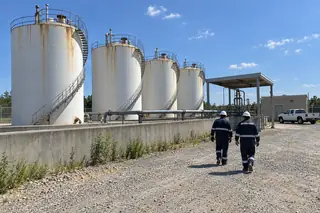
A generator belly tank is the fuel tank built into the base under the generator. EPA also calls it a sub-base tank. Where NFPA 110 applies, the diesel inside needs a fuel quality test at least once a year.
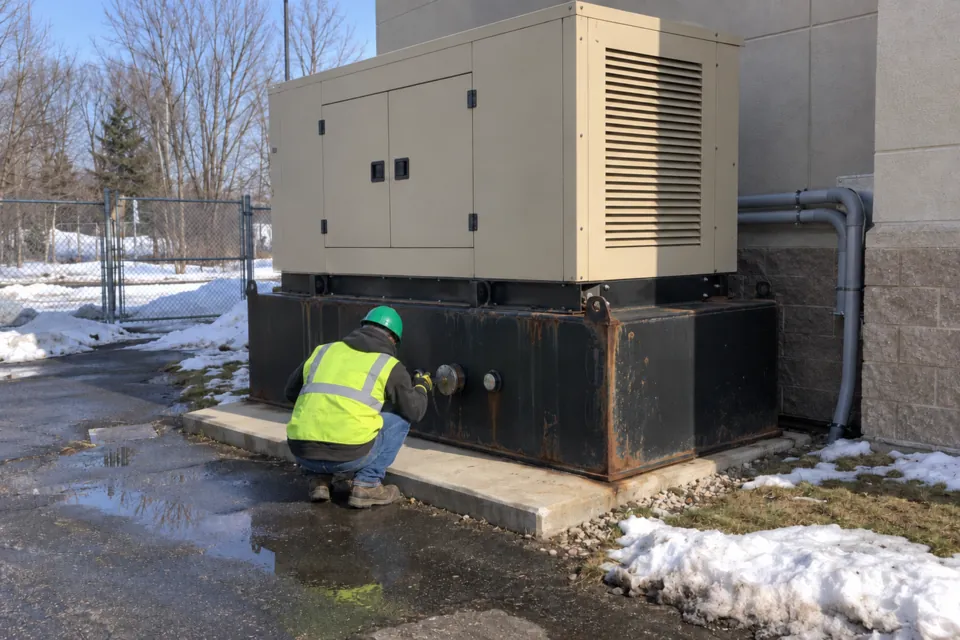
A day tank is a separate, smaller tank in the generator room, usually filled from a larger main tank that may sit outside or underground. In systems with a separate main tank, EPA's 2022 booklet on generator UST systems says belly and day tanks exist to supply the generator when the main storage tank is too far away to feed it directly.
Most owners meet these tanks through compliance paperwork. A hospital surveyor asks for the annual fuel result, a spill plan has to count the tank's gallons, or a hazardous chemical report asks how much diesel is on site.
The recommendation on this page is short: test the fuel every year, and pay for polishing only when a result says the fuel needs it. What follows covers how long diesel can sit, testing and polishing, the SPCC and Tier II counts, the UST 10% rule, replacement, and what a service visit should include.
| Check | What triggers it | Source |
|---|---|---|
| Fuel quality test | At least annually wherever NFPA 110 applies | NFPA 110 (2010) 8.3.8; 42 CFR 482.15(e)(2) and 42 CFR 483.73(e)(2) |
| SPCC count | More than 1,320 gallons of aboveground storage capacity, counting containers of 55 gallons or more | 40 CFR 112.1(d)(2)(ii) |
| EPCRA Tier II | 10,000 pounds or more of diesel present at any one time | 40 CFR 370.10 |
| UST rule | 10% or more of system capacity, tanks plus connected underground piping, underground | 40 CFR 280.12; EPA generator UST booklet; 40 CFR 280.10 |
What is a generator belly tank, and how is it different from a day tank?
A belly tank sits directly beneath the generator as part of its base, while a day tank is built and installed separately and stands in the generator room or a dedicated room of its own. That is how EPA describes the two in its booklet on emergency power generator UST systems, publication EPA-510-K-22-003, which also uses the name sub-base tank.
Many outdoor packaged sets sit on a sub-base tank that holds their whole supply. Larger systems often split the job. A big main tank holds most of the diesel, a transfer pump keeps the day tank topped up near the engine, and the engine draws from that day tank. How many hours of runtime any of these tanks gives is a burn rate question, and the generator runtime calculator works it out from generator size, load and tank capacity.
Both are aboveground tanks, and both fall in the same special-purpose listing category. The UL Code Authority puts generator base tanks and day or utility tanks in a special-purpose group that is certified to UL 142, and the listing mark on a base tank can read Generator Base Tank. That plate is the first thing to look for on a used set or a replacement base.
The distinction matters most for the rules. Each tank counts as its own container in the SPCC total once its capacity reaches 55 gallons, and both get pulled into the UST rule when enough of the system is underground. Fire codes apply on top. As EPA's booklet notes, NFPA 37 (2021 edition) allows fuel tanks of any size in engine or mechanical rooms designed with suitable fire detection and suppression as well as containment. Whether a large indoor day tank is allowed therefore depends on how the room around it is built.
How long can diesel sit in a generator belly tank?
No federal rule sets a fixed storage limit for diesel in a generator tank, and NFPA 110 does not give a number either. What NFPA 110 asks for instead is evidence: where it applies, the fuel gets a quality test at least annually, and the result decides whether the fuel stays. Some codes come at it from the other side; a California health facilities checklist calls for tanks sized so the fuel is consumed within its storage life, or provisions to remediate or replace stale or contaminated fuel.
Diesel in a standby tank typically breaks down slowly and mostly out of sight. Condensation adds water. Microbes grow where that water meets the fuel and leave slime and sludge that plug filters. Oxidation adds gums and sediment over time. A belly tank under an outdoor set heats and cools with the weather, which drives condensation.
For a planning estimate, the fuel shelf life calculator works from fuel type and storage conditions. Use its answer as a reminder to sample, since no estimate can see water sitting in the bottom of your tank.
Stabilizers preserve fuel without restoring it. A biocide kills a microbial colony and leaves the sludge behind for polishing or cleaning to remove.
How often must generator fuel be tested, and when is polishing worth it?
Once a year is the minimum wherever NFPA 110 governs the emergency power system. Section 8.3.8 of the 2010 edition requires that "a fuel quality test shall be performed at least annually using tests approved by ASTM standards," and ASTM D975 is the diesel specification. Hospitals that take part in Medicare are bound to that edition by federal rule: 42 CFR 482.15(e)(2) requires them to follow the NFPA 110 requirements for inspecting and testing the emergency power system and for maintaining it. Long-term care facilities carry the same requirement under 42 CFR 483.73(e)(2), and other buildings follow NFPA 110 when local codes adopt it.
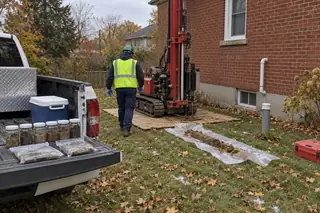
Most fuel labs look for free water, sediment, signs of microbial growth, and whether the fuel still meets ASTM D975. The sample should come from the tank bottom where water and sludge collect, since fuel drawn from the top can pass while the bottom fails. Where a belly tank shares the system with a day tank or main tank, each tank gets its own sample because water collects separately in each. Hospitals that keep generator fuel on site also need a plan under 42 CFR 482.15(e)(3) for keeping emergency power running during the emergency, unless they evacuate.
Generator fuel polishing means circulating the diesel through filters and water separators and back into the tank to strip out water and sediment. It treats fuel that has started to go off. Badly oxidized fuel is beyond what polishing can restore, and sludge stuck to the tank walls takes a full tank cleaning job to remove. Permanent polishing systems plumbed into the tank also exist, and many run on a timer whether the fuel needs it or not. According to EPA's generator booklet, standalone filtration or polishing units fall outside the federal UST rule.
The real choice is between a standing polishing contract and a test-first approach that pays for polishing or new fuel only when a result fails. A contract buys a fixed schedule and a vendor already familiar with the tank, which suits a site where bad fuel during an outage would put patients or servers at risk. A test-first approach spends nothing on polishing in the years the fuel passes, though a failed result then means an unplanned job and possibly a fuel swap on short notice. Which approach costs less changes from year to year, and the lab result is what settles it each time. A polishing contract does not satisfy the NFPA 110 test on its own, so the annual lab result is needed under either approach.
Does a diesel generator fuel tank count toward the SPCC rule?
Yes, an aboveground diesel generator fuel tank of 55 gallons or more counts toward the SPCC threshold. Under 40 CFR 112.1(d)(2)(ii), a facility is exempt when its aggregate aboveground oil storage capacity is 1,320 gallons or less, counting only containers of 55 gallons or more. Location matters too, since the rule covers only sites from which oil could reasonably be expected to reach navigable waters or adjoining shorelines.
EPA's SPCC guidance for regional inspectors treats a generator set as a combination of oil-filled operational equipment and a bulk storage container. The lubrication system may count as operational equipment. The fuel tank is the container, because the guidance says bulk storage tanks providing fuel for the generator typically are not oil-filled operational equipment. EPA's generator booklet lands in the same place, saying SPCC requirements are likely applicable to aboveground piping and to day and belly tanks.
That classification carries a cost. A bulk storage container needs secondary containment sized for the largest single container plus freeboard for precipitation, under 40 CFR 112.8(c)(2). Indoors, a curbed room or a dike around the day tank can provide it. Many belly tanks are double-wall units, and whether the outer wall meets that standard for a given tank is a question the SPCC plan has to answer in writing.
Before deciding a site is under 1,320 gallons, add every aboveground oil container of 55 gallons or more: the belly tank, any day tank, drums, aboveground heating oil tanks, and oil-filled equipment such as transformers. A fully buried main tank covered by the UST rule is generally left out of that count, so the SPCC question usually comes down to the aboveground parts. The SPCC plan guide covers what the plan must contain once the total crosses that line.
When is a generator tank part of a regulated UST system, and what about Tier II?
A generator tank becomes part of a regulated UST system when 10% or more of the system's total capacity (tanks plus connected underground piping) is underground, under the 40 CFR 280.12 definition. EPA's booklet then says shop-built tanks, day tanks, belly tanks and other aboveground tanks in that system "are regulated as part of the UST system," and that regardless of size they must meet all applicable federal UST requirements. The 10% test counts the whole system, so a buried main tank feeding an indoor day tank usually pulls the day tank in with it.
Emergency generator tanks were once deferred from the federal release detection requirements. 40 CFR 280.10 ended the deferral. Systems installed on or before October 13, 2015 had 3 years, until October 13, 2018, to meet release detection, and systems installed after that date must meet every requirement from installation. The leak detection guide covers the release detection methods those systems use, and the UST inspection guide covers the inspections and tests that come with being inside the rule.
EPCRA Tier II reporting is a separate count with a different unit. Under 40 CFR 370.10, a facility reports diesel, an OSHA hazardous chemical, once 10,000 pounds or more is present at any one time. The higher thresholds of 75,000 gallons of gasoline and 100,000 gallons of diesel apply only at retail gas stations whose tanks are fully underground and compliant. A hospital or data center does not qualify for them. Count every tank on site together, and use the fuel weight calculator to turn gallons on hand into pounds.
One exception matters for buildings with basement generator rooms: 40 CFR 280.12 does not count a tank in a basement or similar underground area as a UST when it sits on or above the floor.
When does a belly tank need replacing?
A belly tank needs replacing when it can no longer be trusted to hold fuel, or when the generator above it is replaced. Four common triggers: a leak alarm between the walls of a double-wall tank, corrosion that a cleaning exposes inside, damage to the outer wall, and a new generator whose frame does not match the old base.
Treat an interstitial alarm as urgent. It means fuel or water has got into the space between the two shells, so one of the walls has failed, or the sensor has. Check the sensor first, then have the tank inspected before the next outage puts it to work. Inside a regulated UST system, liquid in that space is a suspected release under 40 CFR 280.50, reportable to the implementing agency within 24 hours unless the system is found not to be leaking and the liquid is removed.
A replacement changes the paperwork along with the hardware. The new sub-base tank should carry a UL 142 listing for generator base service, and the SPCC plan will usually need amending to show the new container. Inside a regulated UST system the new tank is UST equipment, and EPA's booklet says any system put in after April 11, 2016, or replaced since then, must have secondary containment and use interstitial monitoring.
Replacement is installation work. The UST contractor directory lists tank contractors by state. The gas station build cost guide covers tank installation costs and permits on the commercial side. If the same project retires a buried main tank, tank decommissioning vs removal sets out the two closure paths and what each one leaves in the ground.
What does a generator fuel service visit include?
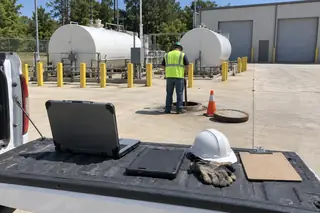
A generator fuel service visit should leave you with four things: a bottom sample sent to a lab, a water check, a visual inspection of the tank and fittings, and a leak monitor record. Any water found should be drawn off on the same visit. Anything less is a fuel delivery with a clipboard.
Day tank systems add more to check. The transfer pump, the float or level switches, the overfill protection and the alarms all need testing, because a day tank that stops refilling from the main tank will run the engine dry on its own small supply. Sites inside the UST rule add the release detection and inspection records that rule requires.
Ask for every result in writing, dated, with the sample point named. CMS surveyors check hospitals and nursing homes against the NFPA 110 requirement, and the dated lab report is the evidence. Keeping several years of results together lets a new facility manager see whether the fuel is trending worse. The same binder is a sensible home for SPCC inspection records and, where it applies, the Tier II filing.
The exception to test-first is a site that cannot absorb a failed result at all, such as a hospital whose survey rides on its fuel record. There, a standing polishing contract alongside the annual test is the easier position to defend.