Gasoline at a fueling site usually needs a UL 2085 tank; diesel has more options. A UL 142 tank is a shop fabricated steel aboveground tank for flammable and combustible liquids, built as a single wall, double wall or diked unit. Its protected cousin, the UL 2085 tank, is tested so that less heat reaches the inner tank during a hydrocarbon pool fire lasting 2 hours, and it comes with secondary containment and impact protection built in.
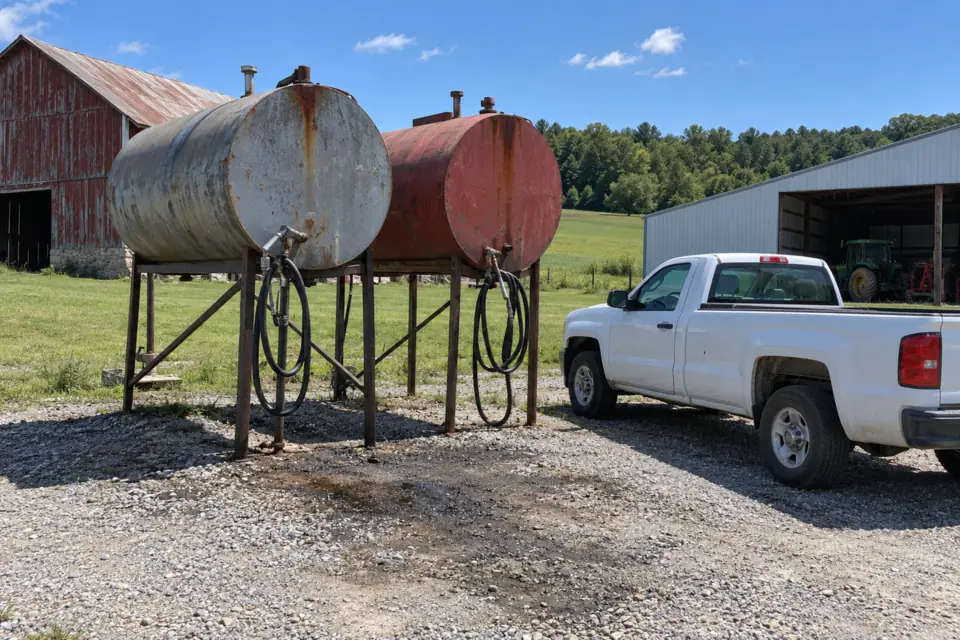
Fleet managers, farm owners, facility managers and general contractors see both numbers on quotes and spec sheets. The label shapes what a fire marshal will accept at a fueling site, and the tank's construction decides how much spill containment still has to be built around it.
Both listings cover aboveground use only; buried tanks follow their own underground tank inspection and testing schedule.
What follows compares the two standards and then works through gasoline under IFC 2306.2.3. After that come containment under 40 CFR 112, job sites under OSHA 29 CFR 1926.152, the rent or buy question, and a table matching tanks to jobs.
What is a UL 142 tank?
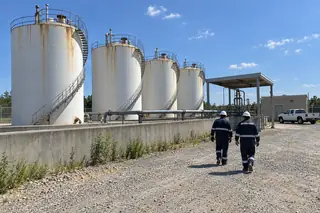
UL 142 is the Standard for Steel Aboveground Tanks for Flammable and Combustible Liquids, and its scope is steel primary, secondary and diked type atmospheric tanks. In practice that gives three builds. A single wall tank is one steel shell, a double wall tank wraps a second steel shell around the first, and a diked tank sits inside an open steel basin made to catch a leak. According to the UL Code Authority explainer, the standard specifically applies to shop fabricated tanks, the kind built in a factory and delivered whole.
Portable transport tanks and tanks mounted on vehicles or trailers fall outside the standard, a detail that matters to anyone renting a trailer tank. Generator base tanks and day tanks stay inside it: UL describes them, along with work-top tanks, as special-purpose tanks certified under UL 142.
Fire codes pick the listing up through NFPA. NFPA 30 and NFPA 30A require atmospheric tanks to meet a recognized engineering standard, and UL 142, UL 2080 and UL 2085 all qualify. The International Fire Code and NFPA 1 in turn require installation in line with NFPA 30 and 30A, so the listing becomes part of the fire inspection. Manufacturers leak test every tank before it leaves the line, and the label on the shell is the record that it was built and tested to the standard.
The listing ends where the shop work ends. Accessories installed on site are outside it, and UL notes that final venting systems must be installed in accordance with local codes. Any listing can be confirmed in UL Product iQ with a free account before the purchase order goes out.
UL 2085 vs UL 142: what does the protected tank add?
A UL 2085 fuel tank is a steel tank built to hold back heat in a fire, with secondary containment built in and protection against vehicle collisions and projectiles. UL titles it the Standard for Protected Aboveground Tanks for Flammable and Combustible Liquids. Under that standard the tank must further reduce heat transfer to the primary tank during a two-hour hydrocarbon pool fire. That requirement goes past UL 2080, which limits heat transfer in the same fire and adds impact resistance.
Both fire ratings come from the same fire test. UL 2080 and UL 2085 share a test with SwRI 97-04, according to the Steel Tank Institute: a 2,000 degree furnace test for 2 hours, where only the pass/fail criteria vary. A protected tank has to keep more of that heat away from the fuel than a UL 2080 tank does.
Containment is the second difference, and it is narrower than it looks. The UL 142 two-shell version already has a steel secondary shell, so the gap between the standards on containment comes down to choice. UL 2085 requires built-in secondary containment on every tank, while UL 142 lets the buyer pick the construction. A single wall unit relies on a dike or other containment built around it on site, which takes up yard space and leaves an open basin that collects rain. What the two-shell UL 142 build lacks is the fire rating and the collision protection.
Impact protection carries a condition: UL 2085 covers projectiles and vehicle collisions provided the tank is properly labeled. The comparison table below lines up the builds a buyer usually chooses between.
| Build | Standard | Secondary containment | Fire and impact protection | Usual fit |
|---|---|---|---|---|
| UL 142 single wall | Steel Aboveground Tanks for Flammable and Combustible Liquids | None in the tank; relies on a dike or other containment built around it | Steel shell only | Diesel where a dike is built around the tank |
| UL 142 double wall | Steel Aboveground Tanks for Flammable and Combustible Liquids | Steel secondary shell; may generally satisfy SPCC containment when EPA's five elements are met | Steel shells only | Diesel at fleet yards and farms, where the fire code official accepts it |
| UL 2085 protected | Protected Aboveground Tanks for Flammable and Combustible Liquids | Built in, on every tank | Further reduces heat transfer in a hydrocarbon pool fire lasting 2 hours; covers vehicle collisions and projectiles when properly labeled | Gasoline at fuel dispensing sites; diesel there too unless another tank is approved |
Can gasoline go in a UL 142 tank?
A UL 142 tank can be built for flammable liquids, gasoline included, yet a gasoline storage tank at a fuel dispensing site usually has to be a protected tank instead. Item 1 of IFC 2306.2.3 requires above-grade tanks of Class I liquids at fuel dispensing sites to be listed and labeled as protected aboveground tanks. The UL 2085 listing is how a tank shows that it meets the item.
North Carolina's Office of the State Fire Marshal spells this out in a published interpretation of the dispensing tank section. It reads the first item as requiring "above-grade storage tanks of Class I liquids (gasoline) to be listed and labeled as 'protected above-ground tanks.'" Minnesota took a different route on part of the same section. Minnesota's amendment lets the fire chief approve other tanks in some cases, which is why a model code answer is only a starting point.
For gasoline at a fueling site, start from a UL 2085 protected tank and then confirm with the fire marshal. States adopt the International Fire Code with their own amendments, and that amendment shows how one change can move the answer. The Steel Tank Institute makes the same point about tank placement: each local jurisdiction has its own fire code requirements, though most reference one of the model fire codes. Ask which edition is in force and get the answer in writing. The item says listed and labeled, so a protected tank whose label is missing or unreadable gives the inspector nothing to verify.
A fleet yard that pumps gasoline into its own trucks should start from the same assumption as a retail station. Retail stations add a canopy, public dispensing and a permit file of their own, which the gas station build guide covers line by line. Buying a UL 142 tank for gasoline and having it refused at inspection means buying a second tank.
Do you need a double wall diesel tank, or a dike?
A double wall tank can take the place of a dike under the SPCC rule, provided it meets the conditions in EPA's SPCC Guidance for Regional Inspectors. Chapter 4 of that guidance says shop fabricated double wall aboveground tanks, regardless of size, may generally satisfy the secondary containment requirements of 40 CFR 112.7(c) and 40 CFR 112.8(c)(2). Miss one and the tank needs other containment.
EPA's summary lists five elements. The tank is shop fabricated, the inner tank is a UL-listed steel tank, and the outer tank is built to a nationally accepted industry standard. An overfill alarm plus an automatic flow restrictor or shut-off is fitted, and every transfer is constantly monitored; active or passive containment for vent overfills can stand in for the overfill devices. A double wall diesel tank set up that way typically does not need extra freeboard for precipitation, because rain cannot collect inside a closed outer shell.
The guidance carries three limits. Tanks with fittings below the liquid level may require additional secondary containment, and the outer shell does nothing about a vent overfill during a transfer, since fuel pushed out of the vent lands outside both shells. The double wall also covers only the tank, so piping, the dispenser and the transfer area still fall under the general containment rule in 40 CFR 112.7(c).
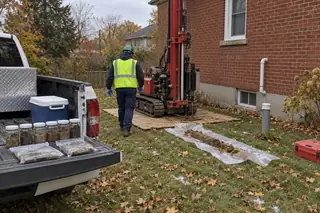
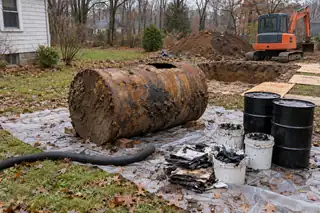
A dike suits a single wall tank or a group of tanks set side by side, and it can back up a two-shell tank with low fittings. UL 142 also lists diked type tanks, where the steel dike is part of the unit, which avoids pouring a concrete basin on site. For diesel at fleet yards and farms, a tank with both shells that meets all five elements saves building and maintaining an open dike around the tank itself. Any dike that does get built is sized by 40 CFR 112.8(c)(2), explained below. If containment ever fails and fuel reaches soil, the job becomes an environmental remediation project with its own sampling and closure steps.
What secondary containment does the SPCC rule require for above ground fuel tanks?
The SPCC rule requires secondary containment for the entire capacity of the largest single container plus sufficient freeboard to contain precipitation, under 40 CFR 112.8(c)(2). Freeboard is the extra height above the spill volume, so a storm falling on a full spill does not overtop the dike.
The rule only applies above a threshold. Under 40 CFR 112.1(d)(2)(ii), a facility with 1,320 gallons or less of aggregate aboveground oil storage is exempt, and only containers of 55 gallons or more count toward that total. Coverage also depends on location under 112.1(b): the rule applies only where a spill could reasonably be expected to make its way into navigable waters or onto adjoining shorelines. Farms work under separate thresholds, so a farm owner should check EPA's farm guidance before relying on the 1,320 gallon figure.
Portable containers get their own line in the rule. Under 40 CFR 112.8(c)(11), they need a secondary means of containment, such as a dike or catchment basin, that holds the largest single compartment or container plus freeboard for precipitation; mobile refuelers are excepted. A skid tank that moves around a yard or between projects fits that description.
Containment is one part of a larger plan. The SPCC plan guide covers whether a facility needs a plan and what the Tier I, Tier II and PE certified versions must each contain. Spill buckets, sumps, berms and overfill protection are covered in the secondary containment guide, and sites that have grown into rows of large tanks belong in the tank farm guide.
Rent or buy: what do construction site fuel tanks need?
Construction sites have to keep flammable liquids in approved closed containers, in tanks located underground, or in aboveground portable tanks in service and refueling areas, under OSHA 29 CFR 1926.152. Those rules apply whether the contractor rents the unit or owns it.
The standard sets distances and hardware. Portable tanks shall not be nearer than 20 feet from any building, and a 12-foot-wide access way for fire equipment has to sit within 200 feet of each portable tank. Dispensing nozzles must close automatically with no latch-open device. Dispensing units need protection against collision, and an emergency power shutoff switch has to be placed remote from the dispensers. OSHA's construction rule also names UL 142, in its 1968 edition, among the acceptable standards for atmospheric tanks.
Renting usually moves maintenance and transport onto the supplier. The site still owns the setbacks and the containment. It owns the spill plan too, and a temporary fuel tank counts toward the 1,320 gallon SPCC threshold like any other container of 55 gallons or more. Ask whether a rented unit is a skid tank or a trailer tank, since UL 142 does not apply to tanks mounted on vehicles or trailers.
Buying makes sense when a tank stays put. On site fuel tanks that never move can have their containment and spill plan built once around a fixed spot. A tank that travels from project to project has to be checked against the 20 foot building distance and the portable container rule every time it is set down. Tank installers appear in the UST contractor directory, sorted by state, under the tank installation service.
Which fuel tank fits which job?
Each job has a usual build: gasoline dispensing points to UL 2085, and diesel at a fleet yard or on a farm usually comes back to a UL 142 double wall or diked unit. A job site starts from an aboveground portable tank, which falls outside UL 142 once it is mounted on a trailer. The table at the end of this guide lines up four common jobs.
At a fleet yard, the fuel decides it. Gasoline at the fueling point starts from a protected tank. For diesel, Item 2 of the same code section allows a protected tank or, when the fire code official approves it, another aboveground tank. Get that approval in writing before ordering a UL 142 double wall unit with an overfill alarm and automatic flow restrictor. Gauging, fuel cards, reconciliation and reporting belong to the wider subject of fleet fueling systems, and on site fuel tanks at a yard are only one piece of that.
Generator base and day tanks are special-purpose tanks certified under UL 142; size one with the generator fuel calculator.
Diesel on a farm is the exception to the protected tank advice above. The fire code sends tanks on farms and construction projects to a separate section, under Item 4 of the dispensing section, so the fueling-site rules above do not set the farm answer. What remains is whether the farm SPCC thresholds call for containment, plus the fire marshal's view of where the tank sits.
| Job | Usual starting point | What to confirm |
|---|---|---|
| Fleet yard | UL 2085 protected tank for gasoline; for diesel, a protected tank or a UL 142 double wall unit the fire code official approves | The fire code official's approval in writing before ordering; overfill alarm and automatic flow restrictor on a double wall tank |
| Farm | UL 142 double wall or diked unit for diesel | The farm SPCC thresholds; containment for the largest tank plus freeboard for precipitation, unless a double wall tank meets EPA's five elements |
| Generator | Generator base or day tank certified under UL 142 | Fuel volume, with the generator fuel calculator |
| Job site | Aboveground portable tank; tanks mounted on vehicles or trailers fall outside UL 142 | 20 feet from any building, collision protection for dispensing units, and secondary containment such as a dike or catchment basin for portable containers |